


Text this colour links to Pages. Text this colour links to Family Trees. Text this colour are links that are disabled for Guests.
Place the mouse over images to see a larger image. Click on paintings to see the painter's Biography Page. Mouse over links for a preview. Move the mouse off the painting or link to close the popup.
All About History Books
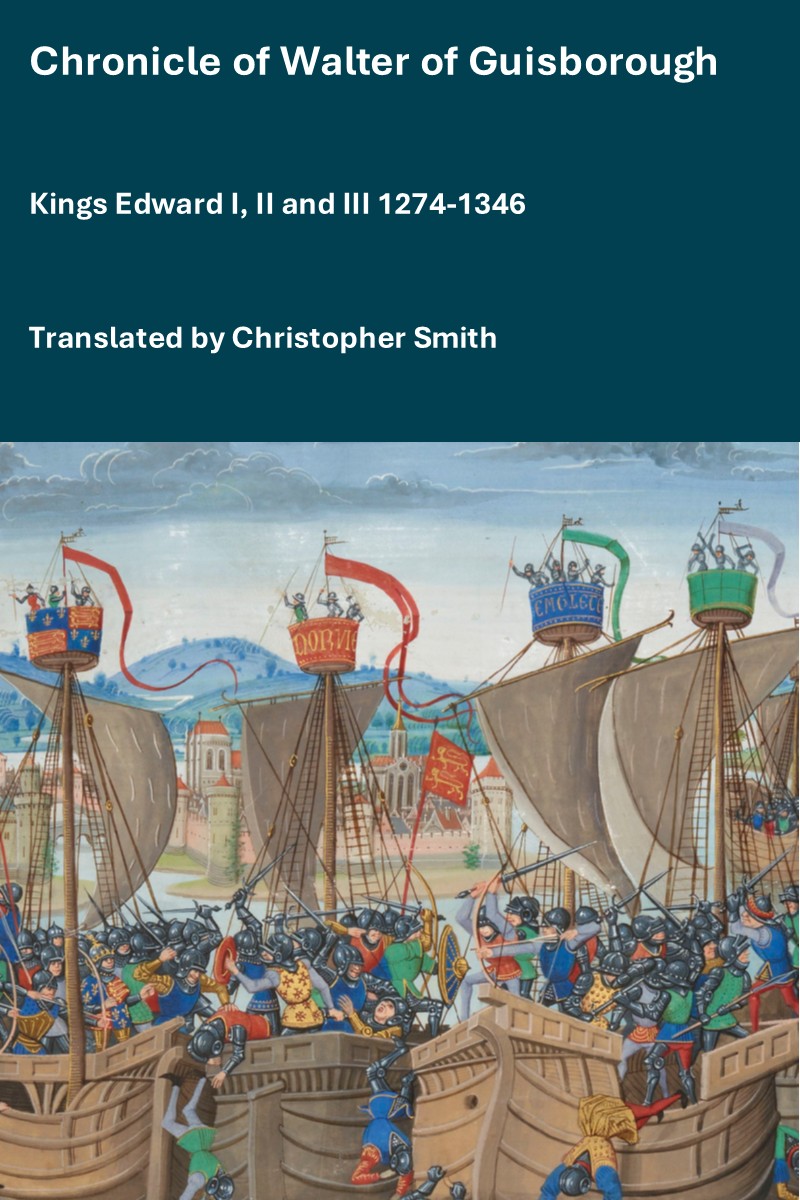
The Chronicle of Walter of Guisborough, a canon regular of the Augustinian Guisborough Priory, Yorkshire, formerly known as The Chronicle of Walter of Hemingburgh, describes the period from 1066 to 1346. Before 1274 the Chronicle is based on other works. Thereafter, the Chronicle is original, and a remarkable source for the events of the time. This book provides a translation of the Chronicle from that date. The Latin source for our translation is the 1849 work edited by Hans Claude Hamilton. Hamilton, in his preface, says: "In the present work we behold perhaps one of the finest samples of our early chronicles, both as regards the value of the events recorded, and the correctness with which they are detailed; Nor will the pleasing style of composition be lightly passed over by those capable of seeing reflected from it the tokens of a vigorous and cultivated mind, and a favourable specimen of the learning and taste of the age in which it was framed." Available at Amazon in eBook and Paperback.
On or before 8th April 1615 William Sydenham was born to William Sydenham of Wynford Eagle in Dorset. He was baptised 8th April 1615.
In 1637 William Sydenham (age 21) and Grace Trenchard were married.
On 17th June 1644 William Sydenham (age 29) was appointed Governor of Weymouth by Robert Devereux 3rd Earl Essex (age 53).
On 10th August 1644 William Sydenham (age 29) and Anthony Ashley-Cooper 1st Earl Shaftesbury (age 23) captured Wareham, Dorset [Map].


In November 1645 William Sydenham (age 30) was elected MP Melcombe Regis.
On 14th August 1649 William Sydenham (age 34) and Colonel Fleetwood were appointed Governor of the Isle of Wight.

Samuel Pepys' Diary. 17th January 1660. Thence I went to Westminster, and met Shaw and Washington, who told me how this day Sydenham (age 44) was voted out of the House for sitting any more this Parliament, and that Salloway was voted out likewise and sent to the Tower, during the pleasure of the House. Home and wrote by the Post, and carried to Whitehall, and coming back turned in at Harper's, where Jack Price was, and I drank with him and he told me, among other, things, how much the Protector (age 33) is altered, though he would seem to bear out his trouble very well, yet he is scarce able to talk sense with a man; and how he will say that "Who should a man trust, if he may not trust to a brother and an uncle;" and "how much those men have to answer before God Almighty, for their playing the knave with him as they did". He told me also, that there was; £100,000 offered, and would have been taken for his restitution, had not the Parliament come in as they did again; and that he do believe that the Protector will live to give a testimony of his valour and revenge yet before he dies, and that the Protector will say so himself sometimes. Thence I went home, it being late and my wife in bed.
All About History Books
The Chronicle of Walter of Guisborough, a canon regular of the Augustinian Guisborough Priory, Yorkshire, formerly known as The Chronicle of Walter of Hemingburgh, describes the period from 1066 to 1346. Before 1274 the Chronicle is based on other works. Thereafter, the Chronicle is original, and a remarkable source for the events of the time. This book provides a translation of the Chronicle from that date. The Latin source for our translation is the 1849 work edited by Hans Claude Hamilton. Hamilton, in his preface, says: "In the present work we behold perhaps one of the finest samples of our early chronicles, both as regards the value of the events recorded, and the correctness with which they are detailed; Nor will the pleasing style of composition be lightly passed over by those capable of seeing reflected from it the tokens of a vigorous and cultivated mind, and a favourable specimen of the learning and taste of the age in which it was framed." Available at Amazon in eBook and Paperback.
In 1661 William Sydenham (age 45) died.
Around August 1661 [his former wife] Grace Trenchard died.