

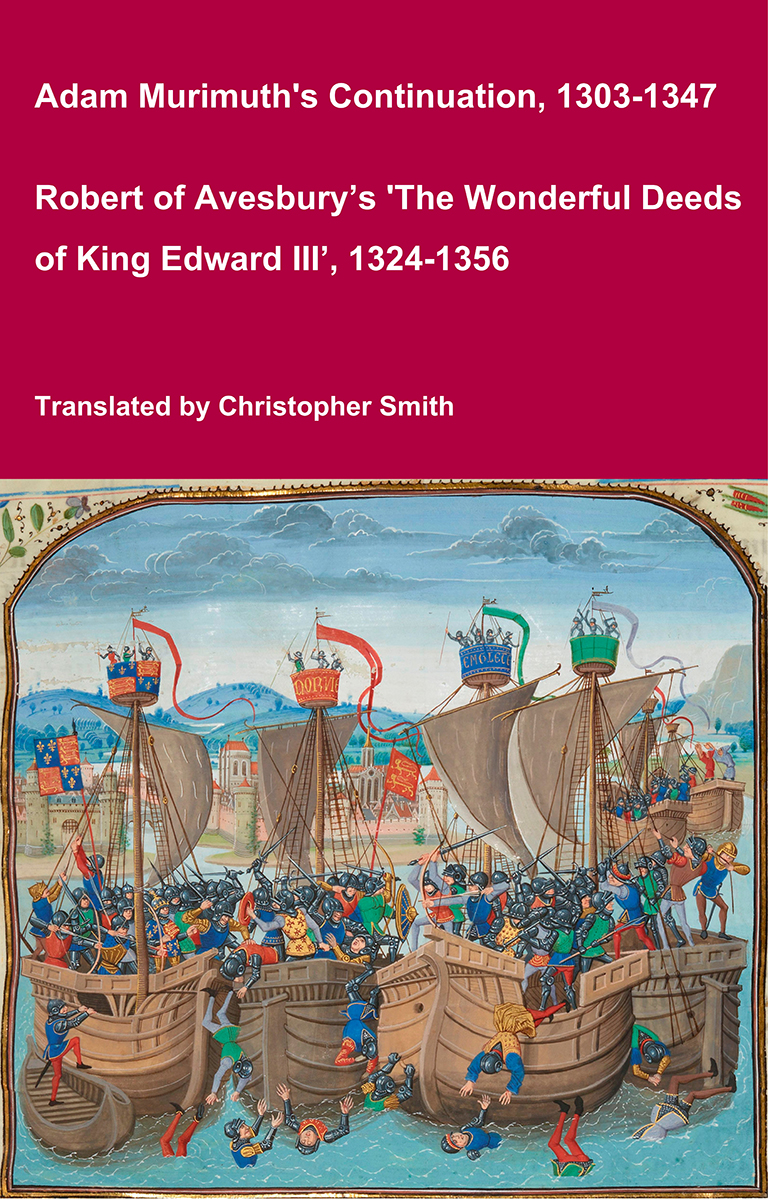
Adam Murimuth's Continuation and Robert of Avesbury’s 'The Wonderful Deeds of King Edward III'
This volume brings together two of the most important contemporary chronicles for the reign of Edward III and the opening phases of the Hundred Years’ War. Written in Latin by English clerical observers, these texts provide a vivid and authoritative window into the political, diplomatic, and military history of fourteenth-century England and its continental ambitions. Adam Murimuth Continuatio's Chronicarum continues an earlier chronicle into the mid-fourteenth century, offering concise but valuable notices on royal policy, foreign relations, and ecclesiastical affairs. Its annalistic structure makes it especially useful for establishing chronology and tracing the development of events year by year. Complementing it, Robert of Avesbury’s De gestis mirabilibus regis Edwardi tertii is a rich documentary chronicle preserving letters, treaties, and official records alongside narrative passages. It is an indispensable source for understanding Edward III’s claim to the French crown, the conduct of war, and the mechanisms of medieval diplomacy. Together, these works offer scholars, students, and enthusiasts a reliable and unembellished account of a transformative period in English and European history. Essential for anyone interested in medieval chronicles, the Hundred Years’ War, or the reign of Edward III.
Available at Amazon in eBook and Paperback format.
Paternal Family Tree: Wessex
Ceawlin King Wessex succeeded King Wessex.
Ceawlin King Wessex was born to Cynric King Wessex.
Anglo-Saxon Chronicle. 556. This year [his father] Cynric and Ceawlin fought with the Britons at Beranbury.
In 556 [his father] Cynric King Wessex and Ceawlin King Wessex defeated the Britons at Barbury Castle [Map] during the Battle of Beran Burg. Barbury Castle [Map] possibly of strategic importance since it is located on the Ridgeway with extensive views over the Thames valley.
Anglo-Saxon Chronicle. 560. This year Ceawlin undertook the government of the West-Saxons; and Ella, on the death of Ida, that of the Northumbrians; each of whom reigned thirty winters. Ella was the son of Iff, Iff of Usfrey, Usfrey of Wilgis, Wilgis of Westerfalcon, Westerfalcon of Seafowl, Seafowl of Sebbald, Sebbald of Sigeat, Sigeat of Swaddy, Swaddy of Seagirt, Seagar of Waddy, Waddy of Woden, Woden of Frithowulf. This year Ethelbert came to the kingdom of the Cantuarians, and held it fifty-three winters. In his days the holy Pope Gregory sent us baptism. That was in the two and thirtieth year of his reign. And Columba, the mass-priest, came to the Picts, and converted them to the belief of Christ. They are the dwellers by the northern moors. And their king gave him the island of Hii, consisting of five hides, as they say, where Columba built a monastary. There he was abbot two and thirty winters; and there he died, when he was seventy-seven years old. The place his successors yet have. The Southern Picts were long before baptized by Bishop Ninnia, who was taught at Rome. His church or monastery is at Hwiterne, hallowed in the name of St. Martin, where he resteth with many holy men. Now, therefore, shall there be ever in Hii an abbot, and no bishop; and to him shall be subject all the bishops of the Scots; because Columba was an abbot—no bishop.
Around 565 [his son] Cuthwine was born to Ceawlin King Wessex.
In 568 Ceawlin King Wessex and [his brother] Cutha Wessex fought against King Æthelberht of Kent [aged 18] at the Battle of Wibbandun and drove him into Kent. The location of the battle is unknown.
Anglo-Saxon Chronicle. 568. This year Ceawlin, and Cutha the brother Ceawlin, fought with Ethelbert, and pursued him into Kent. And they slew two aldermen at Wimbledon, Oslake and Cnebba.
In 577 Ceawlin King Wessex and his son Cuthwine [aged 12] won a major victory over the Britons at the Battle of Dyrham at Hinton Hill Dyrham, Gloucestershire. The victory of resulted in the capture of Gloucester [Map], Cirencester, Gloucestershire [Map] and Bath, Somerset [Map].
Coinmail Briton, Condidan Briton and Farinmail Briton were killed.
Anglo-Saxon Chronicle. 577. This year Cuthwin and Ceawlin fought with the Britons, and slew three kings, Commail, and Condida, and Farinmail, on the spot that is called Derham, and took from them three cities, Gloucester, Cirencester, and Bath.
In 584 Ceawlin King Wessex was defeated, probably by the Britons, possibly by Ceol King Wessex at the First Battle of Woden's Barrow which fought at Adam's Grave [Map], Pewsey, Wiltshire.
In 584 Ceawlin King Wessex and his son [his brother] Cutha Wessex defeated the Britons at the Battle of Fethan Leag which was probably fought at Stoke Lyne, Oxfordshire [Map].
Anglo-Saxon Chronicle. 584. This year Ceawlin and [his brother] Cutha fought with the Britons on the spot that is called Fretherne. There Cutha was slain. And Ceawlin took many towns, as well as immense booty and wealth. He then retreated to his own people.
Anglo-Saxon Chronicle. 592. This year there was a great slaughter of Britons at Wanborough; Ceawlin was driven from his kingdom, and Ceolric reigned six years.
In 592 Ceawlin King Wessex was killed at the Battle of Wanborough. His nephew Ceol succeeded King Wessex.
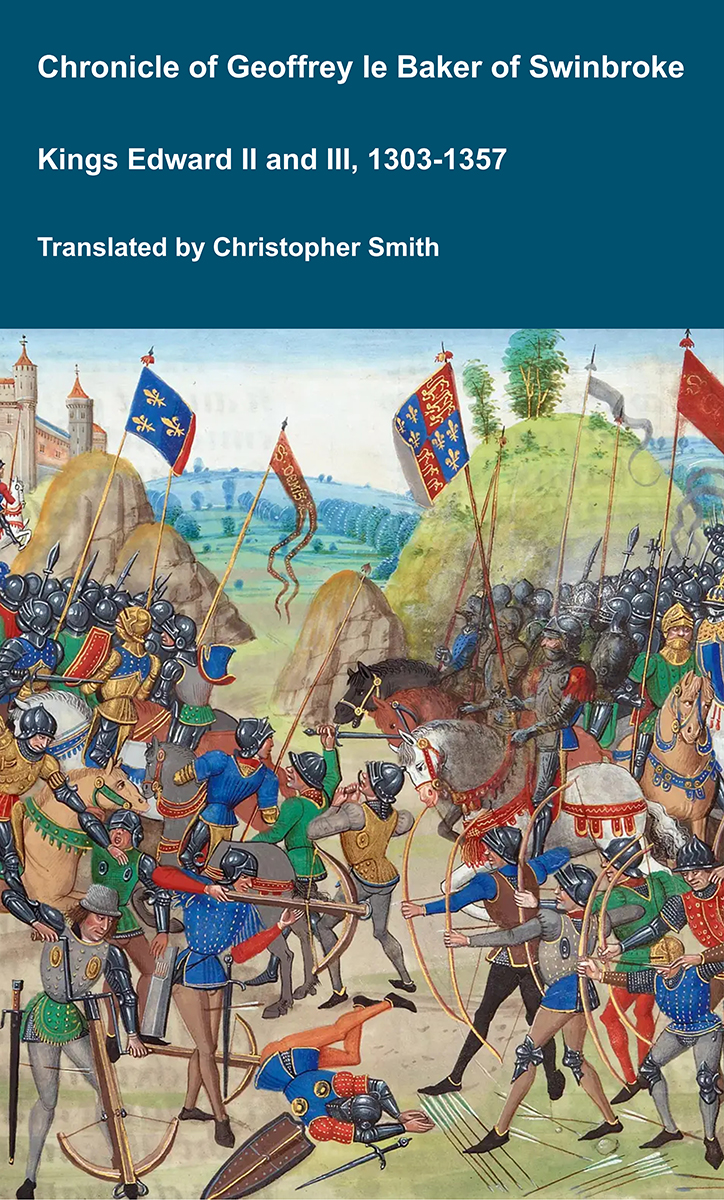
Chronicle of Geoffrey le Baker of Swinbroke
Baker was a secular clerk from Swinbroke, now Swinbrook, an Oxfordshire village two miles east of Burford. His Chronicle describes the events of the period 1303-1356: Gaveston, Bannockburn, Boroughbridge, the murder of King Edward II, the Scottish Wars, Sluys, Crécy, the Black Death, Winchelsea and Poitiers. To quote Herbert Bruce 'it possesses a vigorous and characteristic style, and its value for particular events between 1303 and 1356 has been recognised by its editor and by subsequent writers'. The book provides remarkable detail about the events it describes. Baker's text has been augmented with hundreds of notes, including extracts from other contemporary chronicles, such as the Annales Londonienses, Annales Paulini, Murimuth, Lanercost, Avesbury, Guisborough and Froissart to enrich the reader's understanding. The translation takes as its source the 'Chronicon Galfridi le Baker de Swynebroke' published in 1889, edited by Edward Maunde Thompson.
Available at Amazon in eBook and Paperback format.
Anglo-Saxon Chronicle. 593. This year died Ceawlin, and Cwichelm, and Cryda; and Ethelfrith succeeded to the kingdom of the Northumbrians. He was the son of Ethelric; Ethelric of Ida.
Kings Wessex: Son of Cynric King Wessex
GrandFather: Cerdic King Wessex -2 x Great Grand Son of Cerdic King Wessex
Father: Cynric King Wessex Son of Cerdic King Wessex
Ceawlin King Wessex Son of Cynric King Wessex