

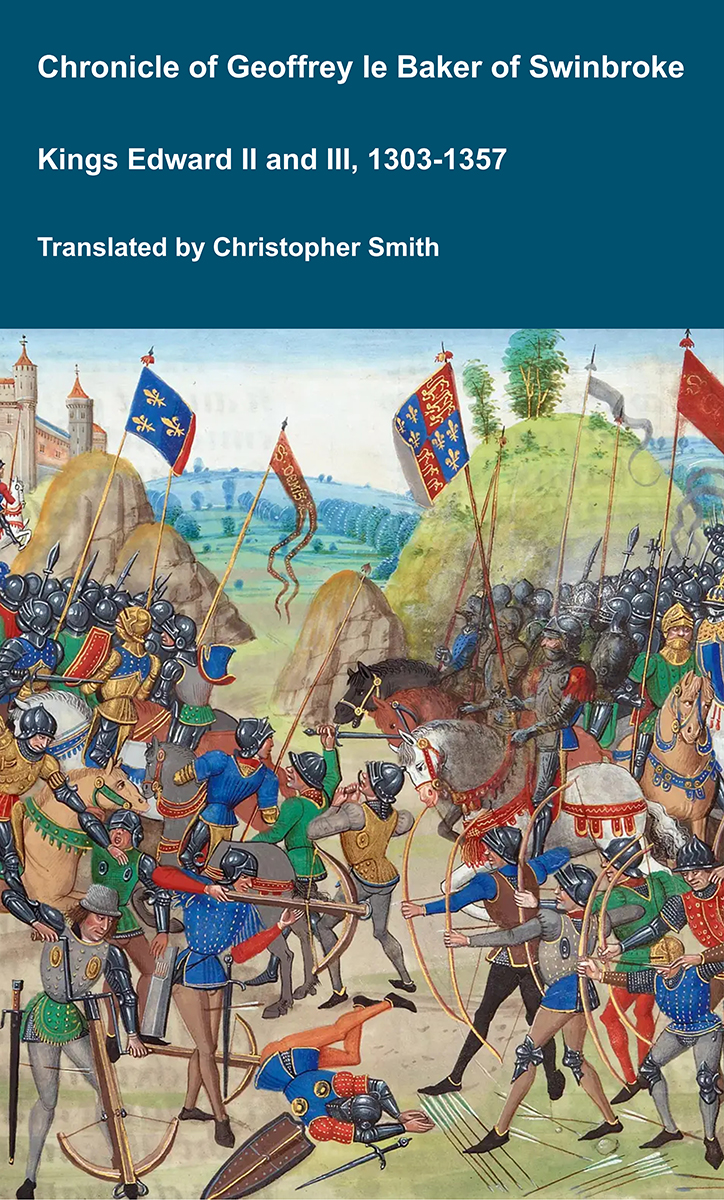
Chronicle of Geoffrey le Baker of Swinbroke
Baker was a secular clerk from Swinbroke, now Swinbrook, an Oxfordshire village two miles east of Burford. His Chronicle describes the events of the period 1303-1356: Gaveston, Bannockburn, Boroughbridge, the murder of King Edward II, the Scottish Wars, Sluys, Crécy, the Black Death, Winchelsea and Poitiers. To quote Herbert Bruce 'it possesses a vigorous and characteristic style, and its value for particular events between 1303 and 1356 has been recognised by its editor and by subsequent writers'. The book provides remarkable detail about the events it describes. Baker's text has been augmented with hundreds of notes, including extracts from other contemporary chronicles, such as the Annales Londonienses, Annales Paulini, Murimuth, Lanercost, Avesbury, Guisborough and Froissart to enrich the reader's understanding. The translation takes as its source the 'Chronicon Galfridi le Baker de Swynebroke' published in 1889, edited by Edward Maunde Thompson.
Available at Amazon in eBook and Paperback format.
Paternal Family Tree: Wessex
Cenwalh King of Wessex was born to [his father] King Cynegils of Wessex.
In 611 [his father] King Cynegils of Wessex succeeded King Wessex.
Around 641 [his father] King Cynegils of Wessex died. His son Cenwalh succeeded King Wessex.
Anglo-Saxon Chronicle. 643. This year Kenwal succeeded to the kingdom of the West-Saxons, and held it one and thirty winters. This Kenwal ordered the old20 church at Winchester [Map] to be built in the name of St. Peter. He was the son of [his father] Cynegils.
Note 20. This epithet appears to have been inserted in some copies of the "Saxon Chronicle" so early as the tenth century; to distinguish the "old" church or minster at Winchester from the "new", A.D. 903.
Anglo-Saxon Chronicle. 645. This year King Kenwal was driven from his dominion by King Penda.
Anglo-Saxon Chronicle. 646. This year King Kenwal was baptized.
Anglo-Saxon Chronicle. 652. This year Kenwal fought at Bradford by the Avon [Map].
Anglo-Saxon Chronicle. 658. This year Kenwal fought with the Welsh at Pen, and pursued them to the Parret. This battle was fought after his return from East-Anglia, where he was three years in exile. Penda had driven him thither and deprived him of his kingdom, because he had discarded his sister.
Anglo-Saxon Chronicle. 660. This year Bishop Egelbert (age 35) departed from Kenwal; and Wina held the bishopric three years. And Egbert accepted the bishopric of Paris, in Gaul, by the Seine.
Anglo-Saxon Chronicle. 661. This year, at Easter, Kenwal fought at Pontesbury; and Wulfere (age 21), the son of Penda, pursued him as far as Ashdown. Cuthred, the son of Cwichelm, and King Kenbert, died in one year. Into the Isle of Wight [Map] also Wulfere, the son of Penda, penetrated, and transferred the inhabitants to Ethelwald, king of the South-Saxons, because Wulfere adopted him in baptism. And Eoppa, a mass-priest, by command of Wilfrid and King Wulfere, was the first of men who brought baptism to the people of the Isle of Wight [Map].
In 672 Cenwalh King of Wessex died.
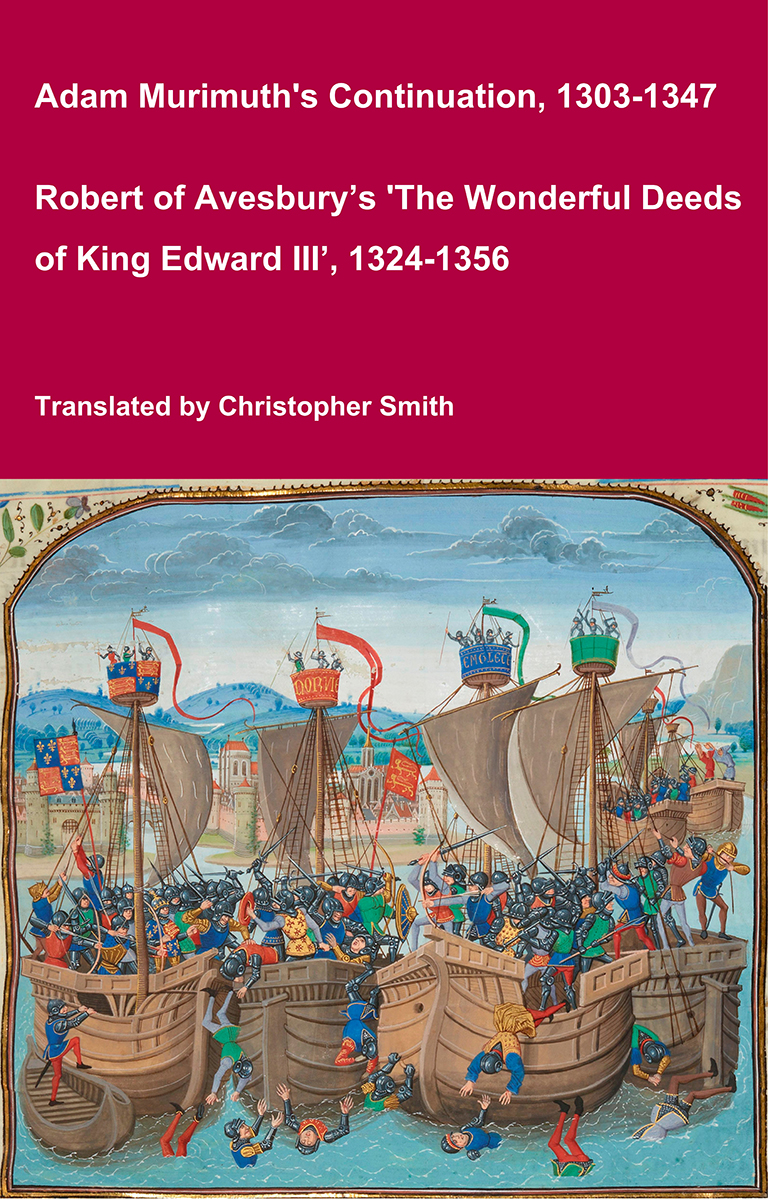
Adam Murimuth's Continuation and Robert of Avesbury’s 'The Wonderful Deeds of King Edward III'
This volume brings together two of the most important contemporary chronicles for the reign of Edward III and the opening phases of the Hundred Years’ War. Written in Latin by English clerical observers, these texts provide a vivid and authoritative window into the political, diplomatic, and military history of fourteenth-century England and its continental ambitions. Adam Murimuth Continuatio's Chronicarum continues an earlier chronicle into the mid-fourteenth century, offering concise but valuable notices on royal policy, foreign relations, and ecclesiastical affairs. Its annalistic structure makes it especially useful for establishing chronology and tracing the development of events year by year. Complementing it, Robert of Avesbury’s De gestis mirabilibus regis Edwardi tertii is a rich documentary chronicle preserving letters, treaties, and official records alongside narrative passages. It is an indispensable source for understanding Edward III’s claim to the French crown, the conduct of war, and the mechanisms of medieval diplomacy. Together, these works offer scholars, students, and enthusiasts a reliable and unembellished account of a transformative period in English and European history. Essential for anyone interested in medieval chronicles, the Hundred Years’ War, or the reign of Edward III.
Available at Amazon in eBook and Paperback format.
Anglo-Saxon Chronicle. 672. This year died King Cenwal; and Sexburga his queen held the government one year after him.
Bede. 673. Eleutherius was the fourth bishop of the West Saxons; for Birinus was the first, Agilbert the second, and Wine the third. When Coinwalch, in whose reign the said Eleutherius was made bishop, died, his under-rulers took upon them the kingdom of the people, and dividing it among themselves, held it ten years; and during their rule he died, and Heddi succeeded him in the bishopric, having been consecrated by Theodore (age 71), in the city of London; during whose prelacy, Cadwalla (age 14), having subdued and removed those rulers, took upon him the government. When he had reigned two years, and whilst the same bishop still governed the church, he quitted his sovereignty for the love of the heavenly kingdom, and, going away to Rome, ended his days there, as shall be said more fully hereafter.
Before Cenwalh King of Wessex and Seaxburh Queen of Wessex were married. He the son of King Cynegils of Wessex.
[his son] Cenfus Wessex was born to Cenwalh King of Wessex.
Kings Wessex: Son of King Cynegils of Wessex
Great x 3 Grandfather: Cerdic King Wessex
Great x 2 Grandfather: Cynric King Wessex
Great x 1 Grandfather: Cutha Wessex
GrandFather: Ceol King Wessex
Father: King Cynegils of Wessex