


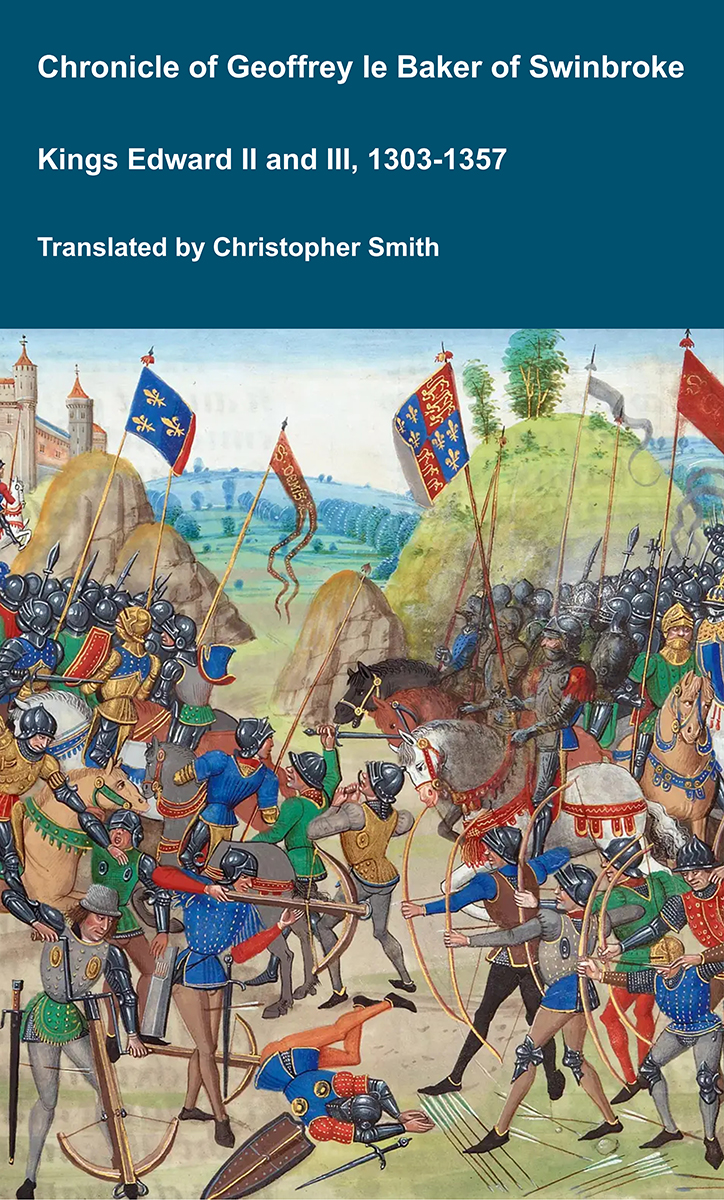
Chronicle of Geoffrey le Baker of Swinbroke
Baker was a secular clerk from Swinbroke, now Swinbrook, an Oxfordshire village two miles east of Burford. His Chronicle describes the events of the period 1303-1356: Gaveston, Bannockburn, Boroughbridge, the murder of King Edward II, the Scottish Wars, Sluys, Crécy, the Black Death, Winchelsea and Poitiers. To quote Herbert Bruce 'it possesses a vigorous and characteristic style, and its value for particular events between 1303 and 1356 has been recognised by its editor and by subsequent writers'. The book provides remarkable detail about the events it describes. Baker's text has been augmented with hundreds of notes, including extracts from other contemporary chronicles, such as the Annales Londonienses, Annales Paulini, Murimuth, Lanercost, Avesbury, Guisborough and Froissart to enrich the reader's understanding. The translation takes as its source the 'Chronicon Galfridi le Baker de Swynebroke' published in 1889, edited by Edward Maunde Thompson.
Available at Amazon in eBook and Paperback format.
Proceedings of the Somerset Archaeological and Natural History Society Volume 51 Page 244 is in Proceedings of the Somerset Archaeological and Natural History Society Volume 51.
OBITUARY DR. ARTHUR BULLEID (deceased), L.R.C.P., F.S.A.
DR. ARTHUR BULLEJD, who died at his home, Dymboro, Midsomer Norton, Somerset, on 27 December, aL the
Bulleid; who was by profession a medical practitioner, had an early opportunity of cultivating a taste for archaeology, and having read Keller's book on the Swiss Lake-dwellings, Munro's ' Lake Dwellings of Europe' and other works, he became imbued with the idea that remains of a somewhat similar nature were to be found in the swamps of central Somerset. So, in his rambles over the moors, he was on the look-out for possible sites, and he visited peat-cutting operations in the vicinity. A little later, he found the mounds about a mile north of Glastonbury, on the road to Godney, which raised a suspicion in his mind that they were artificial. Certain remains which turned up on mole-heaps settled the point, and Arthur Bulleid got into touch with Dr. Robert Munro and Sir W. Boyd Dawkins and other archaeologists. This resulted in the British Association forming a Lake Village Committee in 1893, and making monetary grants from year to year towards the work. The excavations, however, began in 1892 under. the direction of Dr. Bulleid : ·they were found to be unique and became widely known.
In the same year, due to Bulleid's enquiries and his keenness, a flat-bottomed dug-out boat, 17 ft. in length, was recovered at some little distance from the lake village, and is now preserved in the Glastonbury Museum.
The first series of excavations extended until 1898 ; then there was an interval of six years, except for a comparatively small exploration conducted in 1902 by Mr. H. St. George Gray. Further operations were resumed in 1904 under the joint direction of D r. Bulleid and Mr. Gray. This work was completed in 1907. In 191 1, Vol. I of a large fully illustrated report in royal quarto size was published, followed in 1916 by Vol. II. Before the issue of Vol. I, Messrs. Bulleid and Gray began a long series of excavations in 1908 on the site of the neighbouring lake village at Meare, which is in two separate areas known as the West and East villages. Vol. I of the West village was issued in 1948, and Vol. 1I is now in preparation, and will include Dr. Bulleid's description of the dwelli ngs and further chapters by Mr. St. George Gray on the finds, which are very numerous. The Meare exploration has continued season by season up to date except during the period of the two world wars.
Dr. Bulleid's archaeological interests extended beyond the lake villages, and he was a most careful, accurate and painstaking observer, and exceedingly pleasant to work with ; he would go to any trouble to achieve satisfactory results. Moreover, he was a good draughtsman—so essential an attainment for archaeological work and especially in connexion with illustrating published reports. Bulleid was never happier than when working at the lake villages where he made many friends who appreciated his archaeological enthusiasm ; and he took a great interest in excavations conducted by other people.
The writer of these notes, who spent many weeks of his life, from time to time, under Dr. Bulleid's roof, always found him kind and friendly, and of a decidedly hospitable nature.
For the Proceedings of the Society he wrote valued papers, notably 'The Chambered Barrows of North Somerset', ' The Ancient Trackway in Meare Heath' and 'The Shapwick Boat', and in collaboration with Dr. Wilfrid Jackson 'The Burtle Sand Beds in Somerset' (in two papers). Bulleid was one of the very few remaining members of the Somerset Archaeological Society who joined in the last century, namely, in 1893 ; and he was elected a vice-president in 1924. He became a Fellow of the Society of Antiquaries of London in 1896, of which body he was for some years one of the local secretaries for Somerset. He is survived by his wife and all his children—two sons and four daughters.
Harold St George Gray (age 79)
 Become a Member via our Buy Me a Coffee page to read more.
In addition to Bulleid’s (deceased) important archaeological researches there are other sides to his work and character which should not go unrecorded.
Besides being a country doctor, much beloved by the mining community at Midsomer Norton, Arthur Bulleid was essentially an artist-craftsman ; and it is his imaginative sense and clarity of perception which are so well brought out in his approach to the technical and aesthetic problems dealt with in his various writings.
It is perhaps not generally known that his earliest venture was not in medicine but as a potter, going to Staffordshire for a year or so to be apprenticed to one of the big potteries before returning to Glastonbury Pottery to follow the trade. Here, wishing to enhance a small and somewhat sterile craft, he experimented with designs and glazes, but found the management obdurate to any form of enterprise. Frustrated by their attitude he broke with the firm in order to study and take up medicine. The training he underwent at the potter’s wheel and at the kiln were all important in after-life to his understanding of the native British wares.
For a busy man with so many interests his output of drawings was considerable. Besides the published pen and ink line drawings, there exist other much more sensitive pencil sketches including the originals of the Lake Village pottery forms. The essential character of these vessels, with their delicate and often intricate linear and scroll decoration, he was able to grasp and interpret with the ease of a born craftsman.
A more creative side to his make-up may be seen in a series of finely executed designs for wall papers and fabrics, which he carried out in his middle seventies about 1938 and 1939. Although they were never developed commercially owing to the intervention of the war, these brightly painted water colours exhibit not only a complete understanding of the fundamentals of surface pattern but considerable originality in their treatment. They are based on natural flower, stem and leaf form, the most sensitive of all, perhaps, being a delicate design called 'the Glastonbury Thorn' in which the underlying theme has some of the charac- teristics of Celtic scroll work. This is fundamentally English pattern in its truest sense, strongly inspired by William Morris and the work of older craftsmen.
Dr. Bulleid will long be remembered by those who knew him best for that most precious of human gifts, humility of mind. With age and experience this early shyness matured into a philosophical diffidence which was quite charming, combining as it did with a rare beneficence that irradiated his whole personality.
W.A.S.
Become a Member via our Buy Me a Coffee page to read more.