Chronicle of Geoffrey le Baker of Swinbroke
Baker was a secular clerk from Swinbroke, now Swinbrook, an Oxfordshire village two miles east of Burford. His Chronicle describes the events of the period 1303-1356: Gaveston, Bannockburn, Boroughbridge, the murder of King Edward II, the Scottish Wars, Sluys, Crécy, the Black Death, Winchelsea and Poitiers. To quote Herbert Bruce 'it possesses a vigorous and characteristic style, and its value for particular events between 1303 and 1356 has been recognised by its editor and by subsequent writers'. The book provides remarkable detail about the events it describes. Baker's text has been augmented with hundreds of notes, including extracts from other contemporary chronicles, such as the Annales Londonienses, Annales Paulini, Murimuth, Lanercost, Avesbury, Guisborough and Froissart to enrich the reader's understanding. The translation takes as its source the 'Chronicon Galfridi le Baker de Swynebroke' published in 1889, edited by Edward Maunde Thompson.
Available at Amazon in eBook and Paperback format.
On 15th January 1872 Harold St George Gray was born at Lichfield, Staffordshire [Map].
In 1888 Harold St George Gray [aged 15] started working for Augustus Henry Fox Pitt-Rivers [aged 60].
On 12th August 1899 Harold St George Gray [aged 27] and Florence Harriet Young [aged 24] were married at St Mary's Church, Motcombe. The witnesses were her sister Elizabeth, and the bride and groom's fathers.
On or before 10th February 1901, the date he was baptised at St Mary's Church, Iffley, [his son] Lionel St George Gray was born to Harold St George Gray [aged 29] and [his wife] Florence Harriet Young [aged 25].
Harold Gray 1902. Arbor Low Stone Circle [Map] Excavations in 1901 and 1902. By H. St. George Gray [aged 29]
The following is an abstract of a paper communicated to the Society of Antiquaries by Mr. Gray, in April, 1903, and printed in Archæologia, Vol. lviii., pp. 461-498. By kind permission of the Society liberal use has been made of Mr. Gray's paper, and the proofs have been revised by him. We are further indebted to the society for the loan of most of the illustrations in Archæologia, but the size of these pages has necessitated considerable reduction of the plan.
In 1904 Arthur Bulleid [aged 41] re-commenced his excavations at Glastonbury Lake Village with Harold St George Gray [aged 31].
In 1908 Arthur Bulleid [aged 45] and Harold St George Gray [aged 35] excavated the Meare Lake Village.
1911. Census. Harold St George Gray [aged 38], [his wife] Florence Harriet Young [aged 35] and [his son] Lionel St George Gray [aged 9] at Castle House, Taunton.
In 1911 Arthur Bulleid [aged 48] and Harold St George Gray [aged 38] published their first volume of his 'The Glastonbury Lake Village, a full description of the excavations and the relics discovered, 1892-1907': Archive.org.
Adam Murimuth's Continuation and Robert of Avesbury’s 'The Wonderful Deeds of King Edward III'
This volume brings together two of the most important contemporary chronicles for the reign of Edward III and the opening phases of the Hundred Years’ War. Written in Latin by English clerical observers, these texts provide a vivid and authoritative window into the political, diplomatic, and military history of fourteenth-century England and its continental ambitions. Adam Murimuth Continuatio's Chronicarum continues an earlier chronicle into the mid-fourteenth century, offering concise but valuable notices on royal policy, foreign relations, and ecclesiastical affairs. Its annalistic structure makes it especially useful for establishing chronology and tracing the development of events year by year. Complementing it, Robert of Avesbury’s De gestis mirabilibus regis Edwardi tertii is a rich documentary chronicle preserving letters, treaties, and official records alongside narrative passages. It is an indispensable source for understanding Edward III’s claim to the French crown, the conduct of war, and the mechanisms of medieval diplomacy. Together, these works offer scholars, students, and enthusiasts a reliable and unembellished account of a transformative period in English and European history. Essential for anyone interested in medieval chronicles, the Hundred Years’ War, or the reign of Edward III.
Available at Amazon in eBook and Paperback format.
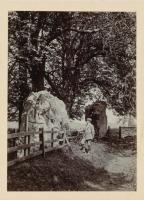
Avebury North Circle Cove [Map]. 13th May 1911. Photograph by Harold St George Gray [aged 39] of (presumably) his wife Florence [aged 35] and their son Lionel [aged 10].
Dorset Natural History and Archaeological Society Volume 35 1914 Page 88. Short Report On The Excavations Of 1913. By H. St. George Gray [aged 41].
In July 1923 [his son] Lionel St George Gray [aged 22] died.

In 1924 Alexander Keiller [aged 34] bought Windmill Hill Causewayed Enclosure [Map] and excavated between 1925 to 1929 with Harold St George Gray [aged 51]. Pottery was found in the bottom of the ditches - probably Windmill Hill Pottery. Upper layers contained Peterborough Ware. Later deposits contained Grooved Ware and Beaker Potsherds suggesting continuous occupation over an extended period.
Diary of WEV Young. 23rd September 1930. Pages 129-131.
Mr Gray [aged 58] called me into the hut at five o'clock and paid me off, remarking as he did so that funds this time were very short (I hope he will get enough for his own "honorarium"). [his wife] Mrs Gray [aged 55] also joined in with a few well chosen remarks, plainly intended for my edification, although addressed to her spouse – "Really dear: I cannot keep on making up the expenses of the excavations, my purse will not allow it. I had to make up five pounds for the Ham Hill work." … In the presence of Sir Joseph and Lady Bowley, I listened meekly to all this … behaving myself with that gruelling humility one should do, in the presence of their superiors, then touching my ragged cap I backed away, and took my leave.
Archaeologia Volume 84 1935 Section VI. The Avebury Excavations, 1908-1922. By H. St. George Gray [aged 62], Esq., F.S.A. Read 15th November 1934.
Proceedings of the Somerset Archaeological and Natural History Society Volume 51 Page 244. OBITUARY DR. ARTHUR BULLEID [deceased], L.R.C.P., F.S.A.
DR. ARTHUR BULLEJD, who died at his home, Dymboro, Midsomer Norton, Somerset, on 27 December, aL the
Bulleid; who was by profession a medical practitioner, had an early opportunity of cultivating a taste for archaeology, and having read Keller's book on the Swiss Lake-dwellings, Munro's ' Lake Dwellings of Europe' and other works, he became imbued with the idea that remains of a somewhat similar nature were to be found in the swamps of central Somerset. So, in his rambles over the moors, he was on the look-out for possible sites, and he visited peat-cutting operations in the vicinity. A little later, he found the mounds about a mile north of Glastonbury, on the road to Godney, which raised a suspicion in his mind that they were artificial. Certain remains which turned up on mole-heaps settled the point, and Arthur Bulleid got into touch with Dr. Robert Munro and Sir W. Boyd Dawkins and other archaeologists. This resulted in the British Association forming a Lake Village Committee in 1893, and making monetary grants from year to year towards the work. The excavations, however, began in 1892 under. the direction of Dr. Bulleid : ·they were found to be unique and became widely known.
In the same year, due to Bulleid's enquiries and his keenness, a flat-bottomed dug-out boat, 17 ft. in length, was recovered at some little distance from the lake village, and is now preserved in the Glastonbury Museum.
The first series of excavations extended until 1898 ; then there was an interval of six years, except for a comparatively small exploration conducted in 1902 by Mr. H. St. George Gray. Further operations were resumed in 1904 under the joint direction of D r. Bulleid and Mr. Gray. This work was completed in 1907. In 191 1, Vol. I of a large fully illustrated report in royal quarto size was published, followed in 1916 by Vol. II. Before the issue of Vol. I, Messrs. Bulleid and Gray began a long series of excavations in 1908 on the site of the neighbouring lake village at Meare, which is in two separate areas known as the West and East villages. Vol. I of the West village was issued in 1948, and Vol. 1I is now in preparation, and will include Dr. Bulleid's description of the dwelli ngs and further chapters by Mr. St. George Gray on the finds, which are very numerous. The Meare exploration has continued season by season up to date except during the period of the two world wars.
Dr. Bulleid's archaeological interests extended beyond the lake villages, and he was a most careful, accurate and painstaking observer, and exceedingly pleasant to work with ; he would go to any trouble to achieve satisfactory results. Moreover, he was a good draughtsman—so essential an attainment for archaeological work and especially in connexion with illustrating published reports. Bulleid was never happier than when working at the lake villages where he made many friends who appreciated his archaeological enthusiasm ; and he took a great interest in excavations conducted by other people.
The writer of these notes, who spent many weeks of his life, from time to time, under Dr. Bulleid's roof, always found him kind and friendly, and of a decidedly hospitable nature.
For the Proceedings of the Society he wrote valued papers, notably 'The Chambered Barrows of North Somerset', ' The Ancient Trackway in Meare Heath' and 'The Shapwick Boat', and in collaboration with Dr. Wilfrid Jackson 'The Burtle Sand Beds in Somerset' (in two papers). Bulleid was one of the very few remaining members of the Somerset Archaeological Society who joined in the last century, namely, in 1893 ; and he was elected a vice-president in 1924. He became a Fellow of the Society of Antiquaries of London in 1896, of which body he was for some years one of the local secretaries for Somerset. He is survived by his wife and all his children—two sons and four daughters.
Harold St George Gray [aged 79]
On 28th February 1963 Harold St George Gray [aged 91] died.
On 5th June 1970 [his former wife] Florence Harriet Young [aged 95] died at Martock, Somerset.
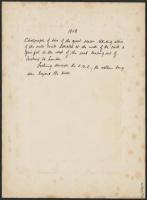
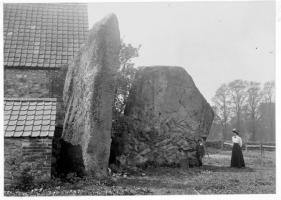
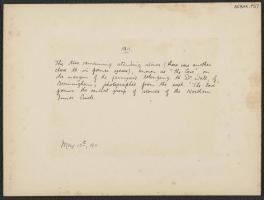
Caption on reverse of the photo: "1909. Two of the great sarsen standing stones [Avebury Outer Circle Stone 46 aka Swindon Stone [Map]] of the outer circle situated at the north of the circle a few feet to the west of the road leading out of Avebury to Swindon. Looking east-north-east, the vallum [bank] being seen beyond the trees". The person in the photo is Harold St George Gray.