

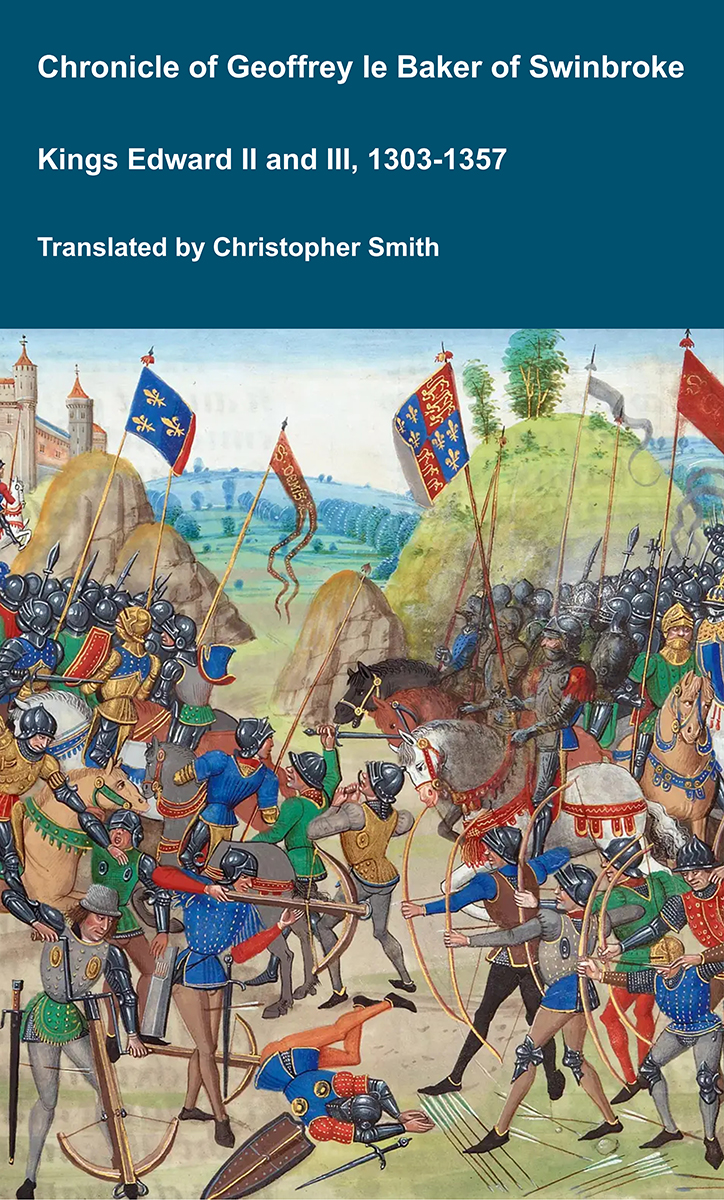
Chronicle of Geoffrey le Baker of Swinbroke
Baker was a secular clerk from Swinbroke, now Swinbrook, an Oxfordshire village two miles east of Burford. His Chronicle describes the events of the period 1303-1356: Gaveston, Bannockburn, Boroughbridge, the murder of King Edward II, the Scottish Wars, Sluys, Crécy, the Black Death, Winchelsea and Poitiers. To quote Herbert Bruce 'it possesses a vigorous and characteristic style, and its value for particular events between 1303 and 1356 has been recognised by its editor and by subsequent writers'. The book provides remarkable detail about the events it describes. Baker's text has been augmented with hundreds of notes, including extracts from other contemporary chronicles, such as the Annales Londonienses, Annales Paulini, Murimuth, Lanercost, Avesbury, Guisborough and Froissart to enrich the reader's understanding. The translation takes as its source the 'Chronicon Galfridi le Baker de Swynebroke' published in 1889, edited by Edward Maunde Thompson.
Available at Amazon in eBook and Paperback format.
St John Lee Church, Hexham is in Hexham, Northumberland [Map], Churches in Northumberland.
Exterior of St John Lee Church, Hexham [Map].


Cup and Ringmarked Stone, and the Oakwood Stone, at St John Lee Church, Hexham [Map].


Hatchments at St John Lee Church, Hexham [Map].


Windows at St John Lee Church, Hexham [Map].
Rood Screen and Interior at St John Lee Church, Hexham [Map].


Bede. How Bishop John cured a dumb man by his blessing. [687 a.d.]
In the beginning of Aldfrid's reign, Bishop Eata died, and was succeeded in the bishopric of the church of Hagustald [Map] by the holy man John, of whom those that knew him well are wont to tell many miracles, and more particularly Berthun, a man worthy of all reverence and of undoubted truthfulness, and once his deacon, now abbot of the monastery called Inderauuda [Map], that is, "In the wood of the Deiri": some of which miracles we have thought fit to hand on to posterity. There is a certain remote dwelling [Map] enclosed by a mound, among scattered trees, not far from the church of Hagustald [Map], being about a mile and a half distant and separated from it by the River Tyne, having an oratory dedicated to St. Michael the Archangel, where the man of God used frequently, as occasion offered, and specially in Lent, to abide with a few companions and in quiet give himself to prayer and study. Having come hither once at the beginning of Lent to stay, he bade his followers find out some poor man labouring under any grievous infirmity, or want, whom they might keep with them during those days, to receive alms, for so he was always used to do.

After 25th May 1770. St John Lee Church, Hexham [Map]. Monument to Reverend Leonard Bentham.

After 25th August 1867. St John Lee Church, Hexham [Map]. Grave of Amos Dent of Hexham who was killed in an accident at Hexham Railway Station on 24 Aug 1867 dying the following day.
After July 1892. Memorial at St John Lee Church, Hexham [Map] to the Reverend Thomas Faulkner.


William of Worcester's Chronicle of England
William of Worcester, born around 1415, and died around 1482 was secretary to John Fastolf, the renowned soldier of the Hundred Years War, during which time he collected documents, letters, and wrote a record of events. Following their return to England in 1440 William was witness to major events. Twice in his chronicle he uses the first person: 1. when writing about the murder of Thomas, 7th Baron Scales, in 1460, he writes '… and I saw him lying naked in the cemetery near the porch of the church of St. Mary Overie in Southwark …' and 2. describing King Edward IV's entry into London in 1461 he writes '… proclaimed that all the people themselves were to recognize and acknowledge Edward as king. I was present and heard this, and immediately went down with them into the city'. William’s Chronicle is rich in detail. It is the source of much information about the Wars of the Roses, including the term 'Diabolical Marriage' to describe the marriage of Queen Elizabeth Woodville’s brother John’s marriage to Katherine, Dowager Duchess of Norfolk, he aged twenty, she sixty-five or more, and the story about a paper crown being placed in mockery on the severed head of Richard, 3rd Duke of York.
Available at Amazon in eBook and Paperback format.

After 27th September 1915. St John Lee Church, Hexham [Map]. Monument to Captain James Harold Cuthbert [deceased],
On 21st May 1916 Simon Richard Richmond Mewburn [aged 31] was killed in action when he led his men to attack a bridge over the Shatt-el-hai, Wasit, Iraq. His body was never found. A fellow Officer wrote: "I can't bear to think that we shall have his cheery company no more in this world" .He has a memorial at St John Lee Church, Hexham [Map] sculpted by Thomas John Clapperton [aged 36].
Simon Richard Richmond Mewburn: On 9th September 1884 he was born. After 21st May 1916. St John Lee Church, Hexham [Map]. Monument to Simon Richard Richmond Mewburn sculpted by Thomas John Clapperton.


After 21st May 1916. St John Lee Church, Hexham [Map]. Monument to Simon Richard Richmond Mewburn [deceased] sculpted by Thomas John Clapperton [aged 36].

After 22nd August 1918. St John Lee Church, Hexham [Map]. Monument to George Pears Walton.

After 8th January 1921. Memorial at St John Lee Church, Hexham [Map] to Rector Christian Paul Sherman.

After 1931. Memorial at St John Lee Church, Hexham [Map] to Major-General Gerald James Cuthbert [aged 69].
Major-General Gerald James Cuthbert: On 12th September 1861 he was born to William Cuthbert of Beaufront Castle. On 1st February 1931 Major-General Gerald James Cuthbert died.
After 1945. Memorial at St John Lee Church, Hexham [Map] to those who fell in World War II, and War Graves.


