

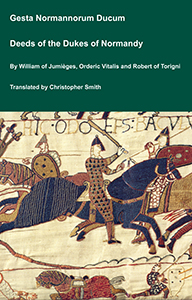
The Deeds of the Dukes of Normandy
The Gesta Normannorum Ducum [The Deeds of the Dukes of Normandy] is a landmark medieval chronicle tracing the rise and fall of the Norman dynasty from its early roots through the pivotal events surrounding the Norman Conquest of England. Originally penned in Latin by the monk William of Jumièges shortly before 1060 and later expanded at the behest of William the Conqueror, the work chronicles the deeds, politics, battles, and leadership of the Norman dukes, especially William’s own claim to the English throne. The narrative combines earlier historical sources with firsthand information and oral testimony to present an authoritative account of Normandy’s transformation from a Viking settlement into one of medieval Europe’s most powerful realms. William’s history emphasizes the legitimacy, military prowess, and governance of the Norman line, framing their expansion, including the conquest of England, as both divinely sanctioned and noble in purpose. Later chroniclers such as Orderic Vitalis and Robert of Torigni continued the history, extending the coverage into the 12th century, providing broader context on ducal rule and its impact. Today this classic work remains a foundational source for understanding Norman identity, medieval statesmanship, and the historical forces that reshaped England and Western Europe between 800AD and 1100AD.
Available at Amazon in eBook and Paperback format.
Captain is in Navy.
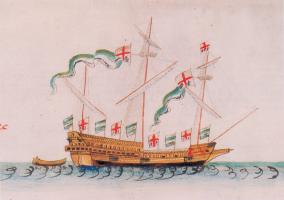
On 19th March 1563 the Greyhound was wrecked on its journey to Le Havre with the loss of around two-hundred lives.
Captain Thomas Finch [aged 51], Arthur Brooke, and brothers John Wentworth [aged 25] and James Wentworth [aged 23] drowned.
The Greyhound in 1546 from the Anthony Roll.
In 1660 Philip Howard [aged 29] was appointed Captain of the King's Lifeguard.
In 1663 Captain Edward Grove was appointed Captain of the Merlin.
In 1664 Admiral John Harman [aged 39] was appointed Captain of the The Gloucester.
In 1665 Captain John Cox was appointed Captain of Mary.
In 1665 Admiral John Harman [aged 40] was appointed Captain of the Royal Charles.
In 1666 Captain John Hubbard was appointed Captain of the Royal Charles.
In 1666 Captain John Cox was appointed Captain of Sovereign.
On 16th August 1770 Captain George Marlay [aged 22] was appointed Captain of the 62nd Regiment.

The London Gazette 12111. War-Office, August 22, 1780.
19th Regiment of Light Dragoons, Cornet John Bailey to be Lieutenant, vice William Wells.
31st Regiment of Fcot, Alexander Giddes, Gent, to be Ensign in one of the Additional Companies, vice Ersktine Hope.
72nd Regiment of Foot, Captain John Hamiiton, of the Huntingdonshire Militia, to be Ensign in one of the Additional Companies, vice Gilbert Hillock.
72nd Regiment of Foot, Serjeant-Major Henry Andrews to be Quarter-Master, vice John Allen.
Southern Regiment of Fencible Men, Alexander Smollet, Gent, to be Ensign, vice Charles Anderson.
To be Majors in the Army.
Captain Banastre Tarleton [aged 26], of 79th Foot.
Captain Archibald Robertson, of the Corps of Engineers.
Captain John Graves Simcoe, of 40th Foot.
Captain John Andre, of 54th Foot.
Lieutenant Ewen Cameron, from Half Pay in the late 78th Regiment, to be Lieutenant in Captain Thomas Cochran's Independent Company of Invalids, vice John George Hobson.
The History of William Marshal was commissioned by his son shortly after William’s death in 1219 to celebrate the Marshal’s remarkable life; it is an authentic, contemporary voice. The manuscript was discovered in 1861 by French historian Paul Meyer. Meyer published the manuscript in its original Anglo-French in 1891 in two books. This book is a line by line translation of the first of Meyer’s books; lines 1-10152. Book 1 of the History begins in 1139 and ends in 1194. It describes the events of the Anarchy, the role of William’s father John, John’s marriages, William’s childhood, his role as a hostage at the siege of Newbury, his injury and imprisonment in Poitou where he met Eleanor of Aquitaine and his life as a knight errant. It continues with the accusation against him of an improper relationship with Margaret, wife of Henry the Young King, his exile, and return, the death of Henry the Young King, the rebellion of Richard, the future King Richard I, war with France, the death of King Henry II, and the capture of King Richard, and the rebellion of John, the future King John. It ends with the release of King Richard and the death of John Marshal.
Available at Amazon in eBook and Paperback format.
In 1462 William Tailboys 7th Baron Kyme [aged 47] was appointed Captain Alnwick Castle.
In 1575 George Howard [aged 50] was appointed Captain Boulogne.
In 1419 William Bourchier 1st Count of Eu [aged 45] was appointed Captain Dieppe.
In 1415 Thomas Beaufort 1st Duke Exeter [aged 37] was appointed Captain Harfleur.
Around 1207 Philip de Albini was appointed Governor of Ludlow Castle.
In 1402 Thomas Beaufort 1st Duke Exeter [aged 24] was appointed Captain Ludlow Castle.
In 1672 Francis Hawley 1st Baron Hawley [aged 63] was appointed Captain of Deal Castle which position he held until 1674.
In 1682 Admiral Francis Wheler [aged 24] was appointed Governor of Deal Castle.
In 1776 John Norris [aged 36] was appointed Captain of Deal Castle.
In 1777 Francis Osborne 5th Duke Leeds [aged 25] was appointed Captain of Deal Castle.



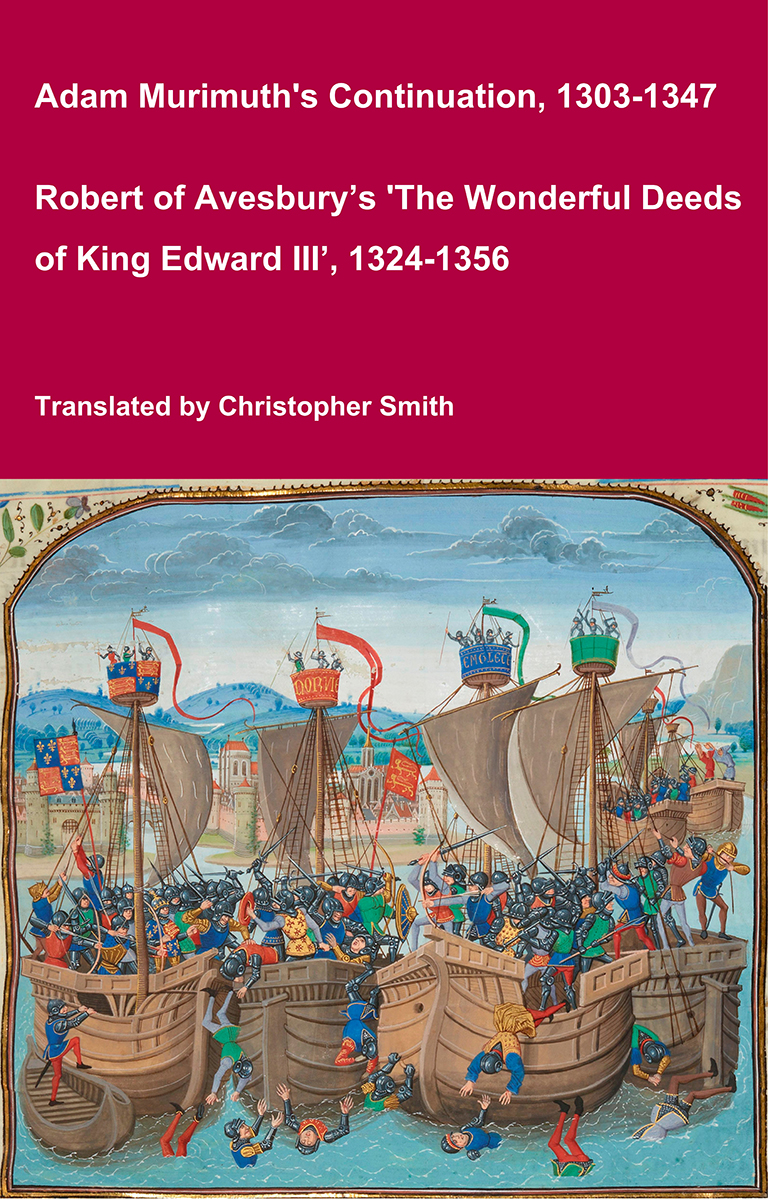
Adam Murimuth's Continuation and Robert of Avesbury’s 'The Wonderful Deeds of King Edward III'
This volume brings together two of the most important contemporary chronicles for the reign of Edward III and the opening phases of the Hundred Years’ War. Written in Latin by English clerical observers, these texts provide a vivid and authoritative window into the political, diplomatic, and military history of fourteenth-century England and its continental ambitions. Adam Murimuth Continuatio's Chronicarum continues an earlier chronicle into the mid-fourteenth century, offering concise but valuable notices on royal policy, foreign relations, and ecclesiastical affairs. Its annalistic structure makes it especially useful for establishing chronology and tracing the development of events year by year. Complementing it, Robert of Avesbury’s De gestis mirabilibus regis Edwardi tertii is a rich documentary chronicle preserving letters, treaties, and official records alongside narrative passages. It is an indispensable source for understanding Edward III’s claim to the French crown, the conduct of war, and the mechanisms of medieval diplomacy. Together, these works offer scholars, students, and enthusiasts a reliable and unembellished account of a transformative period in English and European history. Essential for anyone interested in medieval chronicles, the Hundred Years’ War, or the reign of Edward III.
Available at Amazon in eBook and Paperback format.
Before December 1539 Brian Leyton was appointed Captain of Norham Castle.
In 1419 Thomas Beaufort 1st Duke Exeter [aged 41] was appointed Captain of Rouen.