

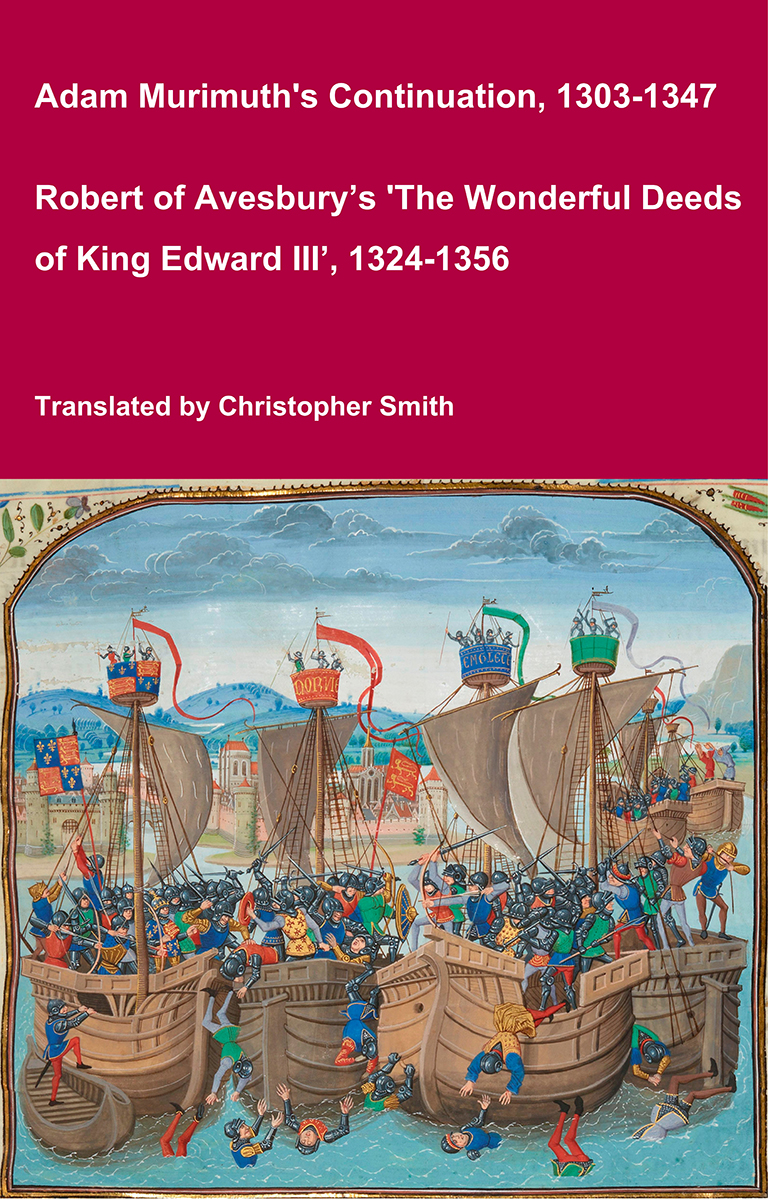
Adam Murimuth's Continuation and Robert of Avesbury’s 'The Wonderful Deeds of King Edward III'
This volume brings together two of the most important contemporary chronicles for the reign of Edward III and the opening phases of the Hundred Years’ War. Written in Latin by English clerical observers, these texts provide a vivid and authoritative window into the political, diplomatic, and military history of fourteenth-century England and its continental ambitions. Adam Murimuth Continuatio's Chronicarum continues an earlier chronicle into the mid-fourteenth century, offering concise but valuable notices on royal policy, foreign relations, and ecclesiastical affairs. Its annalistic structure makes it especially useful for establishing chronology and tracing the development of events year by year. Complementing it, Robert of Avesbury’s De gestis mirabilibus regis Edwardi tertii is a rich documentary chronicle preserving letters, treaties, and official records alongside narrative passages. It is an indispensable source for understanding Edward III’s claim to the French crown, the conduct of war, and the mechanisms of medieval diplomacy. Together, these works offer scholars, students, and enthusiasts a reliable and unembellished account of a transformative period in English and European history. Essential for anyone interested in medieval chronicles, the Hundred Years’ War, or the reign of Edward III.
Available at Amazon in eBook and Paperback format.
 Waverley Abbey
 Combermere Abbey
 Basingwerk Abbey
 Woburn Abbey
 Margam Abbey, Glamorganshire
 Meaux aka Mesla Abbey
 Abbey of St Mary, Haddington
Cistercian is in Religious Buildings by Order.
In 1128 Waverley Abbey [Map] was founded by Bishop William Giffard, the Bishop of Winchester as the first Cistercian Abbey in England.
Around 1130 Combermere Abbey [Map] was founded by Hugh Malbank, Baron of Nantwich, confirmed in 1130 by Ranulf Gernon 4th Earl Chester [aged 31] who was one of the witnesses of its foundation charter. Other witnesses included Hugh Malbank's son, William, and Roger de Clinton, the Bishop of Coventry. The original grant included the manor of Wilkesley, comprising two Domesday manors worth 18 shillings pre-Conquest; the villages of Dodcott, Lodmore and Royal; land at Burleydam; a mill and fishery at Chorley; and woods at Brentwood, Light Birchwood and Butterley Heyes. The Abbey originally belonged to the Savigniac order, which merged with the Cistercian order by 1147.
In 1132 Ranulf Gernon 4th Earl Chester [aged 33] founded Basingwerk Abbey [Map]. The first location of the abbey was at the nearby Hen Blas. In 1147 the abbey joined the Cistercian Order. It was a daughter house of Combermere Abbey [Map].
In 1145 Woburn Abbey [Map] was established as a Cistercian Monastery. It was dissolved by Henry VIII in 1538.
In 1147 Margam Abbey, Glamorganshire [Map] was founded as a Cistercian monastery.
In 1151 William of Blois 1st Earl Albemarle 1st Earl York [aged 50] founded Meaux aka Mesla Abbey [Map] as Cistercian house.
In 1178 the Abbey of St Mary, Haddington [Map], was founded by Countess Ada of Northumbria [aged 58] as a Cistercian nunnery. She was the daughter-in-law of King David I of Scotland, the founder of many Scottish monasteries. Haddington 'Abbey' was in fact a Priory with a Prioress at its head, but commonly called the Abbey.