

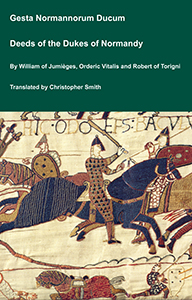
The Deeds of the Dukes of Normandy
The Gesta Normannorum Ducum [The Deeds of the Dukes of Normandy] is a landmark medieval chronicle tracing the rise and fall of the Norman dynasty from its early roots through the pivotal events surrounding the Norman Conquest of England. Originally penned in Latin by the monk William of Jumièges shortly before 1060 and later expanded at the behest of William the Conqueror, the work chronicles the deeds, politics, battles, and leadership of the Norman dukes, especially William’s own claim to the English throne. The narrative combines earlier historical sources with firsthand information and oral testimony to present an authoritative account of Normandy’s transformation from a Viking settlement into one of medieval Europe’s most powerful realms. William’s history emphasizes the legitimacy, military prowess, and governance of the Norman line, framing their expansion, including the conquest of England, as both divinely sanctioned and noble in purpose. Later chroniclers such as Orderic Vitalis and Robert of Torigni continued the history, extending the coverage into the 12th century, providing broader context on ducal rule and its impact. Today this classic work remains a foundational source for understanding Norman identity, medieval statesmanship, and the historical forces that reshaped England and Western Europe between 800AD and 1100AD.
Available at Amazon in eBook and Paperback format.
MP Cockermouth is in Member Parliament.
In 1641 John Fenwick 1st Baronet [aged 71] was elected MP Cockermouth.
In 1659 Wilfrid Lawson [aged 23] was elected MP Cockermouth. He was re-elected in 1660.
In 1661 Wilfrid Lawson 1st Baronet [aged 51] was elected MP Cockermouth.
In 1689 Henry Fletcher 3rd Baronet [aged 27] was elected MP Cockermouth which seat he held until 1690.
In 1690 Wilfrid Lawson 2nd Baronet [aged 25] was elected MP Cockermouth which seat he held until 1695.
In 1698 George Fletcher [aged 32] was elected MP Cockermouth which seat he held until 1701.
In February 1702 Thomas Lamplugh [aged 45] was elected MP Cockermouth at a by-election.
In 1705 Thomas Lamplugh [aged 48] was elected MP Cockermouth at a by-election.
In 1717 Wilfrid Lawson 3rd Baronet [aged 20] stood for the Cockermouth constituency after Nicholas Lechmere accepted a ministerial position and accordingly resigned the seat. However, the returning officer made a double return, returning both Lord Percy Seymour [aged 20] and Sir Wilfrid Lawson. Both parties immediately petitioned against the result; Lord Percy, on the grounds that Lawson was a minor, (not having attained the age of 21), while Lawson based his petition on the grounds of bribery. Although both petitions were withdrawn, Sir Wilfrid did admit the charge and consequently, Lord Percy took the seat.
In 1722 Wilfrid Lawson 3rd Baronet [aged 25] was elected MP Cockermouth which seat he held until his death in 1737.
In 1754 Percy Wyndham O'Brien 1st Earl Thomond [aged 41] was elected MP Cockermouth.
Henrici Quinti, Angliæ Regis, Gesta, is a first-hand account of the Agincourt Campaign, and subsequent events to his death in 1422. The author of the first part was a Chaplain in King Henry's retinue who was present from King Henry's departure at Southampton in 1415, at the siege of Harfleur, the battle of Agincourt, and the celebrations on King Henry's return to London. The second part, by another writer, relates the events that took place including the negotiations at Troye, Henry's marriage and his death in 1422.
Available at Amazon in eBook and Paperback format.
In 1800 Walter Spencer-Stanhope [aged 49] was elected MP Cockermouth.
In 1818 John Beckett 2nd Baronet [aged 42] was elected MP Cockermouth which seat he held until 1821.
In 1830 Philip Pleydell-Bouverie [aged 41] was elected MP Cockermouth.
In 1886 Wilfrid Lawson 2nd Baronet [aged 56] was elected MP Cockermouth which seat he held until 1900.