


The True Chronicles of Jean le Bel Volume 1 Chapters 1-60 1307-1342
The True Chronicles of Jean le Bel offer one of the most vivid and immediate accounts of 14th-century Europe, written by a knight who lived through the events he describes, and experienced some of them first hand. Covering the early decades of the Hundred Years’ War, this remarkable chronicle follows the campaigns of Edward III of England, the politics of France and the Low Countries, and the shifting alliances that shaped medieval warfare. Unlike later historians, Jean le Bel writes with a strong sense of eyewitness authenticity, drawing on personal experience and the testimony of fellow soldiers. His narrative captures not only battles and sieges, but also the realities of military life, diplomacy, and the ideals of chivalry that governed noble society. A key source for Jean Froissart, Le Bel’s chronicle stands on its own as a compelling and insightful work, at once historical record and literary achievement. This translation builds on the 1905 edition published in French by Jules Viard, adding extensive translations from other sources Rymer's Fœdera, the Chronicles of Adam Murimuth, William Nangis, Walter of Guisborough, a Bourgeois of Valenciennes, Geoffrey le Baker of Swinbroke and Richard Lescot to enrich the original text and Viard's notes.
Available at Amazon in eBook and Paperback format.
MP Much Wenlock is in Member Parliament.
In 1529 Edward Hall [aged 33] was elected MP Much Wenlock.
In 1539 Edward Hall [aged 43] was elected MP Much Wenlock.
In November 1554 George Blount [aged 41] was elected MP Much Wenlock.
In 1555 George Blount [aged 42] was elected MP Much Wenlock.
In 1558 George Blount [aged 45] was elected MP Much Wenlock.
In 1563 George Blount [aged 50] was elected MP Much Wenlock.
In 1572 George Blount [aged 59] was elected MP Much Wenlock.
In 1628 George Bridgeman [aged 21] was elected MP Much Wenlock.
In April 1640 Thomas Littleton 2nd Baronet [aged 19] was elected MP Much Wenlock in the Short Parliament.
In November 1640 Thomas Littleton 2nd Baronet [aged 19] was elected MP Much Wenlock in the Long Parliament.
In 1659 Francis Lawley 2nd Baronet [aged 29] was elected MP Much Wenlock.
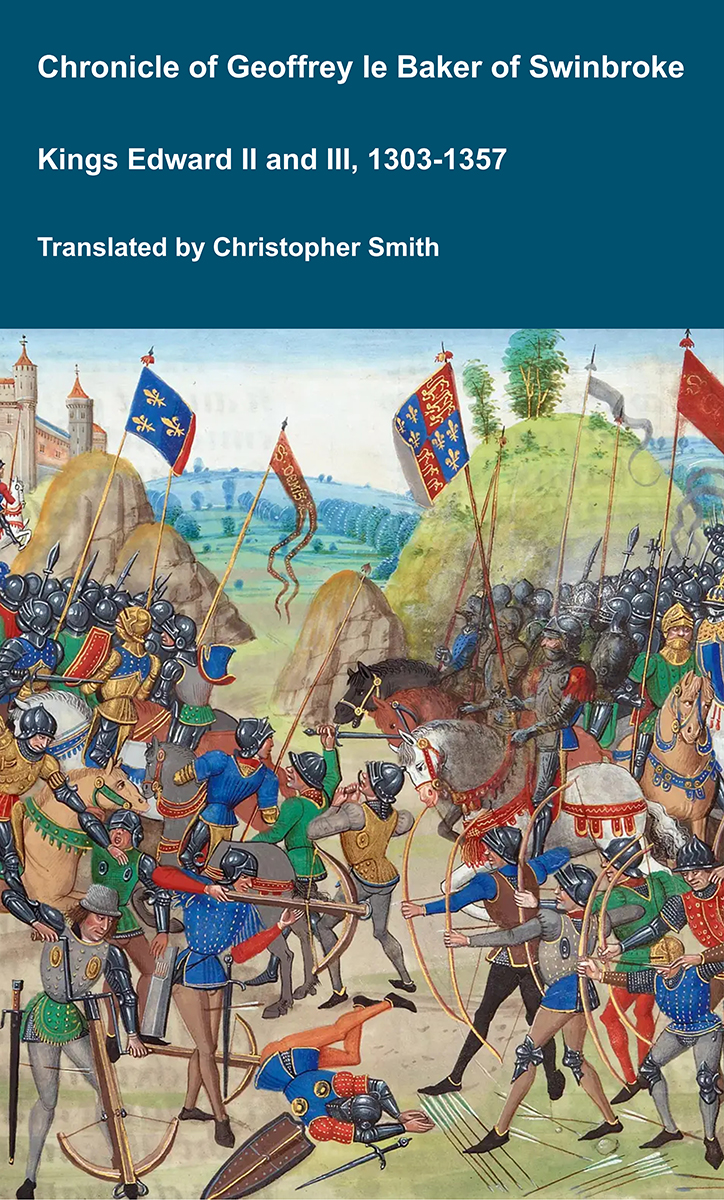
Chronicle of Geoffrey le Baker of Swinbroke
Baker was a secular clerk from Swinbroke, now Swinbrook, an Oxfordshire village two miles east of Burford. His Chronicle describes the events of the period 1303-1356: Gaveston, Bannockburn, Boroughbridge, the murder of King Edward II, the Scottish Wars, Sluys, Crécy, the Black Death, Winchelsea and Poitiers. To quote Herbert Bruce 'it possesses a vigorous and characteristic style, and its value for particular events between 1303 and 1356 has been recognised by its editor and by subsequent writers'. The book provides remarkable detail about the events it describes. Baker's text has been augmented with hundreds of notes, including extracts from other contemporary chronicles, such as the Annales Londonienses, Annales Paulini, Murimuth, Lanercost, Avesbury, Guisborough and Froissart to enrich the reader's understanding. The translation takes as its source the 'Chronicon Galfridi le Baker de Swynebroke' published in 1889, edited by Edward Maunde Thompson.
Available at Amazon in eBook and Paperback format.
In 1660 Francis Lawley 2nd Baronet [aged 30] was elected MP Much Wenlock.
On 13th July 1716 Humphrey Briggs 4th Baronet [aged 46] was elected MP Much Wenlock at a by-election. He was returned in the 1722 General Election. He stood down in 1727.