

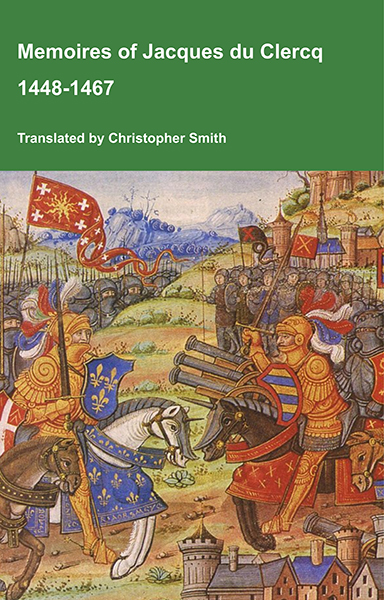
This is a translation of the 'Memoires of Jacques du Clercq', published in 1823 in two volumes, edited by Frederic, Baron de Reissenberg. In his introduction Reissenberg writes: 'Jacques du Clercq tells us that he was born in 1424, and that he was a licentiate in law and a counsellor to Philip the Good, Duke of Burgundy, in the castellany of Douai, Lille, and Orchies. It appears that he established his residence at Arras. In 1446, he married the daughter of Baldwin de la Lacherie, a gentleman who lived in Lille. We read in the fifth book of his Memoirs that his father, also named Jacques du Clercq, had married a lady of the Le Camelin family, from Compiègne. His ancestors, always attached to the counts of Flanders, had constantly served them, whether in their councils or in their armies.' The Memoires cover a period of nineteen years beginning in in 1448, ending in in 1467. It appears that the author had intended to extend the Memoirs beyond that date; no doubt illness or death prevented him from carrying out this plan. As Reissenberg writes the 'merit of this work lies in the simplicity of its narrative, in its tone of good faith, and in a certain air of frankness which naturally wins the reader’s confidence.' Du Clercq ranges from events of national and international importance, including events of the Wars of the Roses in England, to simple, everyday local events such as marriages, robberies, murders, trials and deaths, including that of his own father in Book 5; one of his last entries.
Available at Amazon in eBook and Paperback format.
MP Tavistock is in Member Parliament.
In 1547 Edward Rogers (age 49) was elected MP Tavistock.
In 1563 Richard Cooke (age 33) was elected MP Tavistock.
In 1586 John Glanville (age 44) was elected MP Tavistock.
In 1601 Henry Grey 8th Earl Kent (age 18) was elected MP Tavistock.
In 1621 Baptist Hicks 1st Viscount Campden (age 64) was elected MP Tavistock.
In 1624 Sampson Hele (age 42) was elected MP Tavistock.
In 1641 Colonel John Russell (age 21) was elected MP Tavistock in the Long Parliament.


In 1708 John Cope 6th Baronet (age 34) was elected MP Tavistock which seat he held in 1710, 1713, 1715 and 1722.
In 1715 Francis Drake 4th Baronet (age 21) was elected MP Tavistock. He was re-elected unopposed in 1722.
In 1727 John Cope 6th Baronet (age 53) was elected MP Tavistock and MP Hampshire choosing to sit for the latter.
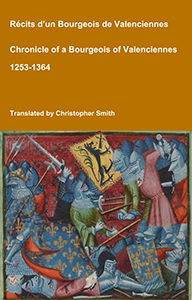
Chronicle of a Bourgeois of Valenciennes
Récits d’un bourgeois de Valenciennes aka The Chronicle of a Bourgeois of Valenciennes is a vivid 14th-century vernacular chronicle written by an anonymous urban chronicler from Valenciennes in the County of Hainaut. It survives in a manuscript that describes local and regional history from about 1253 to 1366, blending chronology, narrative episodes, and eyewitness-style accounts of political, military, and social events in medieval France, Flanders, and the Low Countries. The work begins with a chronological framework of events affecting Valenciennes and its region under rulers such as King Philip VI of France and the shifting allegiances of local nobility. It includes accounts of conflicts, sieges, diplomatic manoeuvres, and the impact of broader struggles like the Hundred Years’ War on urban life in Hainaut. Written from the perspective of a burgher (bourgeois) rather than a monastery or royal court, the chronicle offers a rare lay viewpoint on high politics and warfare, reflecting how merchants, townspeople, and civic institutions experienced the turbulence of the 13th and 14th centuries. Its narrative style combines straightforward reporting of events with moral and civic observations, making it a valuable source for readers interested in medieval urban society, regional politics, and the lived experience of war and governance in pre-modern Europe.
Available at Amazon in eBook and Paperback format.
In 1727 Francis Drake 4th Baronet (age 33) was elected MP Tavistock and MP Bere Alston. He chose to sit for Tavistock which seat he held until 1734.
In 1747 Thomas Brand (age 30) was elected MP Tavistock.
In December 1747 Richard Wrottesley 7th Baronet (age 26) was elected MP Tavistock which seat he held until 1754.
In 1852 George Byng 3rd Earl Strafford (age 21) was elected MP Tavistock.