

William of Worcester's Chronicle of England
William of Worcester, born around 1415, and died around 1482 was secretary to John Fastolf, the renowned soldier of the Hundred Years War, during which time he collected documents, letters, and wrote a record of events. Following their return to England in 1440 William was witness to major events. Twice in his chronicle he uses the first person: 1. when writing about the murder of Thomas, 7th Baron Scales, in 1460, he writes '… and I saw him lying naked in the cemetery near the porch of the church of St. Mary Overie in Southwark …' and 2. describing King Edward IV's entry into London in 1461 he writes '… proclaimed that all the people themselves were to recognize and acknowledge Edward as king. I was present and heard this, and immediately went down with them into the city'. William’s Chronicle is rich in detail. It is the source of much information about the Wars of the Roses, including the term 'Diabolical Marriage' to describe the marriage of Queen Elizabeth Woodville’s brother John’s marriage to Katherine, Dowager Duchess of Norfolk, he aged twenty, she sixty-five or more, and the story about a paper crown being placed in mockery on the severed head of Richard, 3rd Duke of York.
Available at Amazon in eBook and Paperback format.
1000-1049 Cnut is in 11th Century Events.
Anglo-Saxon Chronicle. 1001. This year there was great commotion in England in consequence of an invasion by the Danes, who spread terror and devastation wheresoever they went, plundering and burning and desolating the country with such rapidity, that they advanced in one march as far as the town of Alton [Note. Not clear whether this is Alton, Hampshire]; where the people of Hampshire came against them, and fought with them. There was slain Ethelwerd, high-steward of the king [aged 35], and Leofric of Whitchurch, and Leofwin, high-steward of the king, and Wulfhere, a bishop's thane, and Godwin of Worthy, son of Bishop Elfsy; and of all the men who were engaged with them eighty-one. Of the Danes there was slain a much greater number, though they remained in possession of the field of battle. Thence they proceeded westward, until they came into Devonshire; where Paley came to meet them with the ships which he was able to collect; for he had shaken off his allegiance to King Ethelred, against all the vows of truth and fidelity which he had given him, as well as the presents which the king had bestowed on him in houses and gold and silver. And they burned Teignton, and also many other goodly towns that we cannot name; and then peace was there concluded with them. And they proceeded thence towards Exmouth, Devon, so that they marched at once till they came to Pin-hoo; where Cole, high-steward of the king, and Edsy, reve of the king, came against them with the army that they could collect. But they were there put to flight, and there were many slain, and the Danes had possession of the field of battle. And the next morning they burned the village of Pin-hoo, and of Clist, and also many goodly towns that we cannot name. Then they returned eastward again, till they came to the Isle of Wight [Map]. The next morning they burned the town of Waltham, Essex, and many other small towns; soon after which the people treated with them, and they made peace.
Anglo-Saxon Chronicle. This year came the aforesaid army, after Easter, into East Anglia; and went up at Ipswich, Suffolk [Map], marching continually till they came where they understood Ulfcytel was with his army. This was on the day called the first of the Ascension of our Lord [5th May 1010]. The East-Angles soon fled. Cambridgeshire stood firm against them. There was slain Athelstan, the king's relative, and Oswy, and his son, and Wulfric, son of Leofwin, and Edwy, brother of Efy, and many other good thanes, and a multitude of the people. Thurkytel Myrehead first began the flight; and the Danes remained masters of the field of slaughter. There were they horsed; and afterwards took possession of East-Anglia, where they plundered and burned three months; and then proceeded further into the wild fens, slaying both men and cattle, and burning throughout the fens. Thetford, Norfolk [Map] also they burned, and Cambridge [Map]; and afterwards went back southward into the Thames; and the horsemen rode towards the ships.
Anglo-Saxon Chronicle. 1011. This year sent the king [aged 45] and his council to the army, and desired peace; promising them both tribute and provisions, on condition that they ceased from plunder. They had now overrun East-Anglia, and Essex, and Middlesex, and Oxfordshire, and Cambridgeshire, and Hertfordshire, and Buckinghamshire, and Bedfordshire, and half of Huntingdonshire, and much of Northamptonshire; and, to the south of the Thames, all Kent, and Sussex, and Hastings, and Surrey, and Berkshire, and Hampshire, and much of Wiltshire. All these disasters befel us through bad counsels; that they would not offer tribute in time, or fight with them; but, when they had done most mischief, then entered they into peace and amity with them. And not the less for all this peace, and amity, and tribute, they went everywhere in troops; plundering, and spoiling, and slaying our miserable people. In this year, between the Nativity of St. Mary and Michaelmas, they beset Canterbury, Kent [Map], and entered therein through treachery; for Elfmar delivered the city to them, whose life Archbishop Elfeah [aged 58] formerly saved. And there they seized Archbishop Elfeah, and Elfward the king's steward, and Abbess Leofruna56, and Bishop Godwin; and Abbot Elfmar they suffered to go away. And they took therein all the men, and husbands, and wives; and it was impossible for any man to say how many they were; and in the city they continued afterwards as long as they would. And, when they had surveyed all the city, they then returned to their ships, and led the archbishop with them. Then was a captive he who before was of England head and Christendom;- there might be seen great wretchedness, where oft before great bliss was seen, in the fated city, whence first to us came Christendom, and bliss 'fore God and 'fore the world. And the archbishop they kept with them until the time when they martyred him.
Note 56. "Leofruna abbatissa".-Flor. The insertion of this quotation from Florence of Worcester is important, as it confirms the reading adopted in the text. The abbreviation "abbt", instead of "abb", seems to mark the abbess. She was the last abbess of St. Mildred's in the Isle of Thanet; not Canterbury, as Harpsfield and Lambard say.
Anglo-Saxon Chronicle. 1012. This year came Earldorman Eadric Streona, and all the oldest counsellors of England, clerk and laity, to London before Easter, which was then on the ides of April; and there they abode, over Easter, until all the tribute was paid, which was 48,000 pounds. Then on the Saturday was the army much stirred against the bishop; because he would not promise them any fee, and forbade that any man should give anything for him. They were also much drunken; for there was wine brought them from the south. Then took they the bishop [aged 59], and led him to their hustings, on the eve of the Sunday after Easter, which was the thirteenth [19th April 1012] before the calends of May; and there they then shamefully killed him. They overwhelmed him with bones and horns of oxen; and one of them smote him with an axe-iron on the head; so that he sunk downwards with the blow; and his holy blood fell on the earth, whilst his sacred soul was sent to the realm of God. The corpse in the morning was carried to London; and the bishops, Ednoth and Elfhun, and the citizens, received him with all honour, and buried him in St. Paul's minster [Map]; where God now showeth this holy martyr's miracles. When the tribute was paid, and the peace-oaths were sworn, then dispersed the army as widely as it was before collected. Then submitted to the king five and forty of the ships of the enemy; and promised him, that they would defend this land, and he should feed and clothe them.
On 3rd February 1014 Sweyn "Forkbeard" King of Denmark, Norway and England [aged 54] died. His son Harald succeeded King of Denmark. There was a dispute as to who succeeded to the Kingdom of England with some supporting King Æthelred II of England [aged 48] and some King Cnut of England [aged 19].
Anglo-Saxon Chronicle. 1014. This year King Sweyne [aged 54] ended his days at Candlemas, the third day before the nones of February; and the same year Elfwy, Bishop of York, was consecrated in London, on the festival of St. Juliana. The fleet all chose Knute [aged 19] for king; whereupon advised all the counsellors of England, clergy and laity, that they should send after King Ethelred [aged 48]; saying, that no sovereign was dearer to them than their natural lord, if he would govern them better than he did before. Then sent the king hither his son Edward, with his messengers; who had orders to greet all his people, saying that he would be their faithful lord-would better each of those things that they disliked-and that each of the things should be forgiven which had been either done or said against him; provided they all unanimously, without treachery, turned to him. Then was full friendship established, in word and in deed and in compact, on either side. And every Danish king they proclaimed an outlaw for ever from England. Then came King Ethelred home, in Lent, to his own people; and he was gladly received by them all. Meanwhile, after the death of Sweyne, sat Knute with his army in Gainsborough [Map] until Easter; and it was agreed between him and the people of Lindsey, that they should supply him with horses, and afterwards go out all together and plunder. But King Ethelred with his full force came to Lindsey before they were ready; and they plundered and burned, and slew all the men that they could reach. Knute, the son of Sweyne, went out with his fleet (so were the wretched people deluded by him), and proceeded southward until he came to Sandwich, Kent [Map]. There he landed the hostages that were given to his father, and cut off their hands and ears and their noses. Besides all these evils, the king ordered a tribute to the army that lay at Greenwich, Kent [Map], of 21,000 pounds.
On 23rd April 1014 the Battle of Clontarf was fought between an army led by Brian Boru [aged 73], High King of Ireland, against a Norse-Irish alliance comprising the forces of Sigtrygg Silkbeard, King of Dublin; Máel Mórda mac Murchada, King of Leinster; and a Viking army from abroad led by Sigurd of Orkney and Brodir of Mann. The Viking army was defeated but at the cost of Brian Boru who was killed, as well as his son Muchad and grandson Tairrdelbach.
On 23rd April 1016 King Æthelred II of England [aged 50] died. His son Edmund [aged 26] succeeded I King of England although the Witan meeting at Southampton chose King Cnut of England [aged 21].
Anglo-Saxon Chronicle. After this, King Knute [aged 21] appointed Eric earl over Northumbria, as Utred was; and then went southward another way, all by west, till the whole army came, before Easter, to the ships. Meantime Edmund Etheling [aged 26] went to London to his father [aged 50]: and after Easter went King Knute with all his ships toward London; but it happened that King Ethelred died ere the ships came. He ended his days on St. George's day [23rd April 1016]; having held his kingdom in much tribulation and difficulty as long as his life continued.
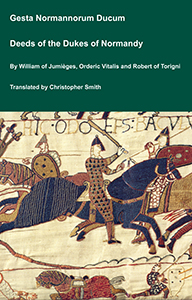
The Deeds of the Dukes of Normandy
The Gesta Normannorum Ducum [The Deeds of the Dukes of Normandy] is a landmark medieval chronicle tracing the rise and fall of the Norman dynasty from its early roots through the pivotal events surrounding the Norman Conquest of England. Originally penned in Latin by the monk William of Jumièges shortly before 1060 and later expanded at the behest of William the Conqueror, the work chronicles the deeds, politics, battles, and leadership of the Norman dukes, especially William’s own claim to the English throne. The narrative combines earlier historical sources with firsthand information and oral testimony to present an authoritative account of Normandy’s transformation from a Viking settlement into one of medieval Europe’s most powerful realms. William’s history emphasizes the legitimacy, military prowess, and governance of the Norman line, framing their expansion, including the conquest of England, as both divinely sanctioned and noble in purpose. Later chroniclers such as Orderic Vitalis and Robert of Torigni continued the history, extending the coverage into the 12th century, providing broader context on ducal rule and its impact. Today this classic work remains a foundational source for understanding Norman identity, medieval statesmanship, and the historical forces that reshaped England and Western Europe between 800AD and 1100AD.
Available at Amazon in eBook and Paperback format.
Hammaburgensis Eecclesiae Pontificum by Adam of Bremen. For three years, therefore, Cnut attacked Britain. Æthelred [aged 50]39, king of the English, besieged in London, died [23rd April 1016], losing his life along with his kingdom. And by the just judgment of God, who, after his brother had been brought to completion through martyrdom, allowed him for thirty-eight years to stain the scepter with blood, he thus paid for his fratricide, leaving behind a small son named Edward, whom he had fathered with his wife Emma.
Triennium ergo Chnut Britanniam oppugnavit. Adelrad, rex Anglorum, apud Lundonam obsessus obiit, simul cum regno amittens vitam. Et iusto iudicio Dei, qui fratre per martyrium consummato 38 annis sceptrum sanguine polluit. Is parricidium taliter expiavit, relinquens filium parvulum nomine Edwardum, quem suscepit ab Imma uxore.
Note 39. Edgar, the most powerful king of the English, had a legitimate son, Edward, a most holy man. His stepmother was Afelrud, who, having killed her step-king, made her own son king.
Edgar, potentissimus rex Anglorum, a legitima filium habuit Edwardum, virum sanctissimum. Cuius noverca Afelrud fuit, quae regem privignum occidens, filium suum eundem in regem posuit.
After 23rd April 1016 King Edmund "Ironside" I of England [aged 26] was crowned I King of England by Archbishop Ælfstan aka Lyfing. His reign lasted seven months.
Anglo-Saxon Chronicle. 1016. After his decease, all the peers that were in London, and the citizens, chose Edmund king [aged 26]; who bravely defended his kingdom while his time was. Then came the ships to Greenwich, Kent [Map], about the gang-days, and within a short interval went to London; where they sunk a deep ditch on the south side, and dragged their ships to the west side of the bridge. Afterwards they trenched the city without, so that no man could go in or out, and often fought against it: but the citizens bravely withstood them. King Edmund had ere this gone out, and invaded the West-Saxons, who all submitted to him; and soon afterward he fought with the enemy at Pen near Gillingham.
Anglo-Saxon Chronicle. [25th June 1016] A second battle he fought, after midsummer, at Sherston, Wiltshire [Map]; where much slaughter was made on either side, and the leaders themselves came together in the fight. Earldorman Eadric Streona and Aylmer the darling were assisting the army against King Edmund. Then collected he his force the third time, and went to London, all by north of the Thames, and so out through Clayhanger, and relieved the citizens, driving the enemy to their ships.
Economium Emmae Reginae. [25th June 1016] Then Thorkell, seeing that the time had come when he could prove his faithfulness to his lord, said: "I myself will take charge of this battle for my lord with my own men. Shall I allow my king, young and fiery as he is, to be drawn into this fight? For if I am victorious, I shall triumph for my king; but if I fall, or should I turn my back in flight, the English will gain no great glory from it, since the king will still survive, he who will renew the battle and, perhaps as victor, avenge my injuries." Since this seemed the counsel of sound judgment to all, and the king gave his consent, Thorkell disembarked with his men, drawing up his forces against the attack of the English, who had gathered in a place called Scorastan [Sherston, Wiltshire [Map]]. A host of more than forty ships of Danes went ashore; yet even this number was not equal to half that of the enemy. But their leader, trusting more in valour than in numbers, wasted no time: he sounded the trumpets, advanced at the forefront, and ever in his heart implored the help of God, cutting down with his sword's edge all who opposed him. At first the English, being stronger, slaughtered the Danes with terrible carnage, so that they had almost won the victory and were forcing their foes to flee, had not the general's exhortation restrained them, and, reminding them of their courage, made them ashamed to flee. For he reminded them that flight was impossible: the enemy held the land, and their ships lay far from the shore; therefore, if they did not conquer, they must all perish together. At this, their spirits rose; and in the battle they soon showed how dangerous desperation can be. Indeed, having despaired of flight, they raged so furiously against the enemy that one might see not only the bodies of the dead falling, but even the living staggering under blows they could scarcely parry. At length, therefore, they won the longed-for victory, and buried the bodies of their comrades as best they could find them. Then, stripping the spoils from the slain, they returned, and began preparing to invade the surrounding region.
Tunc Turkil tempus intuens instare, quo fidelitatem suam domino suo valebat patefacere: Ego inquit hoc certamen domino meo accurabo cum meis evincere, nec regem meum ad bellandum, utpote iuvenem ferventissimum, huic misceri patiar pugnae? Nam si victor fuero, regi ipsi triumphabo; si autem cecidero sive tergum dedero, non Anglis glorias erit adeo, quia rex supererit, qui et proelium restaurabit et fortasse victor meas iniurias vindicabit. Hoc dictum cum sanae mentis esse videretur omnibus, annuente rege ascendit cum suis e navibus, dirigens aciem contra Anglorum inpetum, qui tunc in loco Scorastan dicto fuerat congregatus. Quadraginta denique navium et eo amplius Danorum exercitus ascenderat, sed adhuc hic numerus medietati hostium minime par fuerat. At dux eorum, magis fisus virtute quam multitudine, omnes rumpens morulas classica insonuit, gradiens in prima fronte, et mente semper Dei auxilium exorans, queque obvia metebat mucronis acie. Angli vero in primis fortiores, dira cede Danos obtruncarunt, in tantum ut paene victoriam adepti adversarios fugere cogerent, si non ducis alloquio retenti memoresque virtutis fugam erubescerent. Namque memorabat ille abesse diffugium, in terra scilicet hostes, et a litore longe remotas pupes, ideoque si non vincerent, quod pariter occumbere deberent. Unde illi animosiores effecti, in praelio ilico manifestant, quam periculosa sit desperatio. Enimvero de refugio fugae desperati, tanta in hostes debachati sunt insania, ut non tantum mortuorum aspiceres corpora cadentia, verum etiam vivorum ictus declinantia. Tandem ergo potiti optata victoria, suorum quae reperire poterant tumulabant membra. Ab adversariis quoque diripientes spolia revertuntur, et adiacentem regionem invadendam accinguntur.
Anglo-Saxon Chronicle. After 23rd June 1016. It was within two nights after that the king [aged 26] went over at Brentford [Map]; where he fought with the enemy, and put them to flight: but there many of the English were drowned, from their own carelessness; who went before the main army with a design to plunder. After this the king went into Wessex, and collected his army; but the enemy soon returned to London, and beset the city without, and fought strongly against it both by water and land. But the almighty God delivered them.
Around August 1017 King Cnut of England [aged 22] and Emma aka Ælfgyfu of Normandy Queen Consort England [aged 32] were married. She the daughter of Richard "Fearless" Normandy I Duke Normandy and Gunnora Countess Ponthieu. He the son of Sweyn "Forkbeard" King of Denmark, Norway and England.
History of the Dukes of Normandy by William of Jumieges. The king [Cnut], having been victorious, returned to his ships with his men. Then, moving forward with swift confidence, he besieged London. Within the city King Æthelred lay gravely ill, and as his bodily sickness worsened, he soon departed this life [on 23rd April 1016.]. King Cnut, therefore, when he heard of the king's death, taking counsel with his faithful followers and providing for the future, after a few days had the queen Emma brought out of the city and lawfully united her to himself in Christian marriage1, giving to the whole army, in gold and silver, the value corresponding to her person.
Rex vero victor effectus, ad naves suas cum suis est reversus. Hinc celeri se movens fiducia, Lundoniam circumdat obsidione. Quam intra urbem Eldredus rex graviter ægrotavit, et, crudescente morbo corporis, non multo post hominem exivit. Rex igitur Chunutus, audita morte regis, consultu fidelium suoruin præcavens in futurum, Emmam reginam abstractam ab urbe post aliquot dies sibi junxit christiano more, dans pro illa cuncto exercitui in auro et argento pensum illius corporis.
Note 1. The Economium Emmae Reginae, Book 2, Chapter 16, gives a somewhat more romantic account of the marriage: "When therefore all other things had been duly ordered, nothing was lacking to the king save a most noble consort. He therefore commanded that she be sought everywhere, that when she were found, he might lawfully win her and make her the partner of his realm. Accordingly, search was made through kingdoms and cities, and a royal bride was sought; but though sought far and wide, at length, and hardly, was one found worthy of him. And this imperial bride was discovered on the borders of Gaul, especially in the Norman land, most noble both by lineage and by wealth, yet above all distinguished by the charm of her beauty and prudence, the wisest of all women of her time, in short, a renowned queen. Because of such excellence she was greatly desired by the king, and the more for this reason, that she was born of a conquering race, which had won for itself a part of Gaul against the will of the French and their prince. Why dwell on this at length? Envoys were sent to the lady; royal gifts were sent; and entreating words were sent as well. But she refused, saying that she would never become the wife of Cnut, unless he would swear by oath that he would never cause the son of any other wife to reign after him, but only the son she herself might bear him, if God should grant him one. For the king was said to have had sons by another woman; wherefore she, prudently providing for her own, with wise foresight ordained what would turn to their advantage. The word of the maiden pleased the king, and the oath being taken, the will of the maiden likewise pleased the king; and so, thanks be to God, the lady Emma, most noble among women, became the bride of the most mighty king Cnut. Then Gaul rejoiced, and the land of the English rejoiced also, when such a glory was carried across the seas. Gaul rejoiced, I say, that she had brought forth one so worthy of so great a king; and the land of the English rejoiced that it had received her into its cities. O event a thousand times desired, at length brought to pass by the favouring grace of the Savior! For this it was which both nations had long and fervently desired, that such greatness should be joined to such greatness, and worth to worth, in the marital bond that would at last still the tumults of war. For what greater or more to be desired thing could be hoped for, than that the ruinous and unprofitable toils of war should be ended by the calm tranquility of peace, when now one side, now the other, by the changing chances of battle, had conquered, yet not without great harm to themselves?"
Economium Emmae Reginae. When therefore all other things had been duly ordered, nothing was lacking to the king save a most noble consort. He therefore commanded that she be sought everywhere, that when she were found, he might lawfully win her and make her the partner of his realm. Accordingly, search was made through kingdoms and cities, and a royal bride was sought; but though sought far and wide, at length, and hardly, was one found worthy of him. And this imperial bride was discovered on the borders of Gaul, especially in the Norman land, most noble both by lineage and by wealth, yet above all distinguished by the charm of her beauty and prudence, the wisest of all women of her time, in short, a renowned queen. Because of such excellence she was greatly desired by the king, and the more for this reason, that she was born of a conquering race, which had won for itself a part of Gaul against the will of the French and their prince. Why dwell on this at length? Envoys were sent to the lady; royal gifts were sent; and entreating words were sent as well. But she refused, saying that she would never become the wife of Cnut, unless he would swear by oath that he would never cause the son of any other wife to reign after him, but only the son she herself might bear him, if God should grant him one. For the king was said to have had sons by another woman; wherefore she, prudently providing for her own, with wise foresight ordained what would turn to their advantage. The word of the maiden pleased the king, and the oath being taken, the will of the maiden likewise pleased the king; and so, thanks be to God, the lady Emma, most noble among women, became the bride of the most mighty king Cnut. Then Gaul rejoiced, and the land of the English rejoiced also, when such a glory was carried across the seas. Gaul rejoiced, I say, that she had brought forth one so worthy of so great a king; and the land of the English rejoiced that it had received her into its cities. O event a thousand times desired, at length brought to pass by the favoring grace of the Savior! For this it was which both nations had long and fervently desired, that such greatness should be joined to such greatness, and worth to worth, in the marital bond that would at last still the tumults of war. For what greater or more to be desired thing could be hoped for, than that the ruinous and unprofitable toils of war should be ended by the calm tranquility of peace, when now one side, now the other, by the changing chances of battle, had conquered, yet not without great harm to themselves?
Omnibus itaque rite dispositis, nil regi defuit absque nobilissima coniuge; quam ubique sibi iussit inquirere, ut inventam hanc legaliter adquireret, et adeptam imperii sui consortem faceret. Igitur per regna et per urbes discurritur, et regalis sponsa perquiritur; sed longe lateque quaesite, vix tandem digna repperitur. Inventa est vero haec imperialis sponsa in confinitate Galliae et praecipue in Normandensi regione, stirpe et opibus ditissima, sed tamen pulchritudinis et prudentiae delectamine omnium eius temporum mulierum prudentissima, utpote regina famosa. Propter huiuscemodi insignia multum appetebatur a rege, et pro hoc precipue quod erat oriunda ex victrici gente, que sibi partem Gallie vendicaverat invitis Francigenis et eorum principe. Quid multis immoror? Mittuntur proci ad dominam, mittuntur dona regalia, mittuntur et verba precatoria. Sed abnegat illa, se unquam Chnutonis sponsam fieri, nisi illi iusiurando affirmaret, quod nunquam alterius coniugis filium post se regnare faceret nisi eius, si forte ille Deus ex eo filium dedisset. Dicebatur enim ab alia quadam rex filios habuisse; unde illa suis prudenter providens, scivit ipsis sagaci animo profutura preordinare. Placuit ergo regi verbum virginis, et iusiurando facto virgini placuit voluntas regis; et sic Deo gratis domina Emma mulierum nobilissima fit coniunx regis fortissimi Cnutonis. Letatur Gallia, letatur etiam Anglorum patria, dum tantum decus transvehitur per aequora. Letatur, inquam, Gallia tantam tanto regi dignam se enixam; Anglorum vero letatur patria, talem se recepisse in oppida. O res millenis milies petita votis, vixque tandem effecta auspicante gratia Salvatoris. Hoc erat quod utrobique vehementer iam dudum desideraverat exercitus, scilicet ut tanta tanto, digna etiam digno,maritali convinculata iugo, bellicos sedaret motus. Quid enim maius ac desiderabilius esse posset in votis, quam dampnosos ingratosque labores belli placida finiri tranquillitate pacis, cum pares paribus vi corporis virtuteque animi concurrerent, cumque nunc hi nunc vero illi alternante casu belli non sine magno detrimento sui vincerent?
In 1017 King Cnut of England [aged 22] was crowned King of England by Archbishop Ælfstan aka Lyfing.
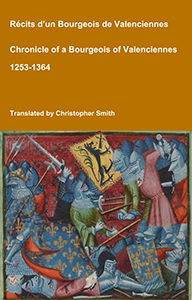
Chronicle of a Bourgeois of Valenciennes
Récits d’un bourgeois de Valenciennes aka The Chronicle of a Bourgeois of Valenciennes is a vivid 14th-century vernacular chronicle written by an anonymous urban chronicler from Valenciennes in the County of Hainaut. It survives in a manuscript that describes local and regional history from about 1253 to 1366, blending chronology, narrative episodes, and eyewitness-style accounts of political, military, and social events in medieval France, Flanders, and the Low Countries. The work begins with a chronological framework of events affecting Valenciennes and its region under rulers such as King Philip VI of France and the shifting allegiances of local nobility. It includes accounts of conflicts, sieges, diplomatic manoeuvres, and the impact of broader struggles like the Hundred Years’ War on urban life in Hainaut. Written from the perspective of a burgher (bourgeois) rather than a monastery or royal court, the chronicle offers a rare lay viewpoint on high politics and warfare, reflecting how merchants, townspeople, and civic institutions experienced the turbulence of the 13th and 14th centuries. Its narrative style combines straightforward reporting of events with moral and civic observations, making it a valuable source for readers interested in medieval urban society, regional politics, and the lived experience of war and governance in pre-modern Europe.
Available at Amazon in eBook and Paperback format.
In 1018 the Battle of Carham aka Coldstream was fought between the combined forces Malcolm I King Alba and Owen "The Bald" Strathclyde against Eadwulf "Cudel" Northumbria Earl Bernicia who was defeated. The outcome of the battle was to fix the Scottish border at the River Tweed.
Anglo-Saxon Chronicle. 1026. This year went King Knute [aged 31] to Denmark with a fleet to the holm by the holy river; where against him came Ulf and Eglaf, with a very large force both by land and sea, from Sweden. There were very many men lost on the side of King Knute, both of Danish and English; and the Swedes had possession of the field of battle.
In 1030 King Olaf "Stout" II of Norway [aged 35] was killed at Stiklestad during the Battle of Stiklestad.
Chronicon ex Chronicis by Florence and John of Worcester. 1035. Robert, duke of Normandy [aged 35], died, and was succeeded by his son William the Bastard [aged 7], then a minor.
History of the Dukes of Normandy by William of Jumieges. Then the duke, unwilling [to leave], devout, and beloved of God, after worshiping Christ with inward sobbing sighs, and after visiting the holy places of the Saints, turned back on his blessed journey and returned to the city of Nicaea. There he was seized by bodily illness, and in the year 1035 from the Lord's Incarnation, following the path appointed for all mankind, he fell asleep at the summons of the divine call, with the angels rejoicing, on the sixth day before the Nones of July [2nd July 1035].
Porro, invitus dux, pius et Deo amabilis, adorato Christo cum internorum singultuum suspiriis, et peragratis Sanctorum locis, felicissimum convertens iter, ad Nicænam regressus est urbem. In qua correptus ægrimonia corporis, millesimo tricesimo quinto ab Incarnatione Domini anno, viam petens universi generis humani, gaudentibus angelis, divinæ vocationis jussu in fine occubuit VI Nonas Julii.
On 2nd July 1035 Robert "Magnificent" Normandy I Duke Normandy [aged 35] died at Nicaea. His son William [aged 7] succeeded II Duke Normandy.
On 12th November 1035 King Cnut of England [aged 40] died at Shaftesbury, Dorset. His son Harold [aged 19] succeeded King of England.
King Harthacnut of Denmark and England [aged 17] succeeded King of Denmark.
Anglo-Saxon Chronicle. 1035. This year died King Knute [aged 40] at Shaftesbury, Dorset, on the second day before the ides of November; and he is buried at Winchester Old Minster in the old minster. He was king over all England very near twenty winters. Soon after his decease, there was a council of all the nobles at Oxford; wherein Earl Leofric, and almost all the thanes north of the Thames, and the naval men in London, chose Harold [aged 19] to be governor of all England, for himself and his brother Hardacnute [aged 17], who was in Denmark. Earl Godwin [aged 34], and all the eldest men in Wessex, withstood it as long as they could; but they could do nothing against it. It was then resolved that Elfgiva [aged 45], the mother of Hardacnute [Note. Aelfgifu Northumbria is the mother of Harold "Harefoot" King England, Emma aka Ælfgyfu of Normandy Queen Consort England [aged 50] is the mother of King Harthacnut of Denmark and England], should remain at Winchester with the household of the king her son. They held all Wessex in hand, and Earl Godwin was their chief man. Some men said of Harold, that he was the son of King Knute and of Elfgive the daughter of Alderman Elfelm; but it was thought very incredible by many men. He was, nevertheless, full king over all England. Harold himself said that he was the son of Knute and of Elfgive the Hampshire lady; though it was not true; but he sent and ordered to be taken from her all the best treasure that she could not hold, which King Knute possessed; and she nevertheless abode there continually within the city as long as she could.
Chronicon ex Chronicis by Florence and John of Worcester. [12th November 1035] Canute [aged 40], king of England, before his death, gave the kingdom of Norway to Sweyn, who was reported to be his son by Elfgiva of Northampton [aged 45] [Note. Possibly a mistake for Northumberland?], the daughter of Alfhelm the ealdorman, and the noble lady Wulfruna. Some, however, asserted that this Elfgiva desired to have a son by the king, but as she could not, she caused the new-born child of a certain priest to be brought to her, and made the king fully believe that she had just borne him a son. He also gave the kingdom of Denmark to Hardicanute [aged 17], his son by the queen Elfgiva [aged 50]. Afterwards, the same year, he departed this life at Shaftesbury on Wednesday, the second of the ides [the 12th] of November; but he was buried at Winchester in the Old Minster, with due honours. After his burial the queen Elfgiva took up her abode there. Harold [aged 19] also said that he was the son of king Canute and Elfgiva of Northampton, although that is far from certain; for some say that he was the son of a cobbler, and that Elfgiva had acted with regard to him as she had done in the case of Sweyn: for our part, as there are doubts on the subject, we cannot settle with any certainty the parentage of either. Harold, however, assuming the royal dignity, sent his guards in the utmost haste to Winchester, and tyrannically seized the largest and best part of the treasure and wealth which king Canute had bequeathed to queen Elfgiva, and having thus robbed her, permitted her to continue her residence at Winchester. He then, with the consent of many of the higher orders of England, began to reign as though he was the lawful heir; but he had not the same power as Canute, because the arrival of Hardicanute, the more rightful heir, was looked for. Hence, shortly afterwards, the kingdom was divided by lot, Harold getting the northern, and Hardicanute the southern portion.
Economium Emmae Reginae. Thus so great a king, after he had returned from Rome, and for a time had remained in his own realm, having ordered all things well, passed to the Lord [12th November 1035], to be crowned on the right hand by the very Lord, the Author of all things. All who heard of his death were troubled and grieved, but most of all those who had served at his throne, of whom the greater part would gladly have died with him, had this not displeased the divine will.
Queen Emma [aged 50], his lady, mourned with her people; the poor wailed with the powerful, the bishops and clergy wept with the monks and nuns. But as much as he was lamented on earth, so much is he rejoiced over in the palace of heaven. These wept for that which they had lost; those rejoice for the soul they have received. These buried the lifeless body; those bear the spirit on high, to rejoice in eternal rest. For his passing, earthly mortals wept alone; but for his soul, let even the citizens of heaven intercede together with those on earth. That his glory may grow day by day, let us pray to God earnestly; and since he earned this by his goodness, let us cry aloud continually: "May the soul of Cnut rest in peace. Amen."
Lugebat domina Emma eius regina cum patriensibus, ululabant pauperes cum potentibus, flebant episcopi et clerici cum monachis et sanctimonialibus; sed quantum lugebatur in mundo, tantum laetatur in caeli palatio. Isti flebant hoc quod perdiderant, illi gratulentur de eius anima quam suscipiant. Isti sepelierunt corpus exanime, illi spiritum deducant in sublime, letandum in aeterna requie. Pro eius transitu soli flebant terreni, sed pro eius spiritu interveniant cum terrenis etiam cives caelici. Ut eius gloria crescat cotidie, oremus Deum intente; et quia hoc promeruit sua bonitate, cotidie clamemus: Anima Cnutonis requiescat in pace. Amen.
Tantus itaque rex postquam Roma est reversus, et in proprio regno aliquantisper demoratus, omnibus bene dispositis transiit ad Dominum, coronandus in parte dextera ab ipso Domino auctore omnium. Turbabantur itaque eius obitu omnes qui audierant, maximeque qui eius solio deservierant, quorum maxima pars cuperet ei commori, si hoc non displiceret divinae dispositioni.
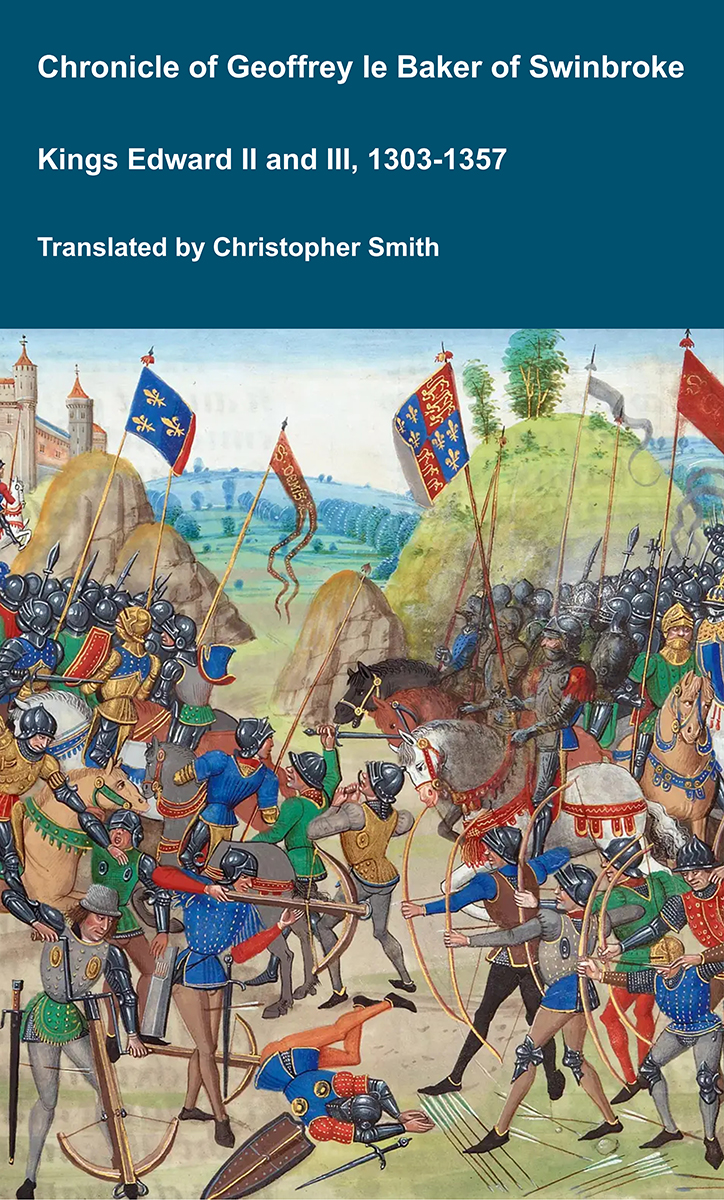
Chronicle of Geoffrey le Baker of Swinbroke
Baker was a secular clerk from Swinbroke, now Swinbrook, an Oxfordshire village two miles east of Burford. His Chronicle describes the events of the period 1303-1356: Gaveston, Bannockburn, Boroughbridge, the murder of King Edward II, the Scottish Wars, Sluys, Crécy, the Black Death, Winchelsea and Poitiers. To quote Herbert Bruce 'it possesses a vigorous and characteristic style, and its value for particular events between 1303 and 1356 has been recognised by its editor and by subsequent writers'. The book provides remarkable detail about the events it describes. Baker's text has been augmented with hundreds of notes, including extracts from other contemporary chronicles, such as the Annales Londonienses, Annales Paulini, Murimuth, Lanercost, Avesbury, Guisborough and Froissart to enrich the reader's understanding. The translation takes as its source the 'Chronicon Galfridi le Baker de Swynebroke' published in 1889, edited by Edward Maunde Thompson.
Available at Amazon in eBook and Paperback format.
In 1036 Ælfred Ætheling Wessex [aged 31] returned to England where he and his men were met by Godwin 1st Earl Kent and Wessex [aged 35] at Guildford, Surrey [Map]; ostensibly friendly. The following day, however, Godwin Godwinson 1st Earl Kent, Earl Wessex 1001-1053's men attacked Aelfred's men murdering most of them. Aelfred was taken to Ely [Map] where he was blinded and died shortly thereafter.
Anglo-Saxon Chronicle. 1036. This year came hither Alfred the innocent etheling [aged 31], son of King Ethelred, and wished to visit his mother [aged 51], who abode at Winchester: but Earl Godwin [aged 35], and other men who had much power in this land, did not suffer it; because such conduct was very agreeable to Harold [aged 20], though it was unjust.
Him did Godwin let, and in prison set. His friends, who did not fly, they slew promiscuously. And those they did not sell, like slaughter'd cattle fell! Whilst some they spared to bind, only to wander blind! Some ham-strung, helpless stood, whilst others they pursued. A deed more dreary none in this our land was done, since Englishmen gave place to hordes of Danish race. But repose we must in God our trust, that blithe as day with Christ live they, who guiltless died- their country's pride! The prince with courage met each cruel evil yet; till 'twas decreed, they should him lead, all bound, as he was then, to Ely-bury fen. But soon their royal prize bereft they of his eyes! Then to the monks they brought their captive; where he sought a refuge from his foes till life's sad evening close. His body ordered then these good and holy men, according to his worth, low in the sacred earth, to the steeple full-nigh, in the south aile to lie of the transept west- his soul with Christ doth rest.
Chronicon ex Chronicis by Florence and John of Worcester. 1036. At the same time he dispersed some of his attendants, others he put in fetters and afterwards deprived of their sight, some he scalped and tortured, amputated their hands and feet and heavily mulcted [extracted money]: many he ordered to be sold, and put to death six hundred of them at Guildford, Surrey [Map] with various torments: but we trust that the souls of those, who, guilty of no crime, had their bodies so cruelly slaughtered in the fields, are now rejoicing with the saints in paradise. On hearing of this, queen Elgiva [aged 51] sent back her son Edward [aged 33], who had remained with her, in all haste to Normandy. Then, by order of Godwin [aged 35] and others, Alfred [aged 31] was conducted, heavily chained, to the Isle of Ely [Map]; but as soon as the ship touched the land, his eyes were most barbarously plucked out while he was on board, and in this state he was taken to the monastery [Map] and handed over to the custody of the monks. There he shortly afterwards died, and his body was buried, with due honours, in the south porch at the west end of the church [Map]; but his spirit is in the enjoyment of the delights of paradise.
Economium Emmae Reginae. 1036. 3.6. Since we have now briefly recounted the struggles of his soldiers, it remains that we should also narrate the martyrdom of their leader, the glorious Alfred; yet let us shorten our speech, lest perchance, if we were to describe in detail all that was done to him, we should multiply the sorrow of many, and most of all, of you, lady queen. Therefore I beg you, lady, do not ask to hear more than what, out of pity for your grief, we shall relate briefly. For much might be said, were we not sparing your sorrow; for truly there is no greater pain for a mother than to see, or even to hear of, the death of her most beloved son. The royal youth was therefore seized secretly in his lodging, and led away into the island called Ely, where he was first mocked by a most wicked soldier. Then were chosen men of yet baser sort, that by their cruelty the lamented youth might be condemned. And these judges decreed that, in contempt, his two eyes should be torn out. When they prepared to carry out the deed, two men were set upon his arms, to hold them, and one upon his breast, another upon his legs, that the punishment might thus be inflicted the more easily. Why do I linger amid such pain? My pen itself trembles as I write, for I shudder to recall what that most blessed youth endured. Let me therefore pass swiftly over the misery of so great a calamity, and touch but briefly upon the end of his martyrdom. For he was held fast by the impious, and, his eyes cruelly gouged out, was slain with utmost wickedness. When the murder was done, they left his lifeless body, which the faithful servants of Christ, the monks of that same island of Ely, took up and buried honourably. At the place of his burial many miracles occur, as some affirm, indeed, those who often say they themselves have seen them. And rightly so: for, being innocently martyred, it is fitting that through him the power of innocence should be exercised. Let therefore Queen Emma rejoice in so great an intercessor, for she who once had a son upon earth now has in heaven a patron.
Ergo quia militum agones succintim transcurrimus, superest ut et eorum principis, gloriosi scilicet Alfridi, martyrium narrando, seriem locutionis adbrevimus, ne forte si singulatim omnia quae ei acta sunt perstringere voluerimus, multis tibique precipue dominae reginae dolorem multiplicemus. Qua in re rogo te, domina, ne requiras amplius quam hoc, quod tibi parcendo breviter dicturi simus. Possent enim multa dici, si non tuo parceremus dolori. Est quippe nullus dolor maior matri, quam videre vel audire mortem dilectissimi filii. Captus est igitur regius iuvenis clam suo in hospicio, eductusque in insula Heli dicta, a milite primum inrisus est iniquissimo. Deinde contemptibiliores eliguntur, ut horum ab insania flendus iuvenis diiudicetur. Qui iudices constituti decreverunt, illi debere oculi utrique ad contemptum primum erui. Quod postquam parant perficere, duo illi super brachia ponuntur, qui interim tenerent illa, et unus super pectus unusque super crura, ut sic facilius illi inferretur poena. Quid hoc in dolore detineor? Mihi ipsi scribenti tremit calamus, dum horreo quae iuvenis passus est beatissimus. Evadam ergo brevius tantae calamitatis miseriam, finemque huius martyrii finetenus perstringam. Namque est ab impiis tentus, effossis etiam luminibus inpiissime est occisus. Qua nece perfecta, relinquunt corpus exanime, quod fideles Christi, monachi scilicet eiusdem insulae Heli, rapientes sepelierunt honorifice. In loco autem sepulcri eius multa fiunt miracula, ut quidam aiunt, qui etiam se haec vidisse saepissime dicunt. Et merito. Innocenter enim fuit martyrizatus, ideoque dignum est ut per eum innocencium exercreatur virtus. Gaudeat igitur Emma regina de tanto intercessore, quia quem quondam in terris habuit filium, nunc habet in caelis patronum.
5th March 1039 at the battle of Battle of Rhyd y groes Edwine Mercia was killed by the Welsh.
Chronicon ex Chronicis by Florence and John of Worcester. 1039. Brihtmar, bishop of Lichfield, died, and was succeeded by Wulfsy. The Welsh slew [Battle of Rhyd y Groes] Edwin, earl Leofric's brother, with Turkill and Ælfgeat, son of Eatsy, two noble king's thanes, and many others at the same time. Hardicanute [aged 21], king of Denmark, sailed to Flanders, on a visit to his mother, Elfgiva [aged 54].
Anglo-Saxon Chronicle. 5th March 1039. The Welsh slew Edwin, brother of Earl Leofric, and Thurkil, and Elfget, and many good men with them.
On 29th May 1040 Renauld I Count of Nevers [aged 35] was killed at the Battle of Seignelay against Robert I Duke Burgundy [aged 29]. His son William [aged 10] succeeded Count Nevers.
Chronicon ex Chronicis by Florence and John of Worcester. 12th November 1041. They arrived there [Worcester [Map]] on the second of the ides [the 12th] of November, and beginning their work of destruction through the city and province continued it for four days; but very few of the citizens or provincials were taken or slain, because, having notice of their coming, the people fled in all directions. A great number of the citizens took refuge in a small island, called Beverege, situated in the middle of the river Severn, and having fortified it, defended themselves so stoutly against their enemies that they obtained terms of peace, and were allowed free liberty to return home. On the fifth day, the city having been burnt, every one marched off loaded with plunder, and the king's wrath was satisfied. Soon afterwards, Edward [aged 38], son of Ethelred the late king of England, came over from Normandy, where he had been an exile many years, and being honourably received by his brother1, king Hardicanute [aged 23], remained at his court.
Note 1. Half-brother. Both sons of Emma aka Ælfgyfu of Normandy Queen Consort England [aged 56].
On 8th June 1042 King Harthacnut of Denmark and England [aged 24] died. His half brother Edward [aged 39] succeeded King of England.
Anglo-Saxon Chronicle. 8th June 1042. This year died King Hardacnute [aged 24] at Lambeth, as he stood drinking: he fell suddenly to the earth with a tremendous struggle; but those who were nigh at hand took him up; and he spoke not a word afterwards, but expired on the sixth day before the ides of June. He was king over all England two years wanting ten nights; and he is buried in the old minster at Winchester with King Knute his father. And his mother for his soul gave to the new minster the head of St. Valentine the Martyr: and ere he was buried all people chose Edward [aged 39] for king in London. And they received him as their king, as was natural; and he reigned as long as God granted him. All that year was the season very severe in many and various respects: both from the inclemency of the weather, and the loss of the fruits of the earth. More cattle died this year than any man ever remembered, either from various diseases, or from the severity of the weather. At this same time died Elfsinus, Abbot of Peterborough; and they chose Arnwy, a monk, for their abbot; because he was a very good and benevolent man.
Chronicon ex Chronicis by Florence and John of Worcester. 1042. Hardicanute [aged 24], king of England, while he was present at a joyous feast given at a place called Lambeth, Surrey [Map], by Osgod Clapa, a man of great wealth, on occasion of his giving the hand of his daughter Githa in marriage to Tovi, surnamed Prudan, a noble and powerful Dane,—and carousing, full of health and merriment, with the bride and some others, fell down, by a sad mischance, while in the act of drinking, and continued speechless until Tuesday the sixth of the ides [the 8th] of June, when he expired. He was carried to Winchester and buried near his father Canute. His brother Edward [aged 39] was proclaimed king at London, chiefly by the exertions of earl Godwin [aged 41], and Living, bishop of Worcester. Edward was the son of Ethelred, who was the son of Edgar, who was the son of Edmund, who was the son of Edward the Elder, who was the son of Alfred.
On 3rd April 1043 King Edward "The Confessor" of England [aged 40] was crowned King of England at Winchester Cathedral [Map] by Archbishop Eadsige.
Chronicon ex Chronicis by Florence and John of Worcester. 1043. Edward [aged 40] was anointed king at Winchester on the first day of Easter, being the third of the nones [the 3rd] of April, by Eadsige, archbishop of Canterbury, Jilric, archbishop of York, and nearly all the bishops of England. In the same year, fourteen days before the feast-day of St. Andrew the apostle [16th November], the king went suddenly and unexpectedly from the city of Gloucester to Winchester, accompanied by the earls Godwin [aged 42], Leofric, and Siward [aged 33]; and by their advice took from his mother [aged 58] all the gold, silver, jewels, precious stones, and other valuables she possessed, because she had been less liberal to him than he expected, and had treated him harshly both before and after he was king. Notwithstanding, he gave orders for her being supplied with all necessaries, and ordered her to remain there quiet.
Anglo-Saxon Chronicle. 3rd April 1043. This year was Edward [aged 40] consecrated king at Winchester [Map], early on Easter-day, with much pomp. Then was Easter on the third day before the nones of April. Archbishop Edsy consecrated him, and before all people well admonished him. And Stigand the priest was consecrated bishop over the East Angles. And this year, fourteen nights before the mass of St. Andrew, it was advised the king, that he and Earl Leofric and Earl Godwin [aged 42] and Earl Siward [aged 33] with their retinue, should ride from Gloucester to Winchester unawares upon the lady [aged 58]; and they deprived her of all the treasures that she had; which were immense; because she was formerly very hard upon the king her son, and did less for him than he wished before he was king, and also since: but they suffered her to remain there afterwards. And soon after this the king determined to invest all the land that his mother had in her hands, and took from her all that she had in gold and in silver and in numberless things; because she formerly held it too fast against him. Soon after this Stigand was deprived of his bishopric; and they took all that he had into their hands for the king, because he was highest the counsel of his mother; and she acted as he advised, as men supposed.
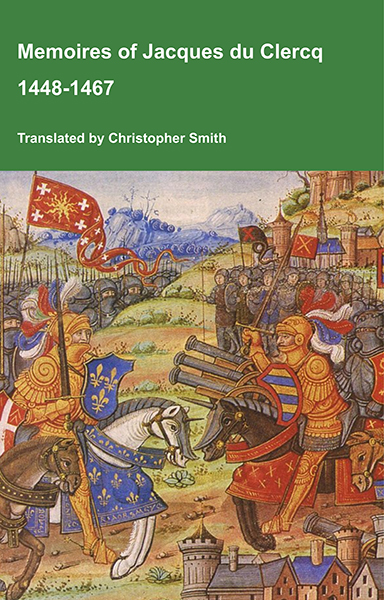
This is a translation of the 'Memoires of Jacques du Clercq', published in 1823 in two volumes, edited by Frederic, Baron de Reissenberg. In his introduction Reissenberg writes: 'Jacques du Clercq tells us that he was born in 1424, and that he was a licentiate in law and a counsellor to Philip the Good, Duke of Burgundy, in the castellany of Douai, Lille, and Orchies. It appears that he established his residence at Arras. In 1446, he married the daughter of Baldwin de la Lacherie, a gentleman who lived in Lille. We read in the fifth book of his Memoirs that his father, also named Jacques du Clercq, had married a lady of the Le Camelin family, from Compiègne. His ancestors, always attached to the counts of Flanders, had constantly served them, whether in their councils or in their armies.' The Memoires cover a period of nineteen years beginning in in 1448, ending in in 1467. It appears that the author had intended to extend the Memoirs beyond that date; no doubt illness or death prevented him from carrying out this plan. As Reissenberg writes the 'merit of this work lies in the simplicity of its narrative, in its tone of good faith, and in a certain air of frankness which naturally wins the reader’s confidence.' Du Clercq ranges from events of national and international importance, including events of the Wars of the Roses in England, to simple, everyday local events such as marriages, robberies, murders, trials and deaths, including that of his own father in Book 5; one of his last entries.
Available at Amazon in eBook and Paperback format.
On 23rd January 1045 King Edward "The Confessor" of England [aged 42] and Edith of Wessex Queen Consort England [aged 19] were married. She by marriage Queen Consort England. The difference in their ages was 23 years. She the daughter of Godwin 1st Earl Kent and Wessex [aged 44] and Gytha Countess Kent and Wessex. He the son of King Æthelred II of England and Emma aka Ælfgyfu of Normandy Queen Consort England [aged 60].
Anglo-Saxon Chronicle. 23rd January 1045. In the same year also King Edward [aged 42] took to wife Edgitha [aged 19], the daughter of Earl Godwin [aged 44], ten nights before Candlemas.
| Godwin pensa par purvéance | Godwin by foresight thought | |
| Kl en fra grant aliance | That he should make a great alliance | |
| Par duner sa fille au roi; | In giving his daughter to the king; | |
| Cele par la bunté de soi | She by her own goodness, | 1180 |
| Pur sun sen e sa doctrine | Through her good sense and learning | |
| Eschisie ert ben a reine, | Might well be chosen for queen, | |
| E partant serra bein endormi | And thus completely at rest would be | |
| De ses murres la fame e cri. | The report and cry of his murders. | |
| Kar mut crent le rei Aedward | For much he fears that King Edward | 1185 |
| La mort sun frère e tempre e tart, | His brother’s death sooner or later | |
| E d'autres traisuns se venge, | And his other treasons will avenge; | |
| E gref vengance aucun tens prenge. | And at some time will take heavy vengeance. | |
| Par losenger e par promettre, | By flattery and by promises, | |
| Par duns, par despendre e mectre, | By gifts, by paying and by expending, | 1190 |
| Fist tant vers cunseillur lu roi, | He did so much with the king’s councillors, | |
| De sun desir k'aveit l’ottrei; | That he obtained his desire; | |
| Plus pur la bunté la pucele, | More by the goodness of the maiden | |
| Ki tant par fu c bone e bele, | Who was so good and beautiful, | |
| Ke le pére, cunte Godwin, | Than through the father, Count Godwin, | 1195 |
| Ki tant savoit art e engin. | Who so well knew art and stratagem. | |
| De cuntredisantz i out meint, | Of opponents he had in it many a one, | |
| Ke Godwin fu traitre ateint, | Because Godwin was an attainted traitor; | |
| Dutent ke li roisseus preinne | They fear that the streamlet take | |
| La savur de la funtaine, | The flavour of its spring, | 1200 |
| Ke la fille traie du père | That the daughter draw from the father | |
| Mau fruit de racine amére; | Evil fruit from bitter root; | |
| Mais la pucele est tant amée | But the maiden is so beloved, | |
| A bone e sage espruvée, | Proved to be good and wise, | |
| Ke ne put aver fuisun | That she can have no opposition, | 1205 |
| Ki deist de li ren si ben nun. | Since nothing ought to be said of her but good. | |
| Si est au roi espusée, | So she is married to the king1 | |
| E reine curunée; | And crowned queen; | |
| Faites su[n]t noces richement, | The nuptials are richly solemnized, | |
| Cum a roi e reine apent, | As befits king and queen; | 1210 |
| Asez i out chivalerie, | Enough of chivalry had they there, | |
| Asez bache[le]rie, | Enough of youth; | |
| Valetz de force e juvente | Knights of bravery and youth, | |
| De juer ki mettent entente, | Who set themselves to play, | |
| Li uns des briser ses lances, | The one to shiver their lances, | 1215 |
| Li autres de mener ces dances, | The other to conduct the dance; | |
| Chantent, balent, e vielent, | They sing, dance, and fiddle, | |
| Harpent, treschent, e sautelent, | Play the harp, frisk and leap; | |
| Mut i out de riches duns | Many rich gifts had she there | |
| Robes, jueus, e gareisuns; | Robes, jewels, and ornaments; | 1220 |
| Li drap de soie e jueus d'or | The dresses of silk and jewels of gold | |
| Muntent a un grant tresor. | Amount to a large treasure. |
Note 1. King Edward the Confessor and Edith were married on 23rd January 1045.
| Tunc florent, splendent, tunc gaudent Anglica regna; | Then England’s realms flourish, gleam, and rejoice; | |
| Suadebant proceres uxorem ducere regni, | The nobles urge the king to take a wife, | |
| Ut soboles regis regalia sceptra tenerct. | So that the king’s offspring may hold the royal sceptre. | |
| Rex stupet et sibimet metuit, timet omnia cautus, | The king is astonished and fears even for himself; cautious, he fears all things, | |
| Præcavet insidias Sirenum, pocula Circes; | He guards against the snares of the Sirens, the cups of Circe. | 180 |
| Undique concutitur; magnates ducere suadent, | On every side he is shaken; the magnates urge him to marry. | |
| Propositi dissuadet honos; sed cedere tandem | His sense of honour argues against the plan; yet at last | |
| Cogitur, invitus assentit; quæritur ergo | He is compelled to yield—unwillingly he gives assent. | |
| Per mare, per terras, regi generosa propago, | And so, across sea and land, a noble lineage is sought for the king. | |
| Quæ proba regina, quæ tanto conjuge digna | One who might become a virtuous queen, one worthy of so great a husband. | 185 |
| Fiat. Commendat rex vitam, se quoque, Christo, | The king entrusts his life, and himself as well, to Christ, | |
| Qui Joseph, et Judith, Susannam vincere fecit | Who enabled Joseph, Judith, and Susanna | |
| Admotas faculas Veneris que libidinis ignes. | To overcome the kindled torches of Venus and the fires of lust. | |
| Conjugium celebrant; producitur inclita virgo, | The marriage is celebrated1; forth is led the noble maiden, | |
| Filia Godwini, quæ nomine fertur Editha. | The daughter of Godwin, who is said to bear the name Edith. | 190 |
| Penelopen' gremio facie gerit illa Lacænam; | In her bearing she displayed Penelope’s modest virtue; | |
| Lilia nupta rosis vultus pinxere favorem. | In her face she bore the beauty of a Spartan woman. | |
| Nec tamen inferior decoravit gratia formam, | Yet grace did not adorn her form less fully | |
| Partibus in reliquis, æquo sed compta decore; | In her other parts, but she was fashioned with balanced beauty. | |
| Nil meliorari quod posset jure reliquit, | She left nothing that could rightly be improved; | 195 |
| Cujus honor, species, virtus, et cætera summa | Her honour, beauty, virtue, and all her other excellences | |
| Describi nequeunt, sed ut aptius eloquar illam, | Cannot be described; but to speak of her more fittingly, | |
| Edwardo similis fulgebat in his et in illis: | She shone as Edward’s equal in these things and in those. | |
| Hanc solam Christus soli decreverat aptam: | Christ alone had decreed her alone to be fitting for him. | |
| Tironi proprio mores infantia cœpit. | From her earliest years, childhood began to shape her character for her own calling. | 200 |
| Quos divinus odor perflans dulcedine cœli | These qualities a divine fragrance, breathing the sweetness of heaven, | |
| Inspiravit, et erexit, firmavit, et auxit. | Inspired, uplifted, strengthened, and increased. |
Note 1. The marriage of King Edward the Confessor and Queen Edith was celebrated on 23rd January 1045.
History of the Dukes of Normandy by William of Jumieges. Fierce and skilled in deceit, Godwin, was at that time the most powerful earl in England, and held a great part of the kingdom of the English, which he had claimed by the nobility of his parents or seized by force or deceit. Edward, therefore, fearing that he might be harmed by the power of so great a man, by his usual craftiness, by the counsel of the Normans, whose loyal support sustained him, graciously forgave him the undeserved destruction of his brother Alfred. And so that firm love might remain between them continually, he [Edward] took his daughter Edith1 in name as his wife in name only. For in truth, as they say, both preserved perpetual virginity. Edward was a good man, gentle and humble, pleasant and patient, merciful, a protector of the poor, and a rightful restorer of the ancient English laws. Many times he saw divine mysteries and pronounced prophecies which were afterward proven by the course of events. He ruled the kingdom of the English happily for nearly twenty-three years.
Ferox dolique commentor Goduinus eo tempore comes in Anglia potentissimus erat, et magnam regni Anglorum partem fortiter tenebat, quam ex parentum nobilitate, seu vi vel fraudulentia vindicaverat. Edwardus itaque metuens tanti viri potentia lædi, dolove solito, Northmannorum consultu, quorum fido vigebat solatio, indignam Aluredi fratris sui pernicien ei benigniter indulsit. Ac ut inter eos firmus amor jugiter maneret, Editham filiam ejus Duxorem nomine tenus duxit. Nam revera, ut dicunt, ambo perpetuam virginitatem conservaverunt. Edwardus nempe vir bonus erat, mitis et humilis, jucundus et longanimis, clemens, pauperum tutor et Anglicarum legum legitimus restituor. Multoties divina mysteria vidit et vaticinia quæ rerum eventu postmodum comprobata sunt, deprompsit, regnumque Anglorum fere 23 annis feliciter rexit.
Note 1. Edward married Edith, daughter of Earl Godwin 1045. There was no issue from the marriage. The following two sources give two differing perspectives on the union:
Estoire de Seint Aedward le Rei, Lines 1176-1208:
"Godwin by foresight thought
That he should make a great alliance
In giving his daughter to the king;
She by her own goodness,
Through her good sense and learning
Might well be chosen for queen,
And thus completely at rest would be
The report and cry of his murders.
For much he fears that King Edward
His brother's death sooner or later
And his other treasons will avenge;
And at some time will take heavy vengeance.
By flattery and by promises,
By gifts, by paying and by expending,
He did so much with the king’s councillors,
That he obtained his desire;
More by the goodness of the maiden
Who was so good and beautiful,
Than through the father, Count Godwin,
Who so well knew art and stratagem.
Of opponents he had in it many a one,
Because Godwin was an attainted traitor;
They fear that the streamlet take
The flavour of its spring,
That the daughter draw from the father
Evil fruit from bitter root;
But the maiden is so beloved,
Proved to be good and wise,
That she can have no opposition,
Since nothing ought to be said of her but good.
So she is married to the king
And crowned queen;"
Vita Ædwardi Regis, Lines 184-202:
"And so, across sea and land, a noble lineage is sought for the king.
One who might become a virtuous queen, one worthy of so great a husband.
The king entrusts his life, and himself as well, to Christ,
Who enabled Joseph, Judith, and Susanna
To overcome the kindled torches of Venus and the fires of lust.
The marriage is celebrated; forth is led the noble maiden,
The daughter of Godwin, who is said to bear the name Edith.
In her bearing she displayed Penelope's modest virtue;
In her face she bore the beauty of a Spartan woman.
Yet grace did not adorn her form less fully
In her other parts, but she was fashioned with balanced beauty.
She left nothing that could rightly be improved;
Her honour, beauty, virtue, and all her other excellences
Cannot be described; but to speak of her more fittingly,
She shone as Edward's equal in these things and in those.
Christ alone had decreed her alone to be fitting for him.
From her earliest years, childhood began to shape her character for her own calling.
These qualities a divine fragrance, breathing the sweetness of heaven,
Inspired, uplifted, strengthened, and increased."
In 1047 King William "Conqueror" I of England [aged 19], supported by Henry I King of the Franks [aged 38], defeated a rebel army led by William's cousin Guy Ivrea [aged 22] who opposed William's succession as Duke of Normandy at the Battle of Val-ès-Dunes in Caen, Calvados, Basse Normandie.
Hamon Dentatus was killed.
History of the Dukes of Normandy by William of Jumieges. Then at last the king, remembering the favour which had once been shown to him by the duke's father, assembled the forces of the Franks, and entering the county of Hiémois, came to Val-ès-Dunes [in summer 1047], where he encountered an innumerable army of armed men, fiercely intent on battle, with drawn swords. The king and the duke, not at all terrified by their savage assault, joined battle by the mutual charge of their soldiers, and at once destroyed them with such slaughter that those whom the sword did not slay were, by the fear of God pressing upon them, swallowed by the river Orne as they fled. A fortunate battle indeed, in which on one single day the strongholds of the insolent and the dwellings of the wicked fell.1
Tunc tandem rex memor beneficii quod a patre ejus sibi quondam impensum fuerat, vires Francorum simul coegit, et Oximensem comitatum aggressus, Valedunas venit, ubi innumerabilium infectissimo armatorum animo exercitum strictis gladiis prælium sibi intentantem offendit. Quorum efferos impetus rex cum duce minime perhorrescens, facto alternatim militum concursu bellum commisit, tantaque eos illico strage delevit, ut quos gladius non exstinxit, Deo formidinem inferente, fugientes fluvius Olnæ absorberet. Felix namque pugna, in qua die sub una corruerunt protervorum castella et facinorosorum domicilia.
Note 1. Wace's Roman de Rou, Edgar Taylor translation, 1837: "Then the troops were to be seen moving with their captains; and there was no rich man or baron there who had not by his side his gonfanon, or other enseigne, round which his men might rally; and cognizances or tokens, and shields painted in various guises. There was great stir over the field; horses were to be seen curvetting, the pikes were raised, the lances brandished, and shields and helmets glistened. As they gallop, they cry their various war cries: those of France cry, MONTJOIE! the sound whereof is pleasant to them. William cries, DEX AIE! which is the signal of Normandy; and Renouf cries loudly, SAINT SEVER, SIRE SAINT SEVOIR; and Dam as-denz goes crying out, SAINT AMANT! SIRE SAINT AMANTU! Great clamour arose in their onset; all the earth quaked and trembled; knights were pricking along, some retiring, others coming up; the bold spurring forward, the cowards shrinking and trembling. Against the King of France and the Frenchmen came up the body of the Costentinese; each party closing with the other, and clashing with levelled lances. When the lances broke and failed, then they assailed each other with swords. Hand to hand they fight, as champions in the lists, when two knights are matched; striking and beating each other down in many ways; wrestling and pushing and triumphing whenever any one yields. Each would be ashamed to flee, each tries to keep the field, each one boasts of his prowess with his fellow; Costentinese and French thus contending with each other. Great is the clamour and hard the strife; the swords are drawn, the lances clash. Many were the vassals to be seen there fighting, Serjeants and knights overthrowing one another. The king himself was struck and beat down off his horse. A Norman whom no one knew had come up among them; he thought that if the king should fall, his army would soon be dispersed; so he struck at him ' de travers/ and overthrew him, and if his hauberk had not been very good, in my opinion he would have been killed. On this account the men of that country said, and yet say, jeering, 'From Costentin came the lance, That struck down the King of France', and if their knight had got clear away, they might well pass with their jeer. But when he tried to go off, and his horse had begun its course, a knight came pricking, and hit him, striking him with such violence as to stretch him out at full length. And he soon fared still worse than even that; for as he recovered himself, and would have mounted his horse, and had laid his hand on the saddle bow, the throng increased around, and bore him from the saddle, throwing him down; and the horses trod him underfoot, so that they left him there for dead. There was great press to raise the king up, and they soon remounted him. He had fallen among his men, and was no way hurt nor injured: so he arose up nimbly and boldly; never more so. As soon as he was on horseback, many were the vassals who were again to be seen striking with lance and sword; Frenchmen assaulting Normans, and Normans turning, dispersing, and moving off the field: and the king shewed himself every where in order to encourage his men, as he had been seen to fall."
In 1049 Reims Cathedral was consecrated. Pope Leo XI was accepted the invitation to attend and announced the Council of Reims was to be held concurrent with consecration. During the course of the Council Geoffrey "Martel" II Count Anjou was excommunicated for the imprisonment of Gervais Chateau Du Loir Archbishop of Reims [aged 42].
In 1049 Enguerrand II Count Ponthieu was excommunicated for his marriage Adelaide Normandy Countess Troyes and Meaux Champagne Aumale Ponthieu [aged 19] being consanguineous during the Council of Reims.
Around 1050 Enguerrand II Count Ponthieu and Adelaide Normandy Countess Troyes and Meaux Champagne Aumale Ponthieu [aged 20] marriage annulled by the Council of Reims on the grounds of consanguinity; they were fourth cousin once removed.
In 1148 Bishop Gilbert Foliot attended the Council of Reims.

Before 1200. Choir Aisle at Hereford Cathedral [Map] left to right ...
In 1198 Bishop William de Vere died.
On 16th April 1148 Bishop Robert de Bethune died in Reims just after the closure of the Council of Reims. His remains were brought to Hereford Cathedral [Map] where he was buried. See Chronicle of Wigmore.
On 27th February 1167 Bishop Robert Melun [aged 67] died.
Bishop William de Vere: he was born to Aubrey II de Vere and Adelize de Clare. In 1186 he was appointed Bishop of Hereford.
Bishop Robert de Bethune: In 1130 he was appointed Bishop of Hereford. On 28th June 1131 Bishop Robert de Bethune was consecrated at Rochester Cathedral [Map].
Bishop Robert Melun: Around 1100 he was born. On 22nd December 1163 Bishop Robert Melun was consecrated Bishop of Hereford by Archbishop Thomas Becket at Canterbury Cathedral [Map].