

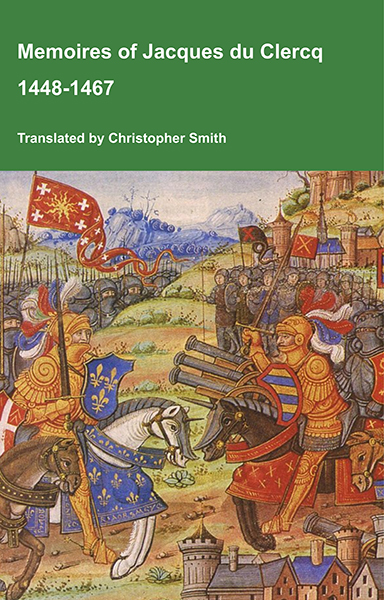
This is a translation of the 'Memoires of Jacques du Clercq', published in 1823 in two volumes, edited by Frederic, Baron de Reissenberg. In his introduction Reissenberg writes: 'Jacques du Clercq tells us that he was born in 1424, and that he was a licentiate in law and a counsellor to Philip the Good, Duke of Burgundy, in the castellany of Douai, Lille, and Orchies. It appears that he established his residence at Arras. In 1446, he married the daughter of Baldwin de la Lacherie, a gentleman who lived in Lille. We read in the fifth book of his Memoirs that his father, also named Jacques du Clercq, had married a lady of the Le Camelin family, from Compiègne. His ancestors, always attached to the counts of Flanders, had constantly served them, whether in their councils or in their armies.' The Memoires cover a period of nineteen years beginning in in 1448, ending in in 1467. It appears that the author had intended to extend the Memoirs beyond that date; no doubt illness or death prevented him from carrying out this plan. As Reissenberg writes the 'merit of this work lies in the simplicity of its narrative, in its tone of good faith, and in a certain air of frankness which naturally wins the reader’s confidence.' Du Clercq ranges from events of national and international importance, including events of the Wars of the Roses in England, to simple, everyday local events such as marriages, robberies, murders, trials and deaths, including that of his own father in Book 5; one of his last entries.
Available at Amazon in eBook and Paperback format.
1920-1940 Abdication is in 20th Century Events.
On 26th January 1921 an express and stopping train collided at Abermule, Newtown.
Seventeen people were killed including Herbert Lionel Henry Vane-Tempest [aged 58], a director of the railway.
"The driver of the down train was oiling his engine at the moment when the tablet holder was handed to his fireman by relief-stationmaster Lewis. It is clear that neither he nor the fireman could have examined the tablet before the train started from Abermule. It is also clear that neither Lewis, Jones, nor Thompson could have looked at the tablet instrument for the Abermule-Newtown section, otherwise they would have seen the indicator showed that a tablet had been withdrawn for an up train. After the down train had started (about 12.3 p.m.), presumably when he returned to the booking office to send the 'entering section' bell signal for the down train to Newtown, and the 'out of section' bell signal to Montgomery, the terrible mistake that had been made was discovered by Thompson, and Lewis realised that he had given the Montgomery - Abermule tablet to the down train. Lewis telephoned to Newtown to ask if the express had left, and was informed by Brock that it had left at 11.59 when he had sent the 'entering section' bell signal. A vain attempt was made to attract the attention of the enginemen of the down train, by lowering and raising the up distant signal, but probably by the time this was attempted, the train had passed the signal post, about 660 yards from the loop points..."
"When [fireman] Owen recovered, he found himself on the ground just behind the second vehicle (No. 310) of his train, which was lying across the railway on top of the first. He saw driver Jones on the opposite side just behind and underneath the third vehicle, which was leaning over towards the slope of the cutting. He got across the framing, and found Jones more seriously injured than himself, and anxiously enquiring whether they had the right tablet. He assured him on the point, but a little later, as his driver was still anxious, he went to look for the tablet and crept under the frame of No. 7730 for the purpose. After a little search he found both tablet holders lying on the ground to the left (north) of the track alongside the wreckage of the two engines. He picked them up and found that one of the tablets for the Montgomery-Abermule section had evidently been carried by the down train. He then returned and showed them to his driver to relieve his anxiety. He subsequently handed the tablet holders to traffic controller Morgan, who travelled in the down train. Morgan eventually passed them for custody to chief traffic inspector George. The latter, immediately after the accident, returned on foot to Abermule, where he arrived at 12.18 p.m. and arranged by telephone for the dispatch of medical and nursing assistance from Newtown."
Herbert Lionel Henry Vane-Tempest: On 6th July 1862 he was born to George Henry Vane-Tempest 5th Marquess Londonderry and Mary Cornelia Edwards Marchioness Londonderry. The Times. 2nd February 1905. The funeral of Lord Henry Vane-Tempest took place yesterday in the family vault in St. Peter's [Map], Montgomeryshire. The Bishop of Bangor, assisted by the Rev J. Williams, rector of the parish, and the Rev. S. J. Evans, officiated. The principal mourmers were the Marquis and Marchioness of Londonderry (brother and sister-in-law), Lord Herbert Vane-Tempest (brother), and Mr. Beaumont, M.P., and Lady Aline Beaumont (brother-in-law and sister). Continues. 9th February 1915. Times Newspaper Obituaries. The news of the death of the Marquess of Londonderry, which occurred at Wynyard, Stockton-on-Tees, yesterday morning, will be received with profound regret far beyond the circle of his personal friends or of the members of the Unionist Party. Lord Londonderry had not been entirely well for some little time past. For a fortnight, it seems, he had been suffering from sciatica. Last week he caught a chill, from which pneumonia developed. On Sunday his condition was seen to be critical. During the night he collapsed, and the end came at 9.30 yesterday morning. Lady Londonderry, who had been in constant attendance on him during his illness, was present at the last, as also were Lady Ilchester and Lord Herbert Vane-Tempest.


On 4th November 1922 the tomb of Tutankhamun 1341BC 1323BC was discovered by Howard Carter [aged 48].
On 16th February 1923 the Burial Chamber of Tutankhamun's Tomb was opened. Howard Carter records in his diary: "Opened sealed doorway before officials Etc. before 1 Abd El Hamid Pasha Suleman, 2 Lacau, 3 Lythgoe, 4 Winlock, 5 Sir W. Garstin, 6 Breasted, 7 Gardiner, 8 Engelbach, 9 Tewfik Boulos, 10 Ibrahim Effendi, 11 Mace1, 12 Callender, 13 Lucas, 14 Burton, 15 Ld. C [aged 56], 16 Lady E [aged 21]." and in his journal: "Opened sealed doorway before the following visitors and officials: Abd El Halim Pasha Suleman, Under Sec. of State P.W.D. Lacau. Dir. Gen. S. des. A. Engelbach. Chief Insp. Up. Eg. S. des A. Ibrahîm Effendi. Insp. Luxor S. des A. and Tewfik Effendi Boulos. Sir William Garstin Lythgoe and Winlock Mace, Callender, and Lucas, and Burton. Ld. C. and Lady E. and others."
Note 1. Assistant Curator of Egyptian Art at the Metropolitan Museum of Art, New York.
On 26th April 1923 King George VI of the United Kingdom [aged 27] and Elizabeth Bowes-Lyon Queen Consort England [aged 22] were married at Westminster Abbey [Map]. She the daughter of Claude Bowes-Lyon 14th Earl Strathmore and Kinghorne [aged 68] and Cecilia Nina Cavendish-Bentinck Countess of Strathmore and Kinghorne [aged 60]. He the son of King George V of the United Kingdom [aged 57] and Victoria Mary Teck Queen Consort England [aged 55].
Mary Elphinstone [aged 12] and Cecilia Bowes-Lyon [aged 11] were bridesmaids.


The Nepal–Britain Treaty was signed on 21 December 1923 in Singha Durbar. The Treaty was the first formal acknowledgement by the British that Nepal, as an independent nation. The seven articles were as follows:
1. Nepal and Britain will forever maintain peace and mutual friendship and respect each other's internal and external independence.
2. All previous treaties, agreements and engagements, since and including the Sugauli Treaty of 1815, which have been concluded between the two Government are hereby cancelled, except so far as they may be altered by the present Treaty.
3. As the preservation of peace and friendly relations with the neighbouring States whose territories adjoin their common frontiers is to the mutual interests of both the High Contracting Parties, they hereby agree to inform each other of any rupture such friendly relations, and each to exert its good offices as far as may be possible to remove such friction and misunderstanding.
4. Each of the High Contracting Parties will use all such measure as it may deem practicable to prevent its territories being used for purpose inimical to the security of the other.
5. In view of the longstanding friendship that has subsisted between the British Government and the Government of Nepal and for the sake of cordial neighbourly relations between them, the British Government agrees that the Nepal Government shall be free to import from or through British India into Nepal whatever arms, ammunition, machinery, warlike material or stores may be required or desired for the strength and welfare of Nepal, and that this arrangement shall hold good for all times as long as the British Government is satisfied that the intentions of the Nepal Government are friendly and that there is no immediate danger to India from such importations. The Nepal such arms, ammunition, etc., across the frontier of Nepal either by the Nepal Government or by private individuals. If, however, any convention for the regulation of the Arms Traffic, to which the British Government may be a party, shall come into force, the right of importation of arms and ammunition by the Nepal Government shall be subject to the proviso that the Nepal Government shall first become a party to that Convention, and that such importation shall only be made in accordance with the provisions of that Convention.
6. No Customs duty shall be levied at British Indian ports on goods imported on behalf of the Nepal Government of immediate transport to that country provided that a certificate from such authority as may from time to time be determined by the two governments shall be presented at the time of importation to the Chief Customs Officer at the port of import setting forth that the goods are the property of the Nepal Government, are required for the public services of the Nepal Government are not for the purpose of any State monopoly or State trade, and are being to Nepal under orders of the Nepal Government, The British Government also agrees to the grant in respect of all trade goods, imported at British Indian ports for immediate transmission to Kathmandu without breaking bulk en route, of a rebate of the full duty paid, provided that in accordance with arrangements already agreed to, between the two Governments, such goods may break bulk for repacking at the port of entry under Customs supervision in accordance with such rules as may from time to time be laid down in this behalf. The rebate may be claimed on the authority of a certificate signed by the said authority that the goods have arrive at Kathmandu with Customs seals unbroken and otherwise untampered with.
7. This Treaty signed in the part of the British Government by Lieutenant-Colonel W.F.T. O'Connor, C.I.E., C.V.O., British Envoy at the Court of Nepal and on the part of Nepal Government by General His Highness Maharaja Sir Chandra Shumsher Junga Bahadur Rana, G.C.B, G.C.S.I., G.D.M.G., G.C.V.O., D.C.I., Thong-lin Pimma Kokang- Wang-Syan, Prime Minister and Marshal of Nepal, shall be ratified and the ratification shall be exchanged at the Kathmandu as soon as practicable.

On 24th April 1922 the first section of the Imperial Wairelass Chain opened between Leafield [Photo,1921], Oxfordshire and Cairo, Egypt.

On 26th January 1926, John Logie Baird gave the first public demonstration of true television images for members of the Royal Institution and a reporter from The Times in his laboratory at 22 Frith Street, Soho, London.
On 20th May 1927 took off from Roosevelt Field on Long Island. After 33½ hours of flying he landed at Le Bourget Aerodrome at 10:22 PM on Saturday, 21st May.
On 7th January 1928 fourteen people died and thousands were made homeless when floodwaters poured over the top of the Thames Embankment and part of the Chelsea Embankment collapsed. During Christmas 1927, heavy snow fell in the Cotswolds in west-central England, where the Thames has its source. A sudden thaw occurred over New Year's Eve, followed by unusually heavy rain, doubling the volume of water coming down the river. The sudden rise in water level coincided with a high spring tide and a storm surge caused by a major extra-tropical cyclone in the North Sea. The storm surge raised the water levels in the Thames Estuary, measured at Southend, to 1.5 metres above normal. The funnelling of the water further up the river caused its level to rise even higher. The situation was worsened by capital dredging that had been carried out between 1909 and 1928. This produced the highest water levels ever recorded in the Thames in London. The flood peaked at about 1:30 am on 7 January when a level of 5.55 metres above the datum line was recorded.
On 24th October 1929 "Black Thursday" a record 12.9 million shares were traded on the New York Stock Exchange.
Jean de Waurin's Chronicle of England Volume 6 Books 3-6: The Wars of the Roses
Jean de Waurin was a French Chronicler, from the Artois region, who was born around 1400, and died around 1474. Waurin’s Chronicle of England, Volume 6, covering the period 1450 to 1471, from which we have selected and translated Chapters relating to the Wars of the Roses, provides a vivid, original, contemporary description of key events some of which he witnessed first-hand, some of which he was told by the key people involved with whom Waurin had a personal relationship.
Available at Amazon in eBook and Paperback format.
On 29th October 1929 "Black Tusday" 16.4 million shares were traded on the New York Stock Exchange.
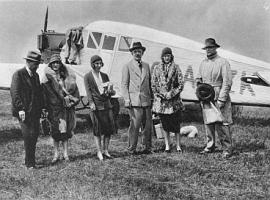
On 21st July 1930 Rosemary Millicent Sutherland-Leveson-Gower [aged 36] died in a plane crash. She was booked on a flight from Le Touquet to Croydon. A seat became available on an earlier flight which she accepted. The flight departed in clear weather. At about at 2:30 pm in poor weather over Kent the tail unit failed, causing the aircraft to stall, which in turn caused the port wing to break away and the plane to crash. All the passengers fell from the aircraft through the hole created by the wing breaking away. The Viscountess' body was found in a meadow.
An inquest was opened on 23 July where the Viscountess was identified by her brother George [aged 41]. After the formal identifications, the inquest was adjourned for the Air Ministry technical investigation to take place. The inquest was resumed on 13 August at which the jury returned a verdict "that the victims met their death falling from an aeroplane, the cause of the accident being unknown".
Rosemary Millicent Sutherland-Leveson-Gower: On 9th August 1893 she was born to Cromartie Sutherland-Leveson-Gower 4th Duke of Sutherland and Millicent Fanny St Clair-Erskine Duchess of Sutherland. On 8th March 1919 William Humble Eric Ward 3rd Earl of Dudley and she were married. She the daughter of Cromartie Sutherland-Leveson-Gower 4th Duke of Sutherland and Millicent Fanny St Clair-Erskine Duchess of Sutherland. He the son of William Humble Ward 2nd Earl of Dudley and Gertrude "Gertie" Millar Countess of Dudley. On 25th July 1930 an Memorial Service was held for Rosemary Millicent Sutherland-Leveson-Gower at St Margaret's Church, Westminster [Map].
George Sutherland-Leveson-Gower 5th Duke of Sutherland: On 29th August 1888 he was born to Cromartie Sutherland-Leveson-Gower 4th Duke of Sutherland and Millicent Fanny St Clair-Erskine Duchess of Sutherland. On 27th June 1913 Cromartie Sutherland-Leveson-Gower 4th Duke of Sutherland died. His son George succeeded 5th Duke Sutherland, 23rd Earl Sutherland, 7th Earl Gower, 8th Baron Gower, 12th Baronet Gower of Stittenham in Yorkshire. On 26th September 1931 Elizabeth Demarest died. Her daughter Elizabeth Sutherland 24th Countess of Sutherland became a ward of her uncle George Sutherland-Leveson-Gower 5th Duke of Sutherland. On 1st February 1963 George Sutherland-Leveson-Gower 5th Duke of Sutherland died. His third cousin once removed John succeeded 6th Duke Sutherland, 6th Marquess Stafford, 8th Earl Gower, 9th Baron Gower, 13th Baronet Gower of Stittenham in Yorkshire. Diana Evelyn Percy by marriage Duchess Sutherland.His niece Elizabeth succeeded 24th Countess Sutherland.
On 21st July 1930 Frederick Temple Hamilton-Temple-Blackwood 3rd Marquess of Dufferin and Ava [aged 55] died in a plane crash. His son Basil [aged 21] succeeded 4th Marquess of Dufferin and Ava, 4th Earl of Ava in County Down and Burma, 4th Earl of Dufferin in County Down, 4th Viscount Dufferin of Claneboye in County Down, 4th Baron Claneboye of Claneboye in County Down, 8th Baron Dufferin and Claneboye of Ballyleidy and Killyleagh in County Down, 8th Baronet Blackwood of Killyleagh in County Down. Maureen Constance Guinness Marchioness of Dufferin and Ava [aged 23] by marriage Marchioness of Dufferin and Ava.
On 21st July 1930 Captain Edward Simons Ward 2nd Baronet [aged 48] died. His brother Commander [aged 45] succeeded 3rd Baronet Ward of Wilbraham Place in Chelsea.
On 5th October 1930 the airship R101 crashed in France during its maiden overseas voyage, killing 48 of the 54 people on board. Christopher Thomson 1st Baron Thomson [aged 55]died. Baron Thomson of Cardington in Bedfordshire extinct.
On 1st May 1931 the Empire State Building was officially opened by United States President Herbert Hoover, who turned on the building's lights with the ceremonial button push from Washington, D.C.
On 20th May 1932 Amelia Earhart [aged 34] took off in her single engine Lockheed Vega 5B from from Harbour Grace, Newfoundland, with a copy of the Telegraph-Journal to confirm the date of the flight. She intended to fly to Paris. After a flight lasting 14 hours, 56 minutes she landed, on 21st May 1937, in a pasture near Culmore, north of Derry, Northern Ireland. The landing was witnessed by Cecil King and T. Sawyer. When a farm hand asked, "Have you flown far?" Earhart replied, "From America." She was the first woman tȯfly solo non-stop across the Atlantic. The dates of her trips five years to the day after Charles Lindburgh's solo flight across the Atlantic.
Photos: 1 Amelia Earhart after her solo Atlantic flight from the US to Londonderry, arriving at Hanworth Aerodrome, England, May 22nd 1932, 2 Amelia Earhart landing in Londonderry in May 1932.
Amelia Earhart: On 24th July 1897 she was born. On 2nd July 1937 Amelia Earhart disappeared after which she declared dead.

On 3rd July 1933 Twickenham Bridge [Map], Hampton Court Bridge [Map] and Chiswick Bridge [Map] were opened by the Prince of Wales [aged 39].
On 4th August 1936 John Charles William Fitzroy 9th Duke Grafton [aged 22] was killed racing his Bugatti at the Limerick Grand Prix. Earl Arlington, Viscount Thetford, Baron Arlington of Arlington in Middlesex and Baron Arlington of Arlington in Middlesex abeyant between his sisters Margaret Jane Fitzroy [aged 20] and Mary Rose Fitzroy [aged 17]. His first cousin once removed Charles [aged 44] succeeded 10th Duke Grafton, 10th Earl Euston, 10th Viscount Ipswich, 10th Baron Sudbury.
On 5th October 1936 the Jarrow March left Jarrow Town Hall, County Durham cheered on by most of the town and bearing banners announcing themselves as the "Jarrow Crusade". The marchers arrived at Marble Arch [Map], London on the 31st October 1936.

On 10th December 1936 King Edward VIII of the United Kingdom [aged 42] signed the instrument of abdication at Fort Belvedere, Windsor Great Park, witnessed by his three brothers: Albert [aged 40], who became King George VI, Henry [aged 36] and George [aged 33].


This is a translation of the 'Memoires of Jacques du Clercq', published in 1823 in two volumes, edited by Frederic, Baron de Reissenberg. In his introduction Reissenberg writes: 'Jacques du Clercq tells us that he was born in 1424, and that he was a licentiate in law and a counsellor to Philip the Good, Duke of Burgundy, in the castellany of Douai, Lille, and Orchies. It appears that he established his residence at Arras. In 1446, he married the daughter of Baldwin de la Lacherie, a gentleman who lived in Lille. We read in the fifth book of his Memoirs that his father, also named Jacques du Clercq, had married a lady of the Le Camelin family, from Compiègne. His ancestors, always attached to the counts of Flanders, had constantly served them, whether in their councils or in their armies.' The Memoires cover a period of nineteen years beginning in in 1448, ending in in 1467. It appears that the author had intended to extend the Memoirs beyond that date; no doubt illness or death prevented him from carrying out this plan. As Reissenberg writes the 'merit of this work lies in the simplicity of its narrative, in its tone of good faith, and in a certain air of frankness which naturally wins the reader’s confidence.' Du Clercq ranges from events of national and international importance, including events of the Wars of the Roses in England, to simple, everyday local events such as marriages, robberies, murders, trials and deaths, including that of his own father in Book 5; one of his last entries.
Available at Amazon in eBook and Paperback format.
On 11th December 1936 the former King Edward VIII [aged 42] made a BBC radio broadcast from Windsor Castle having abdicated the previous day: "At long last I am able to say a few words of my own. I have never wanted to withhold anything, but until now it has not been constitutionally possible for me to speak. A few hours ago I discharged my last duty as King and Emperor, and now that I have been succeeded by my brother, The Duke of York, my first words must be to declare my allegiance to him. This I do with all my heart. You all know the reasons which have impelled me to renounce the Throne. But I want you to understand that in making up my mind I did not forget the country or the Empire which as Prince of Wales, and lately as King, I have for twenty-five years tried to serve. But you must believe me when I tell you that I have found it impossible to carry the heavy burden of responsibility and to discharge my duties as King as I would wish to do without the help and support of the woman I love. And I want you to know that the decision I have made has been mine and mine alone. This was a thing I had to judge entirely for myself. The other person most nearly concerned has tried up to the last to persuade me to take a different course. I have made this, the most serious decision of my life, only upon the single thought of what would in the end be best for all. This decision has been made less difficult to me by the sure knowledge that my brother, with his long training in the public affairs of this country and with his fine qualities, will be able to take my place forthwith, without interruption or injury to the life and progress of the Empire. And he has one matchless blessing, enjoyed by so many of you and not bestowed on me - a happy home with his wife and children. During these hard days I have been comforted by Her Majesty my mother and by my family. The Ministers of the Crown, and in particular Mr. Baldwin, the Prime Minister, have always treated me with full consideration. There has never been any constitutional difference between me and them and between me and Parliament. Bred in the constitutional tradition by my father, I should never have allowed any such issue to arise. Ever since I was Prince of Wales, and later on when I occupied the Throne, I have been treated with the greatest kindness by all classes of the people, wherever I have lived or journeyed throughout the Empire. For that I am very grateful. I now quit altogether public affairs, and I lay down my burden. It may be some time before I return to my native land, but I shall always follow the fortunes of the British race and Empire with profound interest, and if at any time in the future I can be found of service to His Majesty in a private station I shall not fail. And now we all have a new King. I wish him, and you, his people, happiness and prosperity with all my heart. God bless you all. God Save The King."
On 11th December 1936 King Edward VIII of the United Kingdom [aged 42] abdicated VIII King of the United Kingdom. King George VI of the United Kingdom [aged 40] succeeded VI King of the United Kingdom. Duke York merged with the Crown.
On 18th November 1936 Alonso María Orléans Galliera [aged 24] died.
On 12th May 1937 King George VI of the United Kingdom [aged 41] was crowned VI King of the United Kingdom at Westminster Abbey [Map].
On 8th May 1939 Basil Brown, the landowner Mrs Edith Pretty, began excavating Mound 1 at Sutton Hoo, Woodbridge with two new helpers, John Jacobs, one of the gardeners, and William Spooner, the gamekeeper. The Mound would eventually reveal an intact ship burial.
On 29th March 1939 the IRA attempted to destroy Hammersmith Bridge [Map]. Hairdresser Maurice Childs from nearby Chiswick was crossing the bridge at one o'clock in the morning when he saw a smouldering suitcase that was lying on the walkway. He realised it was a bomb and threw it over the side into the Thames, where it exploded. Soon afterwards, another bomb exploded, damaging the bridge and breaking windows in nearby houses. Childs was given an MBE for his quick-thinking.
On 3rd September 1939 France, Great Britain, New Zealand and Australia declare war on Germany after the invasion of Poland, forming the Allied nations.