

Jean de Waurin's Chronicle of England Volume 6 Books 3-6: The Wars of the Roses
Jean de Waurin was a French Chronicler, from the Artois region, who was born around 1400, and died around 1474. Waurin’s Chronicle of England, Volume 6, covering the period 1450 to 1471, from which we have selected and translated Chapters relating to the Wars of the Roses, provides a vivid, original, contemporary description of key events some of which he witnessed first-hand, some of which he was told by the key people involved with whom Waurin had a personal relationship.
Available at Amazon in eBook and Paperback format.
6th Century Events is in 1st Millennium Events.
Anglo-Saxon Chronicle. 552. This year Cynric fought with the Britons on the spot that is called Sarum [Map], and put them to flight. Cerdic was the father of Cynric, Cerdic was the son of Elesa, Elesa of Esla, Esla of Gewis, Gewis of Wye, Wye of Frewin, Frewin of Frithgar, Frithgar of Brand, Brand of Balday, Balday of Woden. In this year Ethelbert, the son of Ermenric, was born, who on the two and thirtieth year of his reign received the rite of baptism, the first of all the kings in Britain.
In 556 Cynric King Wessex and Ceawlin King Wessex defeated the Britons at Barbury Castle [Map] during the Battle of Beran Burg. Barbury Castle [Map] possibly of strategic importance since it is located on the Ridgeway with extensive views over the Thames valley.
In 560 (other sources indicate between 555 and 561) the Battle of Cúl Dreimhne, or the Battle of the Book, at north-west Ireland. Some sources describes the cause of the battle as being over the copyright of a book that Saint Columba had copied. Other sources suggest the battle was over the killing of Diarmait of Curnán (son of Áed mac Echach King Connaught), who was under Saint Columba's protection, by Diarmait mac Cerbaill High King of Ireland.
In 568 Ceawlin King Wessex and Cutha Wessex fought against King Æthelberht of Kent [aged 18] at the Battle of Wibbandun and drove him into Kent. The location of the battle is unknown.
In 577 Ceawlin King Wessex and his son Cuthwine [aged 12] won a major victory over the Britons at the Battle of Dyrham at Hinton Hill Dyrham, Gloucestershire. The victory of resulted in the capture of Gloucester [Map], Cirencester, Gloucestershire [Map] and Bath, Somerset [Map].
Coinmail Briton, Condidan Briton and Farinmail Briton were killed.
The Hwicce was a kingdom in Anglo-Saxon England established in 577 after the Battle of Dyrham. In 628 Hwicce became a sub-kingdom of Mercia after the Battle of Cirencester. Hwicce included most of Worcestershire and Gloucestershire, and the south-west part of Warwickshire.
In 584 Ceawlin King Wessex and his son Cutha Wessex defeated the Britons at the Battle of Fethan Leag which was probably fought at Stoke Lyne, Oxfordshire [Map].
In 584 Ceawlin King Wessex was defeated, probably by the Britons, possibly by Ceol King Wessex at the First Battle of Woden's Barrow which fought at Adam's Grave [Map], Pewsey, Wiltshire.
Anglo-Saxon Chronicle. 592. This year there was a great slaughter of Britons at Wanborough; Ceawlin was driven from his kingdom, and Ceolric reigned six years.
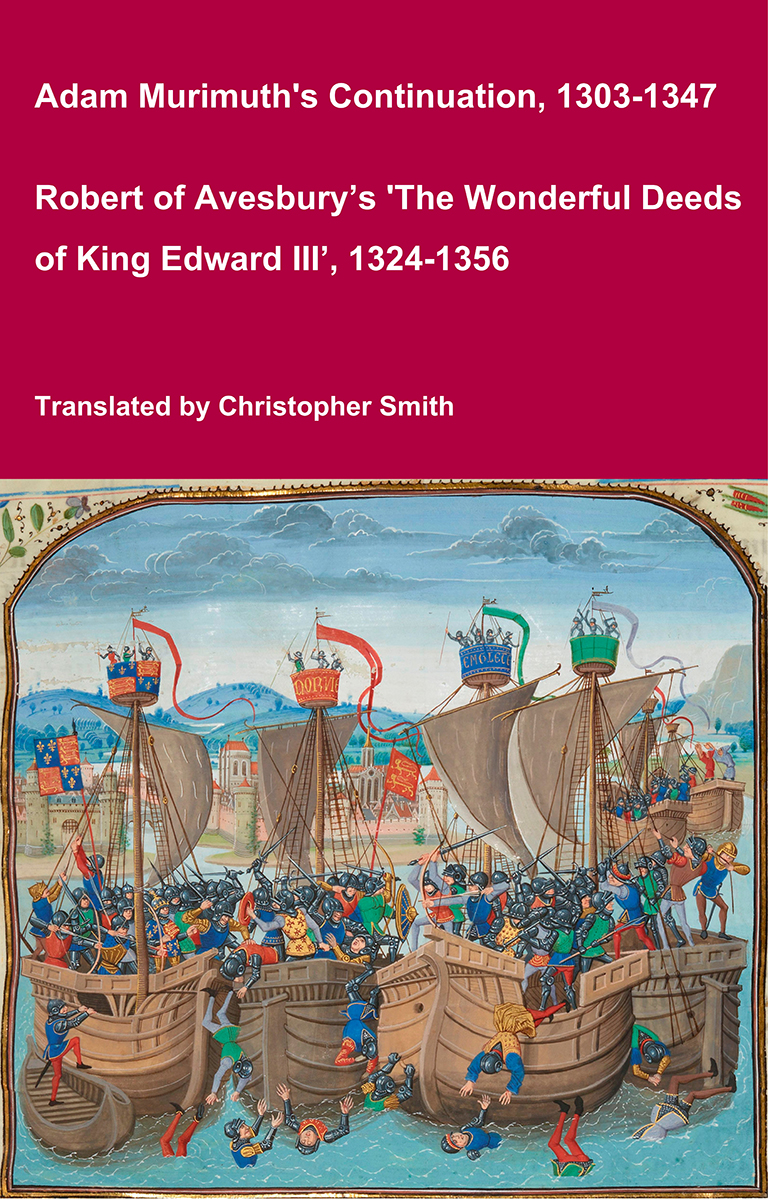
Adam Murimuth's Continuation and Robert of Avesbury’s 'The Wonderful Deeds of King Edward III'
This volume brings together two of the most important contemporary chronicles for the reign of Edward III and the opening phases of the Hundred Years’ War. Written in Latin by English clerical observers, these texts provide a vivid and authoritative window into the political, diplomatic, and military history of fourteenth-century England and its continental ambitions. Adam Murimuth Continuatio's Chronicarum continues an earlier chronicle into the mid-fourteenth century, offering concise but valuable notices on royal policy, foreign relations, and ecclesiastical affairs. Its annalistic structure makes it especially useful for establishing chronology and tracing the development of events year by year. Complementing it, Robert of Avesbury’s De gestis mirabilibus regis Edwardi tertii is a rich documentary chronicle preserving letters, treaties, and official records alongside narrative passages. It is an indispensable source for understanding Edward III’s claim to the French crown, the conduct of war, and the mechanisms of medieval diplomacy. Together, these works offer scholars, students, and enthusiasts a reliable and unembellished account of a transformative period in English and European history. Essential for anyone interested in medieval chronicles, the Hundred Years’ War, or the reign of Edward III.
Available at Amazon in eBook and Paperback format.
In 592 Ceawlin King Wessex was killed at the Battle of Wanborough. His nephew Ceol succeeded King Wessex.