


Death of Catherine of Aragon is in 1536 Death of Catherine of Aragon and Anne Boleyn's Miscarriage.
On 7th January 1536 Catherine of Aragon [aged 50] died at Kimbolton Castle [Map].


Letters and Papers. 7th January 1536. R. O. St. P. I. 452. 37. Sir Edward Chamberleyn [aged 52] and Sir Edm. Bedyngfeld [aged 57] to Cromwell [aged 51].
This 7th Jan., about 10 a.m., the Lady Dowager [aged 50] was annealed with the Holy ointment, Chamberleyn and Bedyngfeld being summoned, and before 2 p.m. she died. Wishes1 to know the King's [aged 44] pleasure concerning the house, servants, and other things. The groom of the Chamber here can cere her. Will send for a plumber to close the body in lead.
Note 1. The letter, though signed by two, is written throughout in the first person singular,— apparently by Bedingfield, who was steward of Catharine's household, though he signs second.
Wriothesley's Chronicle [1508-1562]. 7th January 1536. This yeare, the morrowe after twelve daie being Fridaie and the 7th daie of Januarieb, 1536 the honorable and noble Princes, Queene Katherin [aged 50], former wife to King Henrie the VIII [aged 44], departed from her worldlie lief at Bugden [Map], in Huntingdonshire, about tenne of the clocke at nightb, and...
Note. Stow and Hall, with other authorities, state that Queen Katharine died on the 8th Jannary, but the correctness of our text as to the day is placed beyond a doubt by the original letter of Sir Edward Chamberleyn [aged 52] and Sir Edmund Bedyngfeld [aged 57] transmitting this intelligence to Cromwell [aged 51], still extant in the Public Record Office, and which runs thus:
"Pleaseth yt yower honorable Maystershipp to be advertysed, that this 7th day of January, abowt 10 of the clock before none, the Lady Dowager was aneled with the Holy Oyntment, Mayster Chamberlein and I called to the same; and before 2 of the clock at aftenone she departed to God. Besechyng yow that the Kyng may be advertyscd of the same, and furder to know yower pleasour yn every thyng aperteynyng to that purpose; and, furder, in all other causes concernyng the hows, the servantes, and all other thynges, as shall stand wyth the Kynge's pleasour and yowers."
Note b. This would appear to be an error for 2 o'clock in the afternoon. See preceding note.


Spanish Chronicle Chapter 24. [7th January 1536]. How the blessed queen Katharine [aged 50] died.
Letters and Papers. After 7th January 1536. R. O. 38. [Katharine of Arragon?]
Provision to be made for bowelling, cering, and enclosing the corpse in lead. For lights and other things about the corpse, in the house, or the next church or chapel, and who shall execute exequies and ceremonies. Proportions for all manner of lights, and for blacks to be distributed. What personages, aud how many personages, women, to be appointed as principal mourners. How many chariots shall follow the corpse, and what apparel shall be appointed for them. Where the body shall be interred. How many prelates shall be present at the interment. What dole shall be dealt in every place, and in pence, half groats, or groats, or in all after the diversity of the place.
Letters to be made for the appointment of such personages of honour as shall be at the same.
In Wriothesley's hand, p. 1.
Letters and Papers. After 7th January 1536. 39. Burial of Katharine of Arragon.
"A remembrance for thenterrement of the right excellent and noble Princesse the Lady Catherin, Doughter to the right highe and mighty Prince Ferdinand, late King of Castle, and late Wief to the noble and excellent prince Arthur, Brother to our Soveraign Lorde King Henry the viijth."
Directions as to the corpse being "sered, tramayled, leded, and chested with spices, &c.;" for a hearse "with five principalles and lights." to be set in the church or chapel where the body shall first remain, and another "with nine principalls or lights" in the church where it shall be buried; for staff torches to be borne by yeomen and long torches in great towns as the body shall pass; for wax; for double barriers about the principal hearse, the inner for ladies and the outer for lords. At the removal the body is to be attended by three mutes; divers noblemen and four knights to bear a canopy over it, six knights to bear the body and six barons to assist. The chief mourner and eight others to accompany the corpse. Arrangements for nightly watch, chariot to convey the corpse, with pall and puffed image of a Princess; four gentlemen to bear at the four corners, &c. "The chief mourner on horseback, her horse trapped with black velvet to follow immediately the corpse," with eight ladies after her on palfreys trapped in black cloth. Two other chariots to follow.
ii. "The painter's charge;" for the supply of banners and scutcheons.
iii. "The charges of the wardrobe." To provide cloth for 30 ladies and gentlemen mourners, and for the noblemen present, and for her officers.
iv. "The rate of the liveries" for dukes or duchesses, earls, &c., cloth for themselves and for a number of servants according to their degrees.
v. "To be also remembered." To appoint prelates to execute for the time she shall be unburied, &c.; also touching doles and various other matters; among others what place the body shall be interred in.
"The 25th day of this present month of January, it is commanded that all such stuff as is committed to the doings of the chandler, the painter, the saddler, and all other having anything to be done touching the interment, shall be ready and bestowed in such places as be to them appointed for the same."
In Wriothesley's hand, pp. 8.
 Become a Member via our Buy Me a Coffee page to read more.
Letters and Papers. After 7th January 1536. 40. Will of Katharine of Arragon.
Desires the King to let her have the goods she holds of him in gold and silver and the money due to her in time past; that her body may be buried in a convent of Observant Friars; that 500 masses be said for her soul; that some personage go to our Lady of Walsingham on pilgrimage and distribute 20 nobles on the way. Bequests: to Mrs. Darel 200l. for her marriage. To my daughter, the collar of gold which I brought out of Spain. To Mrs. Blanche 100l. To Mrs. Margery and Mrs. [Whyller] 40l. each. To Mrs. Mary, my physicians [wife, and] Mrs. Isabel, daughter to Mr. Ma[rguerite], 40l. each. To ray physician the year's coming [wages]. To Francisco Philippo all that I owe him, and 40l. besides. To Master John, my apothecary, [a year's wages] and all that is due to him besides. That Mr. Whiller be paid expenses about the making of my gown, and 20l. besides. To Philip, Anthony, and Bastian, 20l. each. To the little maidens 10l. each. That my goldsmith be paid his wages for the year coming and all that is due to him besides. That my lavander be paid what is due to her and her wages for the year coming. To Isabel of Vergas 20l. To my ghostly father his wages for the year coming. That ornaments be made of my gowns for the convent where I shall be [buried] "and the furs of the same 1 give to my daughter."
Pp. 2. Mutilated.
Ibid. f. 216b. ii. The following is written in Cromwell's hand on a separate slip, not as Strype says, at the end of the will:—" Tawnton; Downton; Hendon. Richard Polerd, William Portma[n], Thomas Powlet, William Peter, Tho. Lee, Raffe Sadeler."
Otho. C. x. 217. 2. French translation of the above.
Pp. 2. Mutilated.
Become a Member via our Buy Me a Coffee page to read more.
Abbot John Whethamstede’s Chronicle of the Abbey of St Albans
Abbot John Whethamstede's Register aka Chronicle of his second term at the Abbey of St Albans, 1451-1461, is a remarkable text that describes his first-hand experience of the beginning of the Wars of the Roses including the First and Second Battles of St Albans, 1455 and 1461, respectively, their cause, and their consequences, not least on the Abbey itself. His text also includes Loveday, Blore Heath, Northampton, the Act of Accord, Wakefield, and Towton, and ends with the Coronation of King Edward IV. In addition to the events of the Wars of the Roses, Abbot John, or his scribes who wrote the Chronicle, include details in the life of the Abbey such as charters, letters, land exchanges, visits by legates, and disputes, which provide a rich insight into the day-to-day life of the Abbey, and the challenges faced by its Abbot.
Available at Amazon in eBook and Paperback format.
Letters and Papers. After 7th January 1536. Jan. Otho. C. x. 219b. B. M. 41. [Sir Edmund Bedyngfeld [aged 57]] to Cromwell.
The bowelling and cering is already done in the best manner. The leading and chesting is prepared for, and shall be finished with all speed. We are glad of the coming of the Comptroller hither by the King's commandment to order all things for the interring, which is directed to be at Peterborough.
To the best of our power we have commanded the safe custody of the gates so that nothing can issue. The persons who had the custo[dy of her] jewels, plate, and apparel, have given us a just and plain declaration, containing much more than [we could] see or know before. Will do all we can for the entertainment of such personages of honour as repair hither by commandment. [We have] declared to the servants how good and [gracious] master you have been in obtaining the King's favour towa[rds them. They are] greatly comforted with his gracious pro[mise]. "Further[more as for] the preparation of the house, it shall be d[one] . . . . and likewise the prelates and priests s . . . . . repair for the execution of all manner c[eremonies ap]pertaining for the funerals and a . . . [acco]rding to your mastership's command."
P. 1. Mutilated.
Chronicle of Edward Hall [1496-1548]. 8th January 1536. And the eighth day of January following died the Princess Dowager [deceased] at Kimbolton and was buried at Peterborough. Queen Anne [aged 35] wore yellow for the mourning.


Annales of England by John Stow. 8th January 1536. The eight of Januarie dyed Ladie Katherine Dowager at Kymbalton, ad was buryed at Peterborowe.
Letters and Papers. 9th January 1536. Vienna Archives. 59. Chapuys [aged 46] to Charles V.
Just after having finished my last letter of 30 Dec. I mounted horse to go with all possible haste "selon la grande compagnie que menvoie" to see the Queen [deceased]. On my arrival she called roe at once, and that it might not be supposed her sickness was feigned and also because there was a friend of Cromwell's whom the King had sent to accompany me, or rather to spy and note all that was said and done, the Queen thought best, with my consent, that my conductor and the principal persons of the house, such as the chamberlain and steward, who had not seen her for more than a year, and several others, should be at our first interview. After I had kissed hands she took occasion to thank me for the numerous services I had done her hitherto and the trouble I had taken to come and see her, a thing that she had very ardently desired, thinking that my coming would be salutary for her, and, at all events, if it pleased God to take her, it would be a consolation to her to die under my guidance (entre mes braz) and not unprepared, like a beast. I gave her every hope, both of her health and otherwise, informing her of the offers the King had made me of what houses she would, and to cause her to be paid the remainder of certain arrears, adding, for her further consolation, that the King was very sorry for her illness; and on this I begged her to take heart and get well, if for no other consideration, because the union and peace of Christendom depended upon her life. To show this I used many arguments, as had been prearranged with another person between the Queen and me, in order that my conductor and some of the bystanders might make report of it, so that by this means they might have the greater care of her life. After some other conversation, the Queen bade me rest after the fatigue of the journey, and meanwhile she thought she could sleep a little, which she had not done for two hours altogether during the six days previous. Shortly afterwards she sent for me again, and I spent full two hours in conversation with her, and though I several times wished to leave her for fear of wearying her, I could not do so, she said it was so great a pleasure and consolation. I spent the same period of time with her every day of the four days I staid there. She inquired about the health of your Majesty and the state of your affairs, and regretted her misfortune and that of the Princess, and the delay of remedy by which all good men had suffered in person and in goods, and so many ladies were going to perdition. But, on my showing her that your Majesty could not have done better than you had done hitherto, considering the great affairs which had hindered you, and also that the delay had not been without advantages (for, besides there being some hope that the French, who formerly solicited the favour of this King, would now turn their backs, there was this, that the Pope, by reason of the death of the cardinal of Rochester, and other disorders, intended to seek a remedy in the name of the Holy See, and thus, preparations being made at the instance of the Holy See, the King could not blame her as the cause), she was quite satisfied and thought the delay had been for the best. And as to the heresies here [I said] she knew well that God said there must of necessity be heresies and slanders for the exaltation of the good and confusion of the wicked, and that she must consider that the heresies were not so rooted here that they would not soon be remedied, and that it was to be hoped that those who had been deluded would afterwards be the most firm, like St. Peter after he had tripped. of these words she showed herself very glad, for she had previously had some scruple of conscience because [the heresies] had arisen from her affair.
Having staid there four days, and seeing that she began to take a little sleep, and also that her stomach retained her food, and that she was better than she had been, she thought, and her physician agreed with her (considering her out of danger), that I should return, so as not to abuse the licence the King had given me, and also to request the King to give her a more convenient house, as he had promised me at my departure. I therefore took leave of her on Tuesday evening, leaving her very cheerful; and that evening I saw her laugh two or three times, and about half an hour after I left her she desired to have some pastime (soy recreer) with one of my men "que fait du plaisant." On Wednesday morning one of her chamber told me that she had slept better. Her physician confirmed to me again his good hope of her health, and said I need not fear to leave, for, if any new danger arose, he would inform me with all diligence. Thereupon I started, and took my journey at leisure, lest any further news should overtake me on the road; but none came. This morning I sent to Cromwell to know when I could have audience of the King his master to thank him for the good cheer he had caused to be shown me in my journey, and also to speak about the said house. He sent to inform me of the lamentable news of the death of the most virtuous Queen, which took place on Friday the morrow of the Kings, about 2 p.m. This has been the most cruel news that could come to me, especially as I fear the good Princess will die of grief, or that the concubine [aged 35] will hasten what she has long threatened to do, viz., to kill her; and it is to be feared that there is little help for it. I will do my best to comfort her, in which a letter from your Majesty would help greatly. I cannot relate in detail the circumstances of the Queen's decease, nor how she has disposed of her affairs, for none of her servants has yet come. I know not if they have been detained.
This evening, on sending to tell (qu. ask?) Cromwell what they had determined to do, that I might for my part do my duty, he told my man that just as he was entering the gate he had dispatched one of his own to inform me, on the part of the King and Council, that it was determined to give her a very solemn and honorable funeral both on account of her virtue and as having been wife of Prince Arthur, and, moreover, for her lineage and relationship to your Majesty, and that, if I wished to be present, the King would send me some black cloth for myself and my servants, but that the time and place had not yet been arranged. I replied that, presuming that everything would be done duly, I agreed to be present, and that, as to the cloth, the King need not trouble himself about it, for I was provided. It is certain that they will not perform her exequies as Queen, but only as Princess, and for this reason I despatch in haste to Flanders one of my servants who will have time to go and come, that I may know how to conduct myself, for nothing will be done for 18 or 20 days. The Queen's illness began about five weeks ago, as I then wrote to your Majesty, and the attack was renewed on the morrow of Christmas day. It was a pain in the stomach, so violent that she could retain no food. I asked her physician several times if there was any suspicion of poison. He said he was afraid it was so, for after she had drunk some Welsh beer she had been worse, and that it must have been a slow and subtle poison1 for he could not discover evidences of simple and pure poison; but on opening her, indications will be seen. London, 9 Jan. 1535. Fr., from a modern copy, pp. 4.
Note 1. "Poison aterminec (qu. atermoiee?) et artificieuse."
Become a Member via our Buy Me a Coffee page to read more.
Letters and Papers. 9th January 1536. Add. MS. 28,588, f. 114. B. M. 60. Chapuys [aged 46] to Ortiz.
Received on the 29th ult. the Emperor's letter of the 3rd ult., and with them, the [account of the] receptions given to the Emperor in Micina and Naples.
Hearing that the Queen was very ill, went to ask the King for leave to visit her, which he obtained, with some trouble. Set off as soon as possible. Found that the Queen had been troubled with vomiting and pain in the stomach for a week, being unable to eat or sleep, except so little that it might be called nothing. She was so wasted that she could not support herself either on her feet or sitting in bed. During four days that he was with her she got better, and seemed to be much comforted by his visit. She did not cease to tell him that he had served her well, and shown the affection for her service, which she knew that he felt. She desired him to return and solicit her removal, in which the physician concurred, thinking her out of danger for the time. Returned as she wished, and to-day news came to the King that on the third day after his departure she had a relapse and died in twelve hours, which was the day before yesterday, Friday the 7th, at 2 p.m. Feels it deeply, and hopes the same fate will not happen to the Princess. Will not now mention what her Highness said, and her last wishes. Refers to his letter to Cifuentes. London, 9 Jan. 1536. Sp., pp. 3. Modern copy.
Letters and Papers. 21st January 1536. Vienna Archives. 141. Chapuys [aged 46] to Charles V.
Now the King and Concubine [aged 35] are planning in several ways to entangle the Princess in their webs, and compel her to consent to their damnable statutes and detestable opinions; and Cromwell was not ashamed, in talking with one of my men, to tell him you had no reason to profess so great grief for the death of the Queen, which he considered very convenient and advantageous for the preservation of friendship between your Majesty and his master; that henceforth we should communicate more freely together, and that nothing remained but to get the Princess to obey the will of the King, her father, in which he was assured I could aid more effectually than anybody else, and that by so doing I should not only gratify the King but do a very good office for the Princess, who on complying with the King's will would be better treated than ever. The Concubine, according to what the Princess sent to tell me, threw the first bait to her, and caused her to be told by her aunt, the gouvernante [aged 60] of the said Princess, that if she would lay aside her obstinacy and obey her father, she would be the best friend to her in the world and be like another mother, and would obtain for her anything she could ask, and that if she wished to come to Court she would be exempted from holding the tail of her gown, "et si la meneroit tousjours a son cause" (?); and the said gouvernante does not cease with hot tears to implore the said Princess to consider these matters; to which the Princess has made no other reply than that there was no daughter in the world who would be more obedient to her father in what she could do saving her honor and conscience.From what the Princess has sent to tell me, it seems probable that the King will shortly send to her a number of his councillors to summon her to give the oath. She requested me to notify to her what to reply, and I wrote that I thought she had best show as good courage and constancy as ever with requisite modesty and dignity (honesteté), for if they began to find her at all shaken they would pursue her to the end without ever leaving her in peace; and that I thought they would not insist very much on her renouncing her right openly, nor abjuring the authority of the Pope directly, but that they might press her to swear to the Concubine as Queen, alleging that as the Queen was dead there could be no excuse for opposition. I wrote to her to use every effort to avoid any discussion with the King's deputies, beseeching them to leave her in peace that she might pray to God for the soul of the Queen, her mother, and also for His aid, and declaring that she was a poor and simple orphan without experience, aid, or counsel, that she did not understand laws or canons, and did not know how then to answer them; that she should also beseech them to intercede with the King, her father, to have pity on her weakness and ignorance; and, if she thought it necessary to say more, she might add that as it is not the custom to swear [fealty] here to Queens, and such a thing had not been done when her mother was held as Queen, she cannot but suspect that it would be directly or indirectly to her prejudice; also that if she (Anne Boleyn) was Queen, her swearing or refusing to swear did not matter, and likewise if she is not; and that she remembers well one thing,—that in the Consistorial sentence by which the first marriage had been declared valid, this second marriage was annulled, and it was declared that this lady could not claim the title of Queen, for which reason she thought in conscience that she could not go against the Pope's command, and that by so doing she-would prejudice her own right. I also suggested to the Princess that she might tell her gouvernante it was but waste of time to press such matters upon her, because she would lose her life ten times before consenting to it without being better informed and her scruple of conscience removed by other persons than those of this realm whom she held "suspects," and that, if the King, her father, would give her time till she came "en eaige de perfection," from which she was perhaps not far removed, God would inspire her to devote herself entirely to him and enter religion, in which case she considers her honor and conscience might be preserved; or she might be meanwhile otherwise informed;—that this delay could be no disadvantage to the King, her father, but rather the contrary, for if she came to consent to matters the act at such an age would be of more validity. This I wrote to her, not as a positive instruction, but only as matter for consideration. I will think more at large of other means for putting the matter off in case of extremity, but if they have determined to poison her (luy donner a manger), neither taking the Sacrament nor any other security that can be invented will be of much avail.
Become a Member via our Buy Me a Coffee page to read more.
Letters and Papers. 21st January 1536. The Queen [deceased] died two hours after midday, and eight hours afterwards she was opened by command of those who had charge of it on the part of the King, and no one was allowed to be present, not even her confessor or physician, but only the candle-maker of the house and one servant and a "compagnon," who opened her, and although it was not their business, and they were no surgeons, yet they have often done such a duty, at least the principal, who on coming out told the Bishop of Llandaff, her confessor, but in great secrecy as a thing which would cost his life, that he had found the body and all the internal organs as sound as possible except the heart, which was quite black and hideous, and even after he had washed it three times it did not change color. He divided it through the middle and found the interior of the same color, which also would not change on being washed, and also some black round thing which clung closely to the outside of the heart. On my man asking the physician if she had died of poison he replied that the thing was too evident by what had been said to the Bishop her confessor, and if that had not been disclosed the thing was sufficiently clear from the report and circumstances of the illness.
Letters and Papers. 21st January 1536. Vienna Archives. 141. Chapuys [aged 46] to Charles V.
You could not conceive the joy that the King and those who favour this concubinage have shown at the death of the good Queen, especially the earl of Wiltshire [aged 59] and his son [aged 33], who said it was a pity the Princess [aged 19] did not keep company with her. The King, on the Saturday he heard the news, exclaimed "God be praised that we are free from all suspicion of war"; and that the time had come that he would manage the French better than he had done hitherto, because they would do now whatever he wanted from a fear lest he should ally himself again with your Majesty, seeing that the cause which disturbed your friendship was gone. On the following day, Sunday, the King was clad all over in yellow, from top to toe, except the white feather he had in his bonnet, and the Little Bastard [aged 2] was conducted to mass with trumpets and other great triumphs. After dinner the King entered the room in which the ladies danced, and there did several things like one transported with joy. At last he sent for his Little Bastard, and carrying her in his arms he showed her first to one and then to another. He has done the like on other days since, and has run some courses (couru quelques lances) at Greenwich. From all I hear the grief of the people at this news is incredible, and the indignation they feel against the King, on whom they lay the blame of her death, part of them believing it was by poison and others by grief; and they are the more indignant at the joy the King has exhibited. This would be a good time, while the people are so indignant, for the Pope to proceed to the necessary remedies, by which these men would be all the more taken by surprise, as they have no suspicion of any application being made for them now that the Queen is dead, and do not believe that the Pope dare take upon him to make war especially while a good part of Germany and other Princes are in the same predicament. Nevertheless, now that the Queen is dead, it is right for her honor and that of all her kin that she be declared to have died Queen, and it is right especially to proceed to the execution of the sentence, because it touches the Princess, and to dissolve this marriage which is no wise rendered valid by the Queen's death, and, if there be another thing, that he cannot have this woman to wife nor even any other during her life according to law, unless the Pope give him a dispensation; and it appears that those here have some hope of drawing the Pope to their side, for only three days ago Cromwell said openly at table that a legate might possibly be seen here a few days hence, who would come to confirm all their business, and yesterday commands were issued to the curates and other preachers not to preach against purgatory, images, or adoration of the saints, or other doubtful questions until further orders. Perhaps by this means and others they hope to lull his Holiness to sleep until your Majesty has parted from him, which would be a very serious and irremediable evil. I think those here will have given charge to the courier, whom they despatched in great haste to give the news of the Queen's death in France, to go on to Rome in order to prevent the immediate publication of censures.
Become a Member via our Buy Me a Coffee page to read more.
Calendar of State Papers of Spain. 21st January 1536. Wien, Rep. P.C., Fasc. 236, No. 3. Eustace Chapuys [aged 46] to the Emperor [aged 35].
Now that the good Queen is dead, they are trying in various ways to catch the Princess in, their net, and make her subscribe to their damnable statutes and detestable opinions; so much so that the other day Cromwell, in conversation with one of my men, was not ashamed to say that there was no reason to mourn so much at the death of the Queen, which after all must be considered as most advantageous for the preservation of the friendship between Your Majesty and the King, his master, since in future he and I might communicate and talk more frankly on the subject; that it only remained for us now to induce the Princess to accede to the King's will and wishes; which end he (Cromwell) was sure that I could, if I chose, promote move efficiently than any other living man; and that it was necessary that I should do my best for the accomplishment of that object, as, besides the pleasure I might give the King by doing so, the Princess herself would be greatly benefited through it, since by submitting to the King's will she would be much better treated than ever she had been.
A, bait of this sort has already been thrown out, for, according to a message received from the Princess, the concubine [aged 35] has lately sent her word through her own aunt [aged 60], under whose keeping she still is, as I have informed Your Majesty, that should she consent to wave her obstinacy, and be obedient, like a dutiful daughter, to her father's commands, she (the concubine) would at once become her warmest friend, and a second mother to her, and that, if she wished to go to Court, she should be exempted from being her train-bearer, and might walk by her side. And I aim also told that the governess is continually begging and entreating her in the warmest possible terms to reconsider these offers. Nevertheless, the Princess' answer has always been that no daughter in the world would be move obedient to her father's wishes and commands than she herself is prepared to be, provided her honour and conscience are safeguarded.
According to another message received from the Princess, the King says that he will shortly send to her certain of his Privy Councillors for the purpose of summoning her to swear to the statutes; and she asks me how she is to answer the summons in case of its being made, which is most likely. My answer in writing has been that, in my opinion, she ought to show greater firmness and determination now than ever, more courage and persistence, coupled with the requisite modesty; for if these people once believe her to be the least shaken in her purpose, they are sure to go on persecuting her to the end without leaving her a moment's peace. I fancied (said I to her) that they would not now insist upon her renouncing openly her rights, nor directly disowning the Popes authority in Church matters; they, most likely, would press her to swear to the concubine as Queen, alleging that her own mother being dead, there could be no excuse now for opposition on that head. I have, therefore, written to her to avoid as much as possible entering into conversation or dispute with the Kings deputies, if they should go to her, to request them to leave her in peace, praying God for the soul of her deceased mother, as well as imploring His help in her present situation, she being a poor orphan without experience, aid, or counsel. She was to tell the deputies that she herself knew nothing of civil or canon law, and was unable to answer and meet their arguments, and therefore begged and entreated them to intercede with the King, her father, to have pity on her ignorance or incapacity. If, moreover, she chose to go on with, her excuses, she might add that, considering it was not the custom here, in England, to impose oaths upon queens—that ceremony not having taken place when her mother was married to the King, her father—she could not help thinking that the whole of this had been planned to do her injury. That were she to become in future a queen, her present renunciation of her rights would he invalid; she would inherit the Crown all the same. One thing she recollected, which was that in the consistorial sentence respecting her father s marriage, it was fully stated that whilst his first marriage was declared good, valid, and legitimate, his second was pronounced null and void, it being expressly stated, that lady Anne could never assume the title of queen. Lastly, it seemed to her as if she could not conscientiously contravene the Pope's commands, for were she to do so, and derogate from other articles in the sentence, she would evidently impair her own rights.
I have likewise written to the Princess that, if she thought it advisable, she might say to her governess that it was time lost to press such affairs on her at the present juncture, for she would rather lose ten lives, if she had them, than submit and consent to what they wanted of her, without being better informed, thereupon. She might add, that in order to enlighten and instruct her on the subject, people abroad could be found—for those in England she thoroughly mistrusted—to impart the requisite information and doctrine on such delicate points; and that should the King, her father, grant her a respite until she was of age, which was not now far off, perhaps God would inspire her with the wish of entering into a religious house and devoting herself entirely to Him, in which case she thought her conscience would be completely safe-guarded. Should the King grant this respite, she might perhaps acquire more solid information on the subject than she now possesses. The delay asked for could in nowise prejudice the King's interests, but would, on the contrary, be beneficial to him, for were she now to accede and consent to what is wanted of her, the act, when she was of age, would still be more valid and efficient. This much I wrote to the Princess, not in a resolute manner and by way of advice, but merely for the sake of argument, to be used if convenient. I shall consider the matter over and over again, and look out for other means of parrying the impending blow, or at least averting it for some time. If, however, the King and his concubine have decided to make her swallow poison, neither the tender of the oath itself, nor any other thing we might think of, would be of any use.
I will think more broadly about other possible means to deal with the matter in case of extreme necessity; but if they have decided to give her [poison] to eat, not to give her the sacrament, nor anything else that could be invented here, it would serve very little.
"Je penserar plus largement dessus a autres moyens possibles pour differer la matiere en cas d'estremite; mais silz ont delibcre luy donner a manger [du poison] ne prester le sacrement, ne autre chose que lon sçaist (sçut?) inventer yçi, y serviroit bien peu."
At the Princess pressing request—for she has written to me twice in the warmest possible terms, and also sent several messages; the last of which came this morning—I have applied for leave to visit her. The King has sent me word by Cromwell that as soon as she is removed from her present abode, which will be shortly, the King will be glad to grant the permission applied for. I do not know, however, what to think of this, for the same promise was made some time ago, and when I myself went to the King about it I was told that I could not see her then, but might send weekly one of my own servants to her. This I have done two or three times running, having previously asked Cromwell's permission to that effect; but no later than yesterday my man returned from the Princess without having been able to speak to her, as her governess refused giving him admittance on the plea that, according to orders lately received from Court, no one was to see or speak to the Princess without express orders or some countersign or other from her father. It is true the said, governess said to my man that she would, for my sake, allow him to enter the house and see the Princess, provided he promised not to mention it to anyone, but that she could in nowise let him speak to her. I must observe that this courtesy on the part of the governess was due to a few small presents, which I have lately sent her from time to time by the Princess' advice, who, having from her oratory heard the conversation, and perceiving that there were no means of communicating with my man, said aloud, "You had better let the ambassadors man go; for on no account would I speak to him or to anyone whomsoever without my father's consent." Perhaps they do not want her to be spoken to until they have intimated to her the King's will, as above stated, and therefore I should consider it desirable for Your Majesty to send from your Court some great personage to make the necessary representations, and remonstrate about the treatment of the Princess, which, as she herself has sent to inform me this very morning, is getting worse than ever it was. That would be both a comfort and a consolation for her in the midst of her troubles, and would at the same time inspire these people with courage and hope whilst a remedy coming from these parts is prepared. But it would be most desirable for that purpose that Your Majesty's affairs should then be in such a prosperous condition as to enable the said personage—should Your Majesty determine to send him—to speak boldly, as otherwise all the business would be spoiled; for as the good Queen used frequently to say, by way of prediction, with these people, who are sheep when in face of the wolf, and lions towards those who treat them respectfully, the mildness and moderation occasionally used for the sake of Christendom at large will inevitably cause the ruin and loss of the Church. To this may be added that those who have shown no sorrow and regret at the mothers death will now take courage to finish with the daughter, since, without having recourse to poison, the rigorous treatment to which the Princess has been, and is still, daily subjected will be a sufficient cause for her death. Indeed, many courtiers assert, and have already spread the rumour, that the Princess' sorrow and regret at the loss of her mother, the good Queen, are likely to cause her own death. This is, no doubt, said for the purpose of avoiding suspicion; for certainly it must be said that the pitiful condition in which the Princess has been for some time past is considerably aggravated since her mothers death. There is every reason, as I say, and a good opportunity just now, for the said personage to come and protest against the ill-treatment of the Princess. The pity and affection I feel for the latter has perhaps carried me beyond the just limits of my charge. If so, I beg Your Majesty to forgive me, and excuse the expression of sentiments entirely caused by commiseration.
Since my despatch of the 9th instant no courier has left this capital by whom to write to Your Majesty. Immediately after the death of the good Queen I despatched one of my own men [to Kimbolton], in order to ascertain what had occurred after my departure from that place, to console the poor servants of the Queen's household in their affliction, and see what could be done for them, as well as with regard to the funeral, in case the Queen had made any dispositions in that respect. My man came back three days ago, and informed me that two days after my departure [from Kimbolton] the Queen seemed to improve considerably in health, and that in the afternoon of the Epiphany she herself without the help of any of her maids, combed and tied her hair. That next day, about midnight, she inquired what time it was, and whether it was already near dawn. This enquiry the Queen made several times, for no other purpose, as she herself afterwards declared, than to be able to hear mass and receive the Holy Sacrament: and although the bishop of Llandaff, her confessor, offered to say mass for her before four o'clock in the morning, she would not consent to it, alleging and citing several authoritative passages in Latin to prove that it could not be done. At dawn she heard mass, and took the Holy Sacrament with the greatest fervour and devotion that could be imagined; after which she went on repeating various prayers, begging those who were present to pray for the salvation of her soul, and that God would pardon and forgive the King, her husband, for the wrong he had done her, inspire him to follow the right path, and give him good counsel. After which the Queen received extreme unction, she herself replying distinctly to all the questions of the ritual in a clear audible voice.
Knowing that in England no woman surviving her husband can make a will, the Queen, for fear of infringing the law of the land, would not dispose of her property otherwise than by way of supplication and, request to the King. She accordingly begged her physician to draw out a paper with certain testamentary clause, which she ordered to be brought to me immediately after signing it with her own hand. In that paper, in which she gave directions for certain small sums of money to be distributed among the servants living with her at the time, the good Queen declared that she wished to be buried at a convent of Observant Friars of the Order of St. Francis, to which she bequeathed her robes and dresses to be used as Church ornaments. The furs she had, she reserved for the Princess, her daughter, to whom she likewise bequeathed a necklace with a cross, which she herself had brought from Spain. Such were the good Queens testamentary dispositions. With regard, to her burial and donation to the Observants, Cromwell said, to one of my men whom I sent to him for the purpose, that it was quite impossible, inasmuch as there was no convent of that order then existing in all England; but that any other bequest to the Princess, or to her own family servants would, be complied, with as completely and honourably as I could wish.
The day after I sent my man [to Greenwich] to inquire from Master Cromwell what the Kings wishes were on the whole, and beg that the late Queen's physician (Lasco) and apothecary (Soto) should be sent to the Princess' abode. And, although Cromwell promised to introduce my man to the King's presence, that he himself might convey my message and speak in my name, nothing was done about it, save that Cromwell sent for him and took him to a room of the Royal palace, where the ambassadors from Scotland, now returning to France, happened to be at the time, and there kept him long talking to him, all the time inquiring after my health, asking whether I took exercise in the mornings, and so forth; all this being done, as I imagine, to make the ambassadors there present, believe that mighty matters were then being discussed between us two, and that I had sent my man thither for the purpose. Cromwell at last answered, in a colder manner than the preceding day, as if he were answering in his master's name, that before granting my application with regard to the Queen's bequests the King wished to see those robes and furs of which I spoke, and that if the Princess wished to possess what her mother had bequeathed to her, she was first to show due obedience to her father, the King, adding that it was for me to persuade her to that course. With regard to the late Queen's physician there was no difficulty at all. If my man called at his (Cromwell's) own residence, he would furnish him with proper letters of introduction for the governess. When my man went next day to ask for the letters, he was put off till the day after, and then Cromwell told him that a gentleman, the same who had accompanied me to Kimbolton on my visit to the Queen, would call and explain his views on the subject. He also begged my man to try and induce me not to refuse or avoid giving audience to the gentleman in question.
The gentleman himself came, and began by telling me that it was true that Master Cromwell had promised my secretary to give introductory letters to the physician and apothecary of the late Queen, directing them in the King's name to repair at once to the Princess' quarters; but that since then, having pondered over the matter, and talked with the King about it, the latter had been of opinion that the said physician and apothecary, being both Spanish subjects, and not his own, might make less difficulties about obeying letters coming from me than from him (Cromwell), and that I had best write to them direct. Should they, however, make any difficulties, or should the case be more urgent than it really was—for he did not consider the Princess to be ill—he himself would write to them in a fit manner. With regard to the place of burial, the King, said Cromwell, has already spoken his mind; and as to the robes bequeathed to the Franciscan convent, it was an unnecessary and vain bequest,—one which could not really be carried out, inasmuch as there was a superabundant quantity of ecclesiastic robes and ornaments in the churches of England. Instead of that, some endowment might be made to the abbey in which the Queens body would be interred, which would be, a more suitable donation and one far more worthy of notice than that of her own robes and vestments. The abbey in which she is to be buried, added Cromwell, is one of the most honourable in all England, distant only 16 or 17 miles from the place where she breathed her last; its name is Piterbery (Peterborough). As to the late Queen's servants, no one is better qualified or bound to attend to them, and reward their good services, than the King himself, who had appointed them, and he was ready to act most honourably in that respect. As to the Princess herself, it was in her hands not only to receive and possess everything her mother had bequeathed to her, but likewise to have whatever she might ask for, provided she showed herself a dutiful daughter, obedient to her father's commands.
On this last point the gentleman in question and I disputed for a time; but I have my reasons to believe that he himself regretted having broached the subject, for he knew not what to reply to my arguments, save that the King must needs be obeyed, and that a daughter ought not to presume to be wiser or more conscientious than her own father. Upon which I remarked to him that, in my opinion, the arguments and threats the King had used at various times in order to persuade her were only intended as the means of inducing the Queen, her mother, on whom everything depended, to accede to the King's will; and, moreover, that now that that cause no longer existed, I could not conceive what motive there could be to importune the Princess—especially at a time when she had so much reason to be afflicted and in despair, from which state of despondency and grief, illness, and perhaps also death, might ensue,—an irreparable loss, from which no good could possibly result. The gentleman's answer was that not ribulation or sorrow, no excuse whatever of that sort, ought to prevent the Princess obeying the King's commands; that on no account and for no consideration whatever would the King abandon the line of conduct which seemed to him just and reasonable with regard to his daughter, whatever might come of it afterwards; and that èven if the Princess should die at present that would not be, after all, so great a misfortune as people might think, for the King had, no doubt, by this time well pondered in his mind all the inconveniences and rumours that might rise therefrom, and was, sufficiently prepared to meet all charges.
This same language had the said gentleman held to my secretary as he accompanied him from Cromwell's residence to my own. Your Majesty will easily conceive by these details what the state of affairs here is.


Become a Member via our Buy Me a Coffee page to read more.
Calendar of State Papers of Spain. 21st January 1536. Wien, Rep. P.C., Fasc. 236, No. 3. Eustace Chapuys [aged 46] to the Emperor [aged 35].
The good Queen [deceased] breathed her last at 2 o'clock in the afternoon. Eight hours afterwards, by the King's [aged 44] express commands, the inspection of her body was made, without her confessor or physician or any other officer of her household being present, save the fire-lighter in the house, a servant of his, and a companion of the latter, who proceeded at once to open the body. Neither of them had practised chirurgy, and yet they had often performed the same operation, especially the principal or head of them, who, after making the examination, went to the Bishop of Llandaff, the Queen's confessor, and declared to him in great secrecy, and as if his life depended on it, that he had found the Queen's body and the intestines perfectly sound and healthy, as if nothing had happened, with the single exception of the heart, which was completely black, and of a most hideous aspect; after washing it in three different waters, and finding that it did not change colour, he cut it in two, and found that it was the same inside, so much so that after being washed several times it never changed colour. The man also said that he found inside the heart something black and round, which adhered strongly to the concavities. And moreover, after this spontaneous declaration on the part of the man, my secretary having asked the Queen's physician whether he thought the Queen had died of poison, the latter answered that in his opinion there was no doubt about it, for the bishop had been told so under confession, and besides that, had not the secret been revealed, the symptoms, the course, and the fatal end of her illness were a proof of that.
No words can describe the joy and delight which this King and the promoters of his concubinate [aged 35] have felt at the demise of the good Queen, especially the earl of Vulcher [aged 59], and his son [aged 33], who must have said to themselves, What a pity it was that the Princess [aged 19] had not kept her mother company. The King himself on Saturday, when he received the news, was heard to exclaim, "Thank God, we are now free from any fear of war, and the time has come for dealing with the French much more to our advantage than heretofore, for if they once suspect my becoming the Emperor's friend and ally now that the real cause of our enmity no longer exists I shall be able to do anything I like with them." On the following day, which was Sunday, the King dressed entirely in yellow from head to foot, with the single exception of a white feather in his cap. His bastard daughter [aged 2] was triumphantly taken to church to the sound of trumpets and with great display. Then, after dinner, the King went to the hall, where the ladies were dancing, and there made great demonstration of joy, and at last went into his own apartments, took the little bastard, carried her in his arms, and began to show her first to one, then to another, and did the same on the following days. Since then his joy has somewhat subsided; he has no longer made such demonstrations, but to make up for it, as it were, has been tilting and running lances at Grinduys [Map]. On the other hand, if I am to believe the reports that come to me from every quarter, I must say that the displeasure and grief generally felt at the Queen's demise is really incredible, as well as the indignation of the people against the King. All charge him with being the cause of the Queen's death, which I imagine has been produced partly by poison and partly by despondency and grief; besides which, the joy which the King himself, as abovesaid, manifested upon hearing the news, has considerably confirmed people in that belief.
Whilst the sorrow and indignation of the English last, it will be, in my opinion, the fit moment for urging the present Pope to proceed against this King, and apply the requisite remedy to so many evils. The measure would be most opportune just now; for these people, thinking, as they actually do, that because the good Queen is dead, no further proceedings can be instituted against them, would be greatly astonished, and taken, as it were, by surprise. They fancy, moreover. that the Pope on his own account, and for what personally concerns him and the Church, will not dare to stir and provoke war, especially as a good portion of Germany and other countries is in the same predicament as this King is. Yet, though the Queen is no longer alive, it is due to her memory and to the honour of her royal relatives to have it declared that she actually died Queen of England. It is, moreover, important to proceed at once to the execution of the sentence in what relates to the Princess, and dissolve and annul this second marriage, which certainly has not become more valid and legitimate through the Queen's death. Another declaration would be necessary on the part of the Pope, namely, that the King could not marry this woman, nor any other, during the Queen's life, according to the rules and prescriptions of civil right, unless the Pope himself had granted a dispensation.
It would indeed seem as if these people entertained some hope of making the Pope lean to their side, for only three days ago Cromwell said at dinner (a plainne table) that possibly within a very few days one might see in England a legate and an ambassador from the Pope, who would come to confirm all their former doings. And yesterday an order was issued for the curates and other preachers to abstain from preaching anything either against or in favour of the existence of purgatory, images, the worship of saints, and other doubtful theological questions. Perhaps by this and other means they hope to cajole His Holiness and send him to sleep until Your Majesty has actually left Rome,—which in my opinion, would he a great and irreparable evil; and I fancy that the courier who has taken to France the news of the Queens decease has been instructed to proceed afterwards to Rome in haste, and prevent, if he can, the publication of the ecclesiastical censures.
There has been some rumour here that this King intended going personally to his daughter, the Princess, or sending some high personage to condole with her, and that on that ground the news of her mother's death would be kept from her as long as possible. I hear, however, that nothing of the sort is the case. Four days after the Queen's demise the governess herself went straight to the Princess, and most unceremoniously, without the least preparation, announced to her the sad event. I myself had previously written to the Princess a letter of condolence, and sent it to one of her maids in waiting with instructions to put it into her hands the moment her mother's death should be notified to her. This was done; and I must say that the Princess received such consolation and comfort through it that soon after she herself wrote to me a very good and well penned answer, in which, after thanking me immensely for the invaluable good I have done her, she begged me to let the King know that, unless she were immediately removed from the house and company in which she was, she should consider herself as good as lost; and that, following my advice, she would in the midst of her tribulations do her best to show that courage and constancy of which I had spoken to her, and at all events prepare for death.
In the evening of the day on which the Queen's death was notified to her, the Princess begged her governess to write a letter to the King, asking for the physician and apothecary who had attended on her, rather, as I imagine, to make inquiries and hear the particulars of her last illness, than because she herself wanted their services. To which request of the Princess the King answered, that her complaint, if any, was not the result of illness, but merely of natural affliction, and therefore that she needed no physician nor apothecary at all. The Princess then wrote to me, praying, among other things, that I should solicit and procure the personal attendance of those two officials on the plea that she was really unwell, and could not do without them which I did forthwith, as Your Majesty must have heard.
The day before yesterday I forwarded to her the letter which Your Majesty had written to the Queen, her mother, as well as another from the Queen Regent of Flanders, both of which arrived too late. The letters, however, have been of great consolation to the Princess, as she herself wrote to me half an hour ago; for since her mother's death she writes oftener than before, for no other purpose, as I imagine, than to give a proof of that courage and firmness which I am continually recommending to her. I must add that her good sense, incomparable virtues, and unheard-of patience under the circumstances, enable her to bear with fortitude the loss of a mother whom she loved and cherished as much, perhaps more than any daughter ever did;—the Queen, her mother, having always been her principal refuge in all her tribulations.
Great preparations are being made for the burial of the good Queen, and according to a message received from Master Cromwell [aged 51] the funeral is to be conducted with such a pomp and magnificence that those present will scarcely believe their eyes. It is to take place on the 1st of February; the chief mourner to be the King's own niece [aged 18], that is to say, the daughter of the duke of Suffolk [aged 52]; next to her will go the Duchess, her mother; then the wife of the duke of Norfolk [aged 39], and several other ladies in great numbers. And from what I hear, it is intended to distribute mourning apparel to no less than 600 women of a lower class. As to the lords and gentlemen, nothing has yet transpired as to who they are to be, nor how many. Master Cromwell himself, as I have written to Your Majesty, pressed me on two different occasions to accept the mourning cloth, which this King offered for the purpose no doubt of securing my attendance at the funeral, which is what he greatly desires; but by the advice of the Queen Regent of Flanders (Mary), of the Princess herself, and of many other worthy personages, I have declined, and, refused the cloth proffered; alleging as an excuse that I was already prepared, and had some of it at home, but in reality because I was unwilling to attend a funeral, which, however costly and magnificent, is not that befitting a Queen of England.
The King, or his Privy Council, thought at first that very solemn obsequies ought to be performed at the cathedral church of this city. Numerous carpenters and other artizans had already set to work, but since then the order has been revoked, and there is no talk of it now. Whether they meant it in earnest, and then changed their mind, or whether it was merely a feint to keep people contented and remove suspicion, I cannot say for certain.


Become a Member via our Buy Me a Coffee page to read more.
Calendar of State Papers of Spain. 29th January 1536. Wien, Rep. P. C., Fasc. 229, No. 6. Eustace Chapuys [aged 46] to the Emperor.
On the 21st inst. I wrote to Your Majesty at full length of events in this country. Since then my man has returned [from those parts], and verbally communicated a portion of what has been decided by the queen [of Hungary], regent of Flanders, as well as by Mr. de Roeulx, respecting the enterprise and transport [of troops] in contemplation. The rest I am to hear from the lips of the messenger, whom the said Mr. de Roeulx is shortly to send me. But to tell Your Majesty the plain truth, I am very much afraid that the season and opportunity for such an undertaking have already passed away, nay are lost for some time to come, inasmuch as there is now a talk of removing [the Princess] from the house where she is staying, and where the necessary preparations for her flight had already been made, to another not so well suited for the undertaking. Indeed, had it not been because they are waiting for the good Queen's burial, they would already have had her daughter removed elsewhere. For this reason, and in order to obviate the said difficulty, I had previously asked for the Queen the very same house where they now intend taking the Princess and although there was then very little hope of their granting my application, and hardly any chance of my being able to carry out Your Majesty's views with regard to the Princess' flight, yet I would have done my best, as I am still doing, to look out for the means of her escape. Indeed, I have this very morning sent for one of the men who is concerned in the plot; he has secretly called at this embassy, and after some talk with him, we have come to the conclusion that the undertaking is waxing daily more and more arduous, owing to my people not being allowed now to frequent the house as formerly. Could matters be delayed for some time, I fancy that there might surely be a better opportunity for the removal of the Princess and other persons in the house to a more convenient spot for our plans, as sooner or later the change of residence must take place.
The Princess' governess having lately informed her niece, the Royal mistress, that the former disregarded entirely the offers made to her in her name, and would rather suffer a hundred deaths than change her opinion, or do anything against her honour and conscience, the concubine [aged 35] addressed a letter, or rather defamatory libel, to the governess, at which the Princess has been laughing ever since. I failed not at the time to inform Your Majesty of the fantastic plan formed [for the Princess' escape], namely, to represent her as desirous of entering a convent in order to attain a state of perfection there, and not be accused of lightness or despair, since her father, the King, was actually expelling from their convents both friars and nuns who had before that time entered into religion. The Princess approved of the stratagem, and is ready to carry it out, adding that she herself will say and do whatever may be considered most fit for the success of our enterprise. I will not fail to inform Your Majesty of what may turn out.
I heard some days ago from various quarters, though I must say none sufficiently reliable, that the King's concubine, though she showed great joy at the news of the good Queen's death, and gave a good present to the messenger who brought her the intelligence, had, nevertheless, cried and lamented, herself on the occasion, fearing lest she herself might be brought to the same end as her. And this very morning, some one coming from the lady mentioned in my letter of the 21st of November ultimo, and also from her husband, has stated that both had heard from the lips of one of the principal courtiers that this King had said to one of them in great secrecy, and as if in confession, that he had been seduced and forced into this second marriage by means of sortileges and charms, and that, owing to that, he held it as nul. God (he said) had well shown his displeasure at it by denying him male children. He, therefore, considered that he could take a third wife, which he said he wished much to do.
I must say that this intelligence, though coming from sufficiently authentic quarters, seems to me almost incredible. I will consider what appearance or sign of truth there may be in the report, and look out for the means of letting the governess [aged 60] — who, as I said before, is the concubine's aunt—have a hint of it through a third person, that she may take in future better care of the Princess, and treat her well. My intermediary agent on this occasion has been instructed by me to treat the said governess in the most friendly terms possible, and assure her that, should the Princess recover her state, she will experience no displeasure at her hands, but, on the contrary, shall be favored and rewarded. This much have I thought of promising her in the Princess' name in order to guard against possible events.
Both the physician and apothecary of the late Queen (as I lately informed Your Majesty) have been to visit the Princess who, thanks to God, is now in good health. They have spent two days at the house, not that she herself required their attendance and advice, but because she wanted, as I informed Your Majesty, to hear from them the particulars of the illness and death of the Queen, her mother. It is, however, a wonder to me that the King, after giving the said physician and apothecary permission, at my request, to go to——and visit the Princess, should have scarcely allowed them to speak to her in private, no more than my own servants, who went thither at the same time. Not one of them has had permission to see the Princess in her apartments, and yet she seems to be taking good revenge on her guardians just now, for she hardly ceases writing to me, having now greater opportunity than ever she had, inasmuch as on account of her mourning she remains mostly in her rooms alone.
Become a Member via our Buy Me a Coffee page to read more.
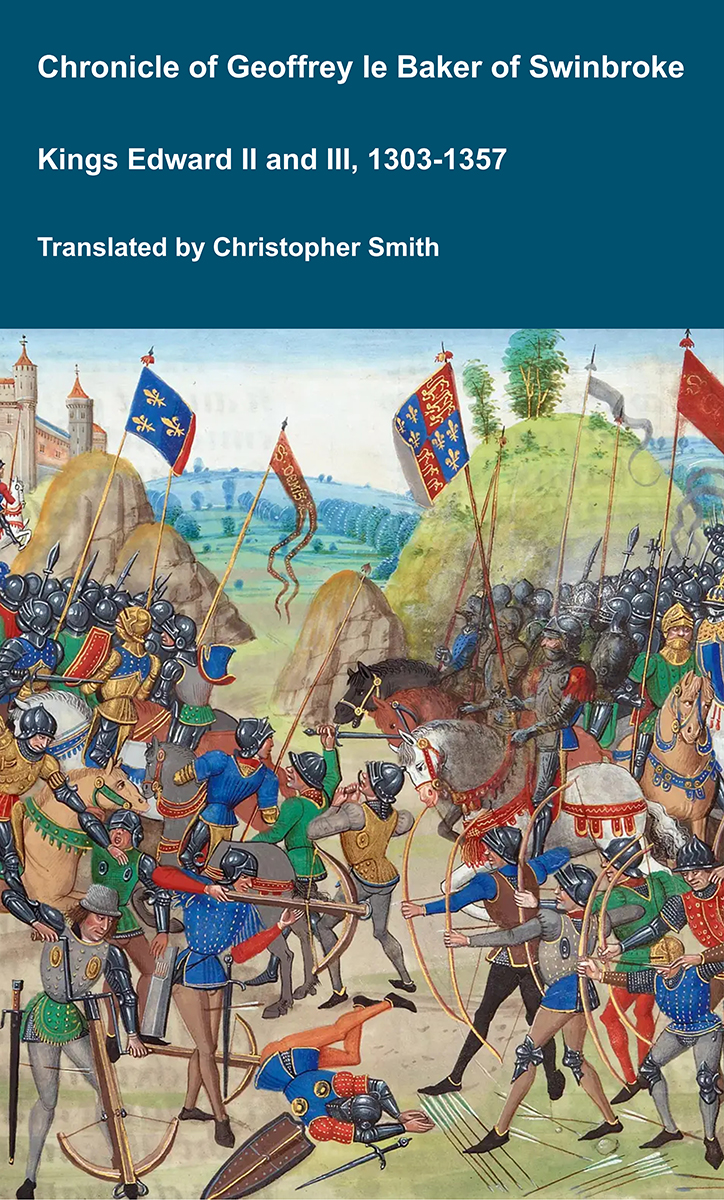
Chronicle of Geoffrey le Baker of Swinbroke
Baker was a secular clerk from Swinbroke, now Swinbrook, an Oxfordshire village two miles east of Burford. His Chronicle describes the events of the period 1303-1356: Gaveston, Bannockburn, Boroughbridge, the murder of King Edward II, the Scottish Wars, Sluys, Crécy, the Black Death, Winchelsea and Poitiers. To quote Herbert Bruce 'it possesses a vigorous and characteristic style, and its value for particular events between 1303 and 1356 has been recognised by its editor and by subsequent writers'. The book provides remarkable detail about the events it describes. Baker's text has been augmented with hundreds of notes, including extracts from other contemporary chronicles, such as the Annales Londonienses, Annales Paulini, Murimuth, Lanercost, Avesbury, Guisborough and Froissart to enrich the reader's understanding. The translation takes as its source the 'Chronicon Galfridi le Baker de Swynebroke' published in 1889, edited by Edward Maunde Thompson.
Available at Amazon in eBook and Paperback format.
Letters and Papers. 29th January 1536. Vienna Archives. 199. Chapuys [aged 46] to Charles V.
Some days ago I was informed from various quarters, which I did not think very good authorities, that notwithstanding the joy shown by the concubine [aged 35] at the news of the good Queen's death, for which she had given a handsome present to the messenger, she had frequently wept, fearing that they might do with her as with the good Queen. This morning I have heard from the lady [aged 33] mentioned in my letters of the 5th November1, and from her husband [aged 40], that they were informed by one of the principal persons at Court that this King had said to some one in great confidence, and as it were in confession, that he had made this marriage, seduced by witchcraft, and for this reason he considered it null; and that this was evident because God did not permit them to have any male issue, and that he believed that he might take another wife, which he gave to understand that he had some wish to do. The thing is very difficult for me to believe, although it comes from a good source. I will watch to see if there are any indications of its probability. Yet I have not forborne to give some little hint of it by a third hand to the Princess' gouvernante [aged 60], so as to warn her to treat the Princess a little better; and I have advised the latter to be as familiar as possible with her gouvernante so as to make her feel that when the Princess comes to her estate she will not regard her with disfavor.
Note 1. The Marchioness of Exeter. See Vol. IX., No. 776.
Letters and Papers. 29th January 1536. Vienna Archives. 200. Chapuys [aged 46] to Granvelle.
Cannot thank him sufficiently for his kindness, which quite overwhelms him As he writes to the Emperor, thinks the enterprise extremely difficult and almost impossible; yet persons who understand matters better than himself think it would not be difficult, for the whole people cries after the Emperor. Many suspect that if the Queen died by poison it was Gregory di Casale who sent it by a kinsman, of Modena, named Gorron, who came hither in haste, and by what he told me the night before he returned, he had come to obtain letters in behalf of the Prothonotary Casale. He said the King and Cromwell would speak to me about it, but they have not done so. Those who suspect this say the said Gregory must have earned somehow the 8 ducats a day the King gave him, and to get a slow poison which should leave no trace, they had sent for him (lavoyent envoye querre la), which Chapuys cannot easily believe, as there would be too great danger of its being made known. London, 29 Jan. 1535.
Letters and Papers. Vienna Archives. 142. Chapuys to Granvelle.
Thanks him for 3,000 ducats. Expresses his great obligations to Granvelle, who has made him what he is. Excuses himself for not having written lately, which was owing to haste, a slight indisposition, and the trouble occasioned by the death of the Queen, who certainly was very grateful to Granvelle for his good services. Among the last words she said, she made her excuse to his Majesty and you, and also to the comendador mayor, that she had not been able to write, and that I should beg his Majesty and request you too on her part one way or other to finish her business; for the slowness of the remedy and the gentleness shown to those here would destroy her and her daughter, and throw all the kingdom into confusion. The said Queen has not been able to give you proof of her good will, but the Princess, if she lives, will accomplish it, being well informed of your good services to her mother and her.
I have just been told there was some rumour that this King and the king of Scots were to have an interview on the frontiers about Easter. I do not attach much importance to it, because if it were so, the Scotch ambassador would have told me something of it. I have not been inclined to talk much of late days, and I refer you to my long letters to his Majesty. London, 21 Jan. 1535.
P.S.—I had arranged with the Queen's physician that whenever her life should be in danger she should be reminded to affirm in extremis that she had never been known by Prince Arthur, but he forgot it in his grief and trouble. It is suspected that the poison came from Italy, as I shall write to you shortly, but I do not believe it. Fr. From a modern copy, pp. 2.