

The History of William Marshal was commissioned by his son shortly after William’s death in 1219 to celebrate the Marshal’s remarkable life; it is an authentic, contemporary voice. The manuscript was discovered in 1861 by French historian Paul Meyer. Meyer published the manuscript in its original Anglo-French in 1891 in two books. This book is a line by line translation of the first of Meyer’s books; lines 1-10152. Book 1 of the History begins in 1139 and ends in 1194. It describes the events of the Anarchy, the role of William’s father John, John’s marriages, William’s childhood, his role as a hostage at the siege of Newbury, his injury and imprisonment in Poitou where he met Eleanor of Aquitaine and his life as a knight errant. It continues with the accusation against him of an improper relationship with Margaret, wife of Henry the Young King, his exile, and return, the death of Henry the Young King, the rebellion of Richard, the future King Richard I, war with France, the death of King Henry II, and the capture of King Richard, and the rebellion of John, the future King John. It ends with the release of King Richard and the death of John Marshal.
Available at Amazon in eBook and Paperback format.
Azure is in Field.
In September 1389 the Scrope vs Grosvenor Case was brought to the Court of Chivalry. Up to that time two families, Scrope and Grosvenor, had been using the armorial  Scrope Arms: Azure, a bend or.
Several hundred witnesses were called including John of Gaunt 1st Duke Lancaster [aged 49], Geoffrey Chaucer [aged 46] and John Savile of Shelley and Golcar [aged 64].
On 3rd September 1386 Owain ap Gruffudd "Glyndŵr" Mathrafal Prince Powys [aged 27] gave evidence at the Church of John the Baptist, Chester [Map].
The Court decided in favour of Scrope.
Neither party was happy with the decision so King Richard II [aged 22] was called upon to give his personal verdict.
On 27th May 1390 he confirmed that Grosvenor could not bear the undifferenced arms.
As a consequence of the case the Grosvenor has for many years used the name Bendor for horses and nicknames.


 Zouche Arms. Azure, ten bezants 4, 3, 2, 1.
 Greene Arms. Azure, three bucks or. Source.
 Grosvenor Arms. Azure a garb or. Source.
 Aylesbury Arms. Azure, a Cross argent. Source.
 Halswell Arms. Azure, three bars wavy argent over all a bend gules. Source
 Bentinck Arms. Azure a cross moline argent. Source.
 Holand Arms. Azure, semée-de-lys argent, a lion rampant. Source.
 Bligh Arms. Azure, a griffin segreant or, armes and langued gules, between three crescents argent.Source.
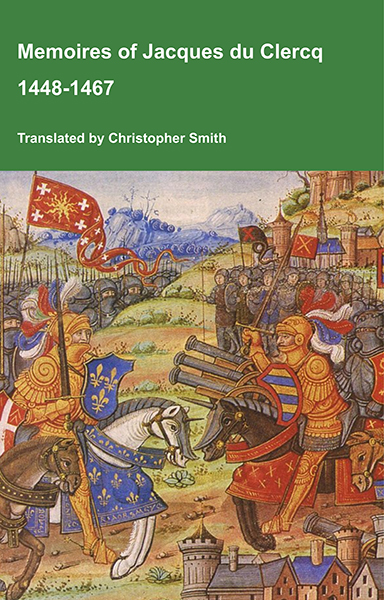
This is a translation of the 'Memoires of Jacques du Clercq', published in 1823 in two volumes, edited by Frederic, Baron de Reissenberg. In his introduction Reissenberg writes: 'Jacques du Clercq tells us that he was born in 1424, and that he was a licentiate in law and a counsellor to Philip the Good, Duke of Burgundy, in the castellany of Douai, Lille, and Orchies. It appears that he established his residence at Arras. In 1446, he married the daughter of Baldwin de la Lacherie, a gentleman who lived in Lille. We read in the fifth book of his Memoirs that his father, also named Jacques du Clercq, had married a lady of the Le Camelin family, from Compiègne. His ancestors, always attached to the counts of Flanders, had constantly served them, whether in their councils or in their armies.' The Memoires cover a period of nineteen years beginning in in 1448, ending in in 1467. It appears that the author had intended to extend the Memoirs beyond that date; no doubt illness or death prevented him from carrying out this plan. As Reissenberg writes the 'merit of this work lies in the simplicity of its narrative, in its tone of good faith, and in a certain air of frankness which naturally wins the reader’s confidence.' Du Clercq ranges from events of national and international importance, including events of the Wars of the Roses in England, to simple, everyday local events such as marriages, robberies, murders, trials and deaths, including that of his own father in Book 5; one of his last entries.
Available at Amazon in eBook and Paperback format.
 Bohun Arms. Azure, a bend argent cotised or between six lions rampant or. Source.
 Ireland Arms. Azure, a harp or stringed argent.
 Cantilupe Arms. Azure three leopard's faces jessant-de-lys or.
 Ivrea Arms. Azure, a lion rampant or, armed and langued gules. Source.
 Conyers Arms. Azure, a maunch or. Source.
 Kevelioc Arms. Azure three garbs or. Source.
 Crewe Arms. Azure a lion rampant Argent. Source.
 Legge Arms. Azure a stag's head caboshed argent. Source.
 Darcy Arms. Azure semée of cross crosslets argent, three cinquefoils of the last. Source.
 Molyneux Arms. Azure a cross moline or. Source.
 Digby Arms. Azure, a fleur de lys argent. Source.

The True Chronicles of Jean le Bel Volume 1 Chapters 1-60 1307-1342
The True Chronicles of Jean le Bel offer one of the most vivid and immediate accounts of 14th-century Europe, written by a knight who lived through the events he describes, and experienced some of them first hand. Covering the early decades of the Hundred Years’ War, this remarkable chronicle follows the campaigns of Edward III of England, the politics of France and the Low Countries, and the shifting alliances that shaped medieval warfare. Unlike later historians, Jean le Bel writes with a strong sense of eyewitness authenticity, drawing on personal experience and the testimony of fellow soldiers. His narrative captures not only battles and sieges, but also the realities of military life, diplomacy, and the ideals of chivalry that governed noble society. A key source for Jean Froissart, Le Bel’s chronicle stands on its own as a compelling and insightful work, at once historical record and literary achievement. This translation builds on the 1905 edition published in French by Jules Viard, adding extensive translations from other sources Rymer's Fœdera, the Chronicles of Adam Murimuth, William Nangis, Walter of Guisborough, a Bourgeois of Valenciennes, Geoffrey le Baker of Swinbroke and Richard Lescot to enrich the original text and Viard's notes.
Available at Amazon in eBook and Paperback format.
 Murray Arms. Azure, three mullets argent, within a double tressure flory counter-flory or. Source.
 Musgrave Arms. Azure six annulets or. Source.
 Fitzhugh Arms. Azure, three chevrons interlaced in base or a chief of the last. Source.
 Oglander Arms. Azure, a stork between three cross-croslets fitchée or. Source
 France Ancient Arms. Azure semy-de-lis or. Source.
 Freschville Arms. Azure, bend argent between six escallops.
 Ponthieu Arms. Azure, three bends or a bordure gules.
 Bardolf Arms. Azure three cinquefoils buttoned gules. Source.
Chronicle of Walter of Guisborough
A canon regular of the Augustinian Guisborough Priory, Yorkshire, formerly known as The Chronicle of Walter of Hemingburgh, describes the period from 1066 to 1346. Before 1274 the Chronicle is based on other works. Thereafter, the Chronicle is original, and a remarkable source for the events of the time. This book provides a translation of the Chronicle from that date. The Latin source for our translation is the 1849 work edited by Hans Claude Hamilton. Hamilton, in his preface, says: 'In the present work we behold perhaps one of the finest samples of our early chronicles, both as regards the value of the events recorded, and the correctness with which they are detailed; Nor will the pleasing style of composition be lightly passed over by those capable of seeing reflected from it the tokens of a vigorous and cultivated mind, and a favourable specimen of the learning and taste of the age in which it was framed.'
Available at Amazon in eBook and Paperback format.
 Robartes Arms. Azure, three estoiles and a chief wavy or. Source.
 Blois Arms. Azure a bend argent cotised. Source.
 Rochfort Arms. Azure, a lion rampant argent. Source.
 Clotworthy Arms. Azure, a chevron ermine between three chaplets or. Source.
Scrope Arms. Azure, a bend or. Source.
 Cullum Arms. Azure, a chevron ermine between three pelicans vulning their breasts or. Source.
 Sedley Ailesford Arms. Azure a fess wavy argent three rams heads argent. Source.
 Dormer Arms. Azure, ten billets or 4,3,2,1 issuant from a chief of the second a demi lion rampant sable langued gules.
 St Leger Arms. Azure fretty argent, a chief or. Source.
 Fortescue Arms. Azure a bend engrailed argent cotised or. Source.
 Tilney Arms. Azure, a chevron between three griffin's heads erased or. Source.
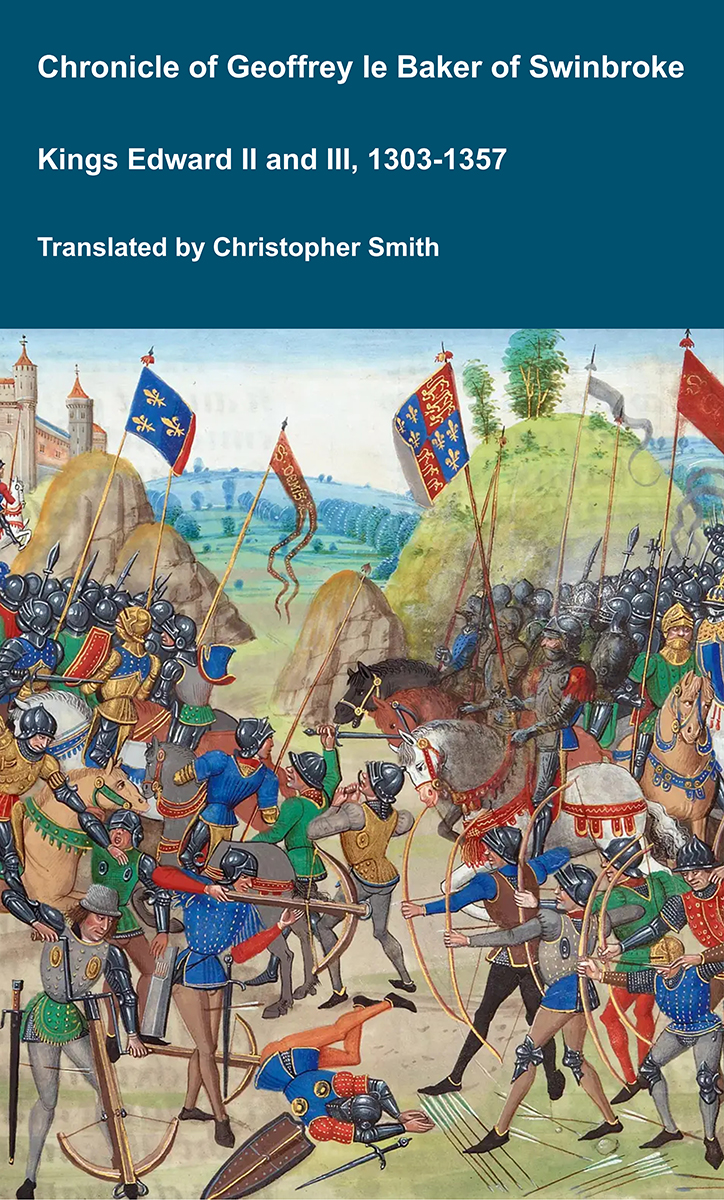
Chronicle of Geoffrey le Baker of Swinbroke
Baker was a secular clerk from Swinbroke, now Swinbrook, an Oxfordshire village two miles east of Burford. His Chronicle describes the events of the period 1303-1356: Gaveston, Bannockburn, Boroughbridge, the murder of King Edward II, the Scottish Wars, Sluys, Crécy, the Black Death, Winchelsea and Poitiers. To quote Herbert Bruce 'it possesses a vigorous and characteristic style, and its value for particular events between 1303 and 1356 has been recognised by its editor and by subsequent writers'. The book provides remarkable detail about the events it describes. Baker's text has been augmented with hundreds of notes, including extracts from other contemporary chronicles, such as the Annales Londonienses, Annales Paulini, Murimuth, Lanercost, Avesbury, Guisborough and Froissart to enrich the reader's understanding. The translation takes as its source the 'Chronicon Galfridi le Baker de Swynebroke' published in 1889, edited by Edward Maunde Thompson.
Available at Amazon in eBook and Paperback format.
 Agar Arms. Azure, a lion rampant or. Source.
 Townshend Arms. Azure, a chevron ermine between three escallops argent. Source.
 Bruyn Arms. Azure, a cross moline or. Appears to be the same as Molyneux Arms.
 De La Pole Arms. Azure, a fess between three leopard's faces or. Source.
 Vincent Arms. Azure, three quatrefoils argent. Source.
 Cosin Arms. Azure, a fret or.
 Fiennes Arms. Azure three lions rampant or. Source.
 Bingham Arms. Azure a bend cotised between six crosses pattee or. Source.
 Watkins Arms. Azure, a fess vair between three leopard's faces jessant-de-lys or. Source.
 Wyndham Arms. Azure, a chevron between three lion's heads erased or.
Jean de Waurin's Chronicle of England Volume 6 Books 3-6: The Wars of the Roses
Jean de Waurin was a French Chronicler, from the Artois region, who was born around 1400, and died around 1474. Waurin’s Chronicle of England, Volume 6, covering the period 1450 to 1471, from which we have selected and translated Chapters relating to the Wars of the Roses, provides a vivid, original, contemporary description of key events some of which he witnessed first-hand, some of which he was told by the key people involved with whom Waurin had a personal relationship.
Available at Amazon in eBook and Paperback format.
 Capet Arms. Azure, three Fleur de lys or. Source.


.svg)


.svg)


.svg)


#/media/File:PoleOfShuteArms.png)
.svg)


.svg)


