

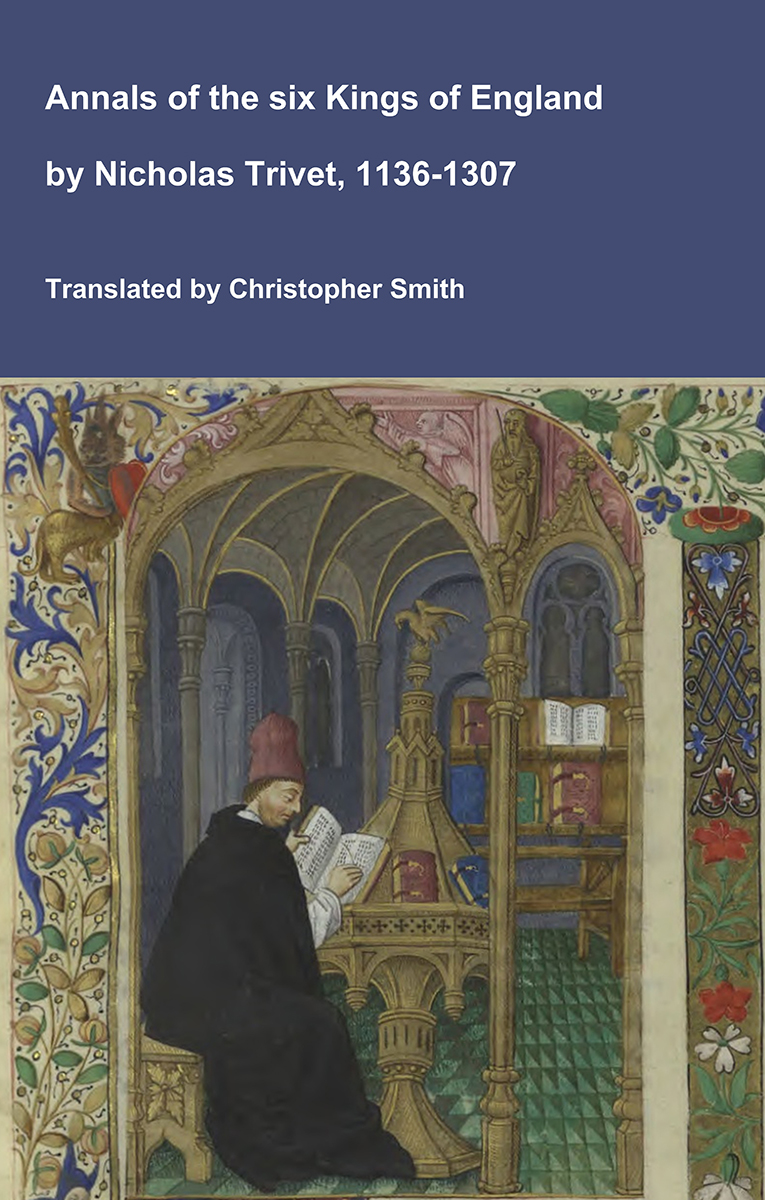
Annals of the six Kings of England by Nicholas Trivet
Translation of the Annals of the Six Kings of England by that traces the rise and rule of the Angevin aka Plantagenet dynasty from the mid-12th to early 14th century. Written by the Dominican scholar Nicholas Trivet, the work offers a vivid account of English history from the reign of King Stephen through to the death of King Edward I, blending political narrative with moral reflection. Covering the reigns of six monarchs—from Stephen to Edward I—the chronicle explores royal authority, rebellion, war, and the shifting balance between crown, church, and nobility. Trivet provides detailed insight into defining moments such as baronial conflicts, Anglo-French rivalry, and the consolidation of royal power under Edward I, whose reign he describes with particular immediacy. The Annals combines careful year-by-year reporting with thoughtful interpretation, presenting history not merely as a sequence of events but as a moral and political lesson. Ideal for readers interested in medieval history, kingship, and the origins of the English state, this chronicle remains a valuable and accessible window into the turbulent world of the Plantagenet kings.
Available at Amazon in eBook and Paperback format.
 St James' Church, Spilsby
 Tewkesbury Abbey
 St Peter's Church, Elford
 St Boniface's Church, Bunbury
 St Andrew's Church, Wingfield
 Belvoir Priory
 St Mary the Virgin Church, Bottesford, Leicestershire
 Church of St Oswald, Methley
 St Mary's Church, Staindrop
 St Mary's Church, Kington
Early Plate Bascinet Period is in Church Monument Periods.
The Early Plate Bascinet Period has similarities with the preceding Camail and Jupon Period. The primary difference being the bascinet being decorated with an orle as a means of further protection.
On 29th March 1372 John Willoughby 3rd Baron Willoughby [aged 49] died. His son Robert [aged 23] succeeded 4th Baron Willoughby de Eresby. Margery Zouche Baroness Willoughby of Eresby [aged 33] by marriage Baroness Willoughby de Eresby.
He was buried at St James' Church, Spilsby [Map]. Early Plate Bascinet Period.
John Willoughby 3rd Baron Willoughby:
In 1323 he was born to John Willoughby 2nd Baron Willoughby and Joan Roscelyn Baroness Willoughby and Latimer at Willoughby-on-the-Wolds, Nottinghamshire [Map].
Before 1349 John Willoughby 3rd Baron Willoughby and Cecily Ufford Baroness Willoughby of Eresby were married. When John married Cecily he changed his arms from  Willoughby Arms to
  Willoughby de Eresby Arms. She the daughter of Robert Ufford 1st Earl Suffolk and Margaret Norwich Countess Suffolk.
Margery Zouche Baroness Willoughby of Eresby: Around 1339 she was born to William Zouche 2nd Baron Zouche Harringworth and Elizabeth Ros Baroness Zouche Harringworth. Before 1st October 1369 Robert Willoughby 4th Baron Willoughby and she were married. They were sixth cousins. On 18th October 1391 Margery Zouche Baroness Willoughby of Eresby died.


On 17th August 1390 Guy de Bryan [aged 71] died. Monument at Tewkesbury Abbey [Map]. Alabaster with, unusually, a portrait rather than a generic face. Early Plate Bascinet Period. He was buried at St James' Church, Slapton.
After 1391. St Peter's Church, Elford [Map]. Some discussion as to whether a monument to Thomas Arderne [aged 54] and Catherine Stafford [aged 53], or to his son John Arderne [aged 21] and Margaret Pilkington [aged 20]. Early Plate Bascinet Period. Holding Hands. Chest with Angels with Rounded Wings holding Shields. Chunky Lions Mane. Angels Supporting Pillow. Possibly Sutton and Prentys.


On 23rd April 1394 Hugh Calverley [aged 70] died. He was probably buried in St Boniface's Church, Bunbury [Map]. Monument Early Plate Bascinet Period. Finely carved Calf's Head on the breastplate representing Hugh Calverley's canting arms. Calf's Head Crest. Hip Belt. Basinet with decorated Orle.


After 9th August 1396 Robert Willoughby 4th Baron Willoughby [deceased] was buried at St James' Church, Spilsby [Map] with his third wife Elizabeth Latimer 5th Baroness Latimer, Baroness Neville and Willoughby. Early Plate Bascinet Period. Remarkable helm on which the Baron's head rests with a Bearded Man crest, or a man's bust ducally crowned. Excellent orle around the Baron's bascinet.


After 1419. Monument to Michael de la Pole 2nd Earl Suffolk and Katherine Stafford Countess Suffolk [aged 43] in St Andrew's Church, Wingfield [Map]. Early Plate Bascinet Period.
Katherine Stafford Countess Suffolk: Around 1376 she was born to Hugh Stafford 2nd Earl Stafford and Philippa Beauchamp Countess Stafford. She a great x 3 granddaughter of King Edward I of England. Before 1394 Michael de la Pole 2nd Earl Suffolk and she were married. She by marriage Countess Suffolk. She the daughter of Hugh Stafford 2nd Earl Stafford and Philippa Beauchamp Countess Stafford. He the son of Michael de la Pole 1st Earl Suffolk and Katherine Wingfield Countess Suffolk. On 8th April 1419 Katherine Stafford Countess Suffolk died.
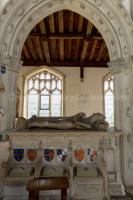
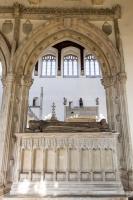
After 22nd March 1421 John Ros 7th Baron Ros Helmsley [deceased] was buried at Belvoir Priory [Map]. His remains and monument were subsequently relocated to the Chancel of St Mary the Virgin Church, Bottesford, Leicestershire [Map]. Early Plate Bascinet Period.
John Ros 7th Baron Ros Helmsley: Around 1397 he was born to William Ros 6th Baron Ros Helmsley and Margaret Fitzalan Baroness Ros of Helmsley. He a great x 4 grandson of King Henry III of England. On 1st September 1414 William Ros 6th Baron Ros Helmsley died. His son John succeeded 7th Baron Ros Helmsley. Before 22nd March 1421 John Ros 7th Baron Ros Helmsley and Margery Despencer 3rd Baroness Despencer, Baroness Ros were married. She by marriage Baroness Ros Helmsley. They were third cousins. He a great x 4 grandson of King Henry III of England.

Detail of Lancastrian Esses Collar and the trefoil fixing holding the Lancastrian Esses Collar to the bottom of the Camail.

Detail of IHC NASARE Lettering and Decorated Orle and decorated Vervelle Cover. Bascinet with Gorget. Lancastrian Esses Collar.

Detail of the Ros Peacock Crest which surmounted his Great Helm; only the feet remain.

Detail of the Hourglass Gauntlets and graffiti.
After 1423. St Peter's Church, Elford [Map]. Monument to John Stanley. Early Plate Bascinet Period. Maiden's Face Buckle. Eagle and Baby Crest; the legend associated with Sir John's descent from his ancestor, Sir Thomas Latham, whose wanted his barren wife to adopt his illegitimate son so he placed the baby in a nearby eagle's nest. His wife was delighted with this 'miracle' and took the child as her own.
Historic England states ... "Knight of circa 1370, alabaster, with bogus Gothic inscription by Richardson to Sir John Stanley, died 1474".
Mark Downing, President of the Church Monuments Society states on FB ... My research concludes c.1410. On a modern alabaster tomb-chest in the north-east corner of the south aisle. Stebbing Shaw quotes the inscription and expenses by Humphrey Stanley who probably acquired the effigy from a dissolved monastic house, with the inscription added c.1540 by possibly a Burton-on-Trent workshop. Restored and re-cut by Richardson in 1848/49. He states that he renewed the eagle crest, parts of the basinet, aventail, left arm, gauntlets, grip of the dagger, rowel spurs, spur straps, first part of the inscription and tomb-chest. Inscription on the right side of the slab: Orate pro aia d'ni Joh'is Stanley milit quondam d'ni de pype clyfton caumpuyle elforde et stotfolde et hui' Cantarie et capelle fundator' Anno d'ni Mil'simo CCCCMO Septuagesimo quarto. It is worth commenting that the rapier sword was not introduced until the sixteenth century and that this sword was cut into the slab when the inscription was added.
Humphrey Stanley: Around 1450 he was born to John Stanley and Elizabeth Vernon at Pipe, Staffordshire. On 19th March 1505 Humphrey Stanley died.


After 17th January 1425. Monument in Church of St Oswald, Methley [Map] to Robert Waterton [deceased] and Cecily Fleming.
York School of Carving. Crocketed arch. He in Early Plate Bascinet Period armour. Large Orle highly decorated with head resting on great helm with feathered crest. Beard with spiral twists. Collar Esses and Crowns Alternating. Misericorde. Hip Belt with decorated buckle. She wearing a squared crespine headress and small Esses Collar. Chest with Angels with Rounded Wings holding Shields. Chunky Lions Mane.
Cecily Fleming: she was born to Robert Fleming of Woodhall. Before 1398 Robert Waterton and she were married. Around 1424 she died.


Abbot John Whethamstede’s Chronicle of the Abbey of St Albans
Abbot John Whethamstede's Register aka Chronicle of his second term at the Abbey of St Albans, 1451-1461, is a remarkable text that describes his first-hand experience of the beginning of the Wars of the Roses including the First and Second Battles of St Albans, 1455 and 1461, respectively, their cause, and their consequences, not least on the Abbey itself. His text also includes Loveday, Blore Heath, Northampton, the Act of Accord, Wakefield, and Towton, and ends with the Coronation of King Edward IV. In addition to the events of the Wars of the Roses, Abbot John, or his scribes who wrote the Chronicle, include details in the life of the Abbey such as charters, letters, land exchanges, visits by legates, and disputes, which provide a rich insight into the day-to-day life of the Abbey, and the challenges faced by its Abbot.
Available at Amazon in eBook and Paperback format.
On 21st October 1425 Ralph Neville 1st Earl of Westmoreland [aged 61] died. He was buried at St Mary's Church, Staindrop [Map]. His grandson Ralph [aged 19] succeeded 2nd Earl of Westmoreland. Elizabeth Percy Countess of Westmoreland [aged 30] by marriage Countess of Westmoreland.
Monument to Ralph Neville 1st Earl of Westmoreland and his wives Margaret Stafford Baroness Neville Raby and Joan Beaufort Countess of Westmoreland [aged 46]. Early Plate Bascinet Period. Orle. Man with Two Wives.
Elizabeth Percy Countess of Westmoreland: Around 1395 she was born to Henry "Hotspur" Percy and Elizabeth Mortimer Baroness Camoys at Alnwick Castle, Northumberland [Map]. She a great x 2 granddaughter of King Edward III of England. Around 1404 John Clifford 7th Baron Clifford and she were married. She by marriage Baroness de Clifford. They were third cousin once removed. He a great x 4 grandson of King Edward I of England. She a great x 2 granddaughter of King Edward III of England. In 1426 Ralph Neville 2nd Earl of Westmoreland and she were married. They were second cousin once removed. He a great x 3 grandson of King Edward I of England. She a great x 2 granddaughter of King Edward III of England. On 26th October 1436 Elizabeth Percy Countess of Westmoreland died.


St Mary's Church, Kington [Map]. Thomas Vaughan killed 24th July 1469 at the Edgecote Moor and wife Elena "Terrible" Gethen so called because she murdered her cousin who had murdered her brother. Alabaster. Early Plate Bascinet Period. Tassets. Believed to have been moved from the Chancel since it is decorated on all sides. Possible Harpur and Moorecock of Burton on Trent - see the folds at the base of her dress and the possible little dog between them. Chest with Angels with Rounded Wings holding Shields.


