


Ordinaries is in Terms.
 Joicey Arms. Argent three lozenges Sable within two bendlets invected gules between two miners' picks in bend proper. Source.
 Nelson Arms. Or, a cross flory sable a bendlet gules. Source.
Bendy is a pattern of diagonal stripes (bendlet), running from top-left to bottom-right.
Crusilly. Sprinkled. Similar, if not the same as Semée.
 Beresford Arms. Argent, crusilly fitchée sable, three fleurs-de-lis within a bordure engrailed of the second. Source.
Orle. A border around the edge of the shield composed of charges.
 Brownlow Arms. Or an escutcheon within an orle of martlets sable. Source
Henrici Quinti, Angliæ Regis, Gesta, is a first-hand account of the Agincourt Campaign, and subsequent events to his death in 1422. The author of the first part was a Chaplain in King Henry's retinue who was present from King Henry's departure at Southampton in 1415, at the siege of Harfleur, the battle of Agincourt, and the celebrations on King Henry's return to London. The second part, by another writer, relates the events that took place including the negotiations at Troye, Henry's marriage and his death in 1422.
Available at Amazon in eBook and Paperback format.
Pale. Vertically. Usually a vertical stripe, sometimes an animal.
 Brandon Arms. Barry of ten argent and gules, a lion rampant or ducally crowned per pale of the first and second. Source.
 Plantagenet Arms. Gules, three lions passant guardant in pale or armed and langued azure. Source.
 Giffard Arms. Gules Three lions passant guardant or in pale or.
 Normandy Arms. Gules, two lions passant guardant in pale or armed and langued azure. Source.
 Strange Arms. Argent, two lions passant in pale gules. Source.
Semée. Seeded like the field being sown.
 Brunswick Luneburg Arms. Per pale, I gules two lions passant guardant or (for Brunswick), II or a semy of hearts gules a lion rampant azure (for Lunenburg).
 Clifton Arms. Sable semée of cinquefoils and a lion rampant argent. Source.
 Darcy Arms. Azure semée of cross crosslets argent, three cinquefoils of the last. Source.
Chronicle of Walter of Guisborough
A canon regular of the Augustinian Guisborough Priory, Yorkshire, formerly known as The Chronicle of Walter of Hemingburgh, describes the period from 1066 to 1346. Before 1274 the Chronicle is based on other works. Thereafter, the Chronicle is original, and a remarkable source for the events of the time. This book provides a translation of the Chronicle from that date. The Latin source for our translation is the 1849 work edited by Hans Claude Hamilton. Hamilton, in his preface, says: 'In the present work we behold perhaps one of the finest samples of our early chronicles, both as regards the value of the events recorded, and the correctness with which they are detailed; Nor will the pleasing style of composition be lightly passed over by those capable of seeing reflected from it the tokens of a vigorous and cultivated mind, and a favourable specimen of the learning and taste of the age in which it was framed.'
Available at Amazon in eBook and Paperback format.
 France Ancient Arms. Azure semy-de-lis or. Source.
 Holand Arms. Azure, semée-de-lys argent, a lion rampant. Source.
 Pierrepoint Arms. Argent, semée of cinquefoils gules, a lion rampant sable. Source.
Tressure. A subordinary. A line or two lines forming a border. Possibly a diminutive of the orle.
 Duke Atholl Arms.
  Earl Atholl Arms overall, an inescutcheon en surtout azure three mullets argent within a double tressure flory or ensigned of a Marquess's coronet. Source.
 Bowes Lyon Arms. Quarterly 1&4 Argent a lion rampant azure, armed and langued gules within a double tressure flory counter-flory of the second (for Lyon); 2&3 ermine three bows stringed palewise in fess proper (for Bowes).
 Marquess Zetland Arms.
  Dundas Arms within a double tressure flory counterflory gules, all within a bordure azure. Source.
 Dunkeld Arms. Or a lion rampant gules armed and langued azure a double tressure flory counter-flory gules.
 Murray Arms. Azure, three mullets argent, within a double tressure flory counter-flory or. Source.
 Earl Roseberry Arms. Quarterly, 1&4 vert, three primroses within a double tressure flory counter-flory or (for Primrose); 2&3 argent, a lion rampant double queued sable (for Cressy). Source.
 Stewart Royal Arms. Or a lion rampant gules armed and langued azure within a double tressure flory counter-flory of the second.
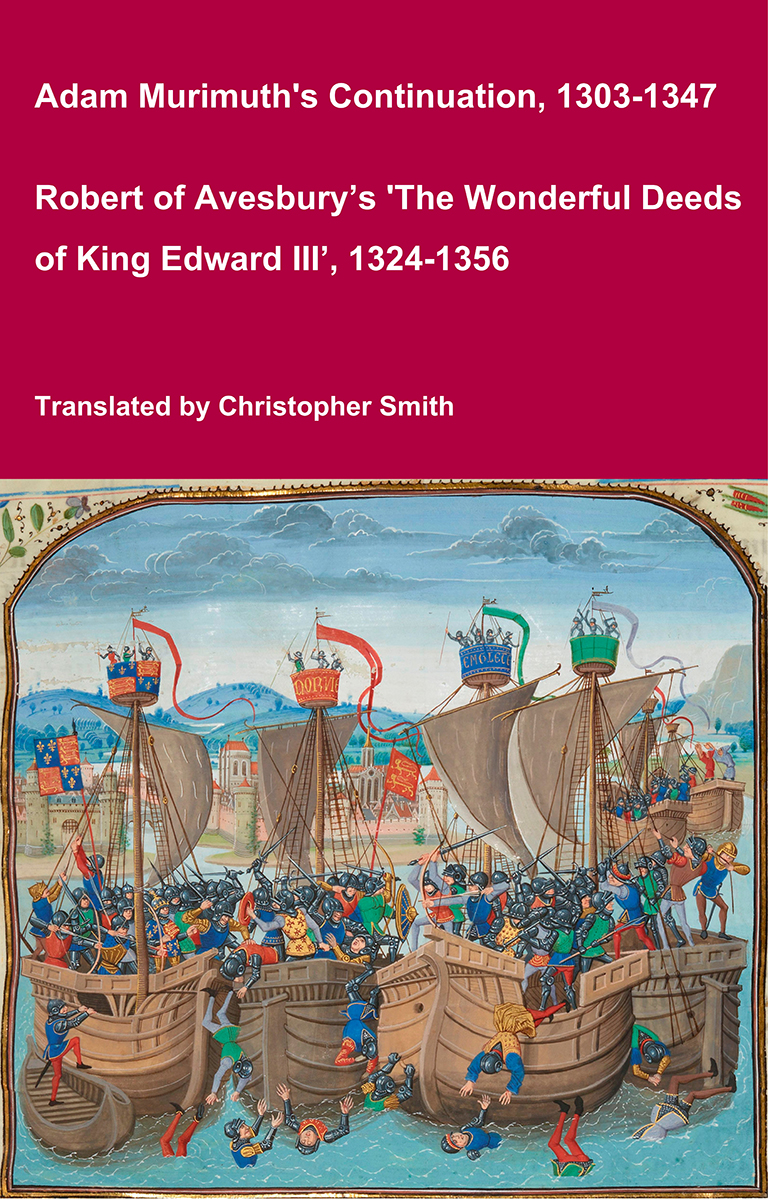
Adam Murimuth's Continuation and Robert of Avesbury’s 'The Wonderful Deeds of King Edward III'
This volume brings together two of the most important contemporary chronicles for the reign of Edward III and the opening phases of the Hundred Years’ War. Written in Latin by English clerical observers, these texts provide a vivid and authoritative window into the political, diplomatic, and military history of fourteenth-century England and its continental ambitions. Adam Murimuth Continuatio's Chronicarum continues an earlier chronicle into the mid-fourteenth century, offering concise but valuable notices on royal policy, foreign relations, and ecclesiastical affairs. Its annalistic structure makes it especially useful for establishing chronology and tracing the development of events year by year. Complementing it, Robert of Avesbury’s De gestis mirabilibus regis Edwardi tertii is a rich documentary chronicle preserving letters, treaties, and official records alongside narrative passages. It is an indispensable source for understanding Edward III’s claim to the French crown, the conduct of war, and the mechanisms of medieval diplomacy. Together, these works offer scholars, students, and enthusiasts a reliable and unembellished account of a transformative period in English and European history. Essential for anyone interested in medieval chronicles, the Hundred Years’ War, or the reign of Edward III.
Available at Amazon in eBook and Paperback format.
Vair describes the pattern made frrom squirrel furs.


#/media/File:Arms_Nelson_(of_Mawdesley,_Lancs).svg)


.svg)
#/media/File:BrandonArms.png)

.svg)


#/media/File:PoleOfShuteArms.png)


.svg)

