

This is a translation of the 'Memoires of Jacques du Clercq', published in 1823 in two volumes, edited by Frederic, Baron de Reissenberg. In his introduction Reissenberg writes: 'Jacques du Clercq tells us that he was born in 1424, and that he was a licentiate in law and a counsellor to Philip the Good, Duke of Burgundy, in the castellany of Douai, Lille, and Orchies. It appears that he established his residence at Arras. In 1446, he married the daughter of Baldwin de la Lacherie, a gentleman who lived in Lille. We read in the fifth book of his Memoirs that his father, also named Jacques du Clercq, had married a lady of the Le Camelin family, from Compiègne. His ancestors, always attached to the counts of Flanders, had constantly served them, whether in their councils or in their armies.' The Memoires cover a period of nineteen years beginning in in 1448, ending in in 1467. It appears that the author had intended to extend the Memoirs beyond that date; no doubt illness or death prevented him from carrying out this plan. As Reissenberg writes the 'merit of this work lies in the simplicity of its narrative, in its tone of good faith, and in a certain air of frankness which naturally wins the reader’s confidence.' Du Clercq ranges from events of national and international importance, including events of the Wars of the Roses in England, to simple, everyday local events such as marriages, robberies, murders, trials and deaths, including that of his own father in Book 5; one of his last entries.
Available at Amazon in eBook and Paperback format.
 Avebury Type Cove
 Arbor Low Henge and Stone Circle
 Avebury North Circle Cove
 Longstones Cove aka Devil's Quoits
 Stanton Drew Cove
 Stenness Type Cove
 Stones of Stenness
Cove is in Late Neolithic to Early Bronze Age Monuments.
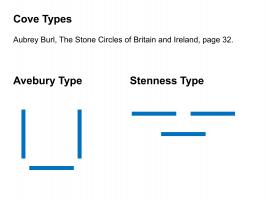
Cove describes a either a three-sided structure, the Avebury Type, formed from upright stones typically at the centre of a Stone Circles or the end of an Avenue, or the Stenness Type: three stones, inline, with the middle offset, as per the following diagram:
A Avebury Type Cove describes three stones set in a C shape.
Arbor Low Henge and Stone Circle [Map]. Aubrey Burl, in his book "A Guide to the Stone Circles of Britain, Ireland and Brittany", states "The three sided Cove is now prostrate, two huge sides tumbled outwards, a long low stone on edge like a sill or septal slab between them at the east and other little stones nearby. A skeleton of a man about 5ft 5ins tall was buried againbst the eastern corner. Immediately east was a deep pit with a human armbone in it. "It is possible", wtrote the excavator, "That a skeleton or skeltons may have been removed from here".
A Stenness Type Cove describes three stones, inline, with the centre stone offset, as per the diagram:
3100BC. The Stones of Stenness [Map] is a Henge and Stone Circles erected around 3100BC based on radio-carbon dating; it isn't clear who undertook the dating? Aubrey Burl, in his book "A Guide to the Stone Circles of Britain, Ireland and Brittany", states "The setting [Stenness Type Cove] had consisted of three erect stones, two in line side by side, N-S, separated by a narrow gap behind which the third stood like the backstone of a chamber. It is a form of Cove.