

Chronicle of a Bourgeois of Valenciennes
Récits d’un bourgeois de Valenciennes aka The Chronicle of a Bourgeois of Valenciennes is a vivid 14th-century vernacular chronicle written by an anonymous urban chronicler from Valenciennes in the County of Hainaut. It survives in a manuscript that describes local and regional history from about 1253 to 1366, blending chronology, narrative episodes, and eyewitness-style accounts of political, military, and social events in medieval France, Flanders, and the Low Countries. The work begins with a chronological framework of events affecting Valenciennes and its region under rulers such as King Philip VI of France and the shifting allegiances of local nobility. It includes accounts of conflicts, sieges, diplomatic manoeuvres, and the impact of broader struggles like the Hundred Years’ War on urban life in Hainaut. Written from the perspective of a burgher (bourgeois) rather than a monastery or royal court, the chronicle offers a rare lay viewpoint on high politics and warfare, reflecting how merchants, townspeople, and civic institutions experienced the turbulence of the 13th and 14th centuries. Its narrative style combines straightforward reporting of events with moral and civic observations, making it a valuable source for readers interested in medieval urban society, regional politics, and the lived experience of war and governance in pre-modern Europe.
Available at Amazon in eBook and Paperback format.
Garnwnda Burial Chamber is in Llanwnda, Pembrokeshire, Prehistoric Wales Neolithic Burials.
An Historical Tour through Pembrokeshire. Proceed to the village of Llanwnda, in which the parish church is situated, where, on the verge of the rocky eminence just above it, stands a (g) Cromlech [Garnwnda Burial Chamber [Map]], resting obliquely on one stone about five feet high from the ground, whose dimensions are fifteen feet by nine, nearly of an equal thickness of two. feet, and uncommonly smooth for so large an unhewn slab of such coarse kind of stone. On a ledge of rock a little higher, behind 1t, appears a detached mass of stone of a most grotesque appearance, as if art had been made use of to add to the wildness of nature; so that, on approaching the Cromlech, it very forcibly arrests the attention, and inclines one to suppose that it might have been, from its singular form and position, meant for an object of idolatry. And this might have been the Hercules saxanus that. Keysler says the northern nations worshipped in rocky places, as easily supplying materials that would admit of taking that diversity of form by which their various deities were characterised.
Note g. (g) As the recurrence of the term Cromlech will be frequent and unavoidable in the course of this work, my English readers may expect some explanation of it; the word literally means a stone that inclines or bends downwards, but here, taken in its popular acceptation, signifies the stone of covenant, or altar of Bardism, which stood in the circle of federation, and was subservient to various ceremonies of that mysterious system. Though often confounded: with the Cistvaen, it is in construction obviously and essentially different, and was so undoubtedly in its use, the Cistvaen. having the space it occupied entirely shut in, and its lid horizontal, whereas the Cromlech resting on one, two, three, or more supporters, is open, and the incum- bent stone almost always with a considerable inclination.
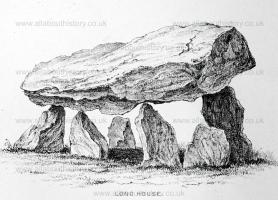
Archaeologia Cambrensis 1872 Pages 81-143. Overlooking the little church of Llanwnda, near Fishguard, is what some, perhaps, would call a variety of the demi-dolmen [Garnwnda Burial Chamber [Map]]; but which is an ordinary dolmen, the capstone of which has slipped, and now rests in a standing position on only one of its supporters. It measures 14 ft. according to Fenton, and is somewhat of triangular form; not very dissimilar to the "Coetan Arthur [Map]" ~ cromlech near Criccieth (described in the Arch. Camb. of 1869, p. 135) in outline of form, but in its thickness very different from the rude masses such as those of Llech Tribedd and others. It is only 20 inches thick. The supporting stones are also of the same character. This dolmen is in such a dilapidated state that it does not contribute any light to the general subject, except as shewing how much the character of such structures depends on the kind of stone available. But for this fact one might be tempted, from its less massive character, to look upon it as somewhat later than the more massive and rougher monuments. On the lower ground are several upright stones irregularly placed; but it would be dangerous to speculate upon their character, as, with the exception of three or four, their age is very questionable.