

Planets is in Solar System.
Mercury ...
is, on average, 0.39 AUs from the Sun.
has a diameter of 2440 Kms; around one third of the Earth.
has an eccentic orbit with the closest distance to the Sun being 47 million kilometers, and the farthest distance being 70 million kilometers.
has a year of 88 days.
spins on its axis every 59 days.
is tilted at 2 degrees.
formed around 4.5 Billion years ago.
John Evelyn's Diary. 24th October 1664. We dined at Sir Timothy Tyrill's [aged 47] at Shotover. This gentleman married the daughter and heir [aged 45] of Dr. James Usher, Archbishop of Armagh, that learned prelate. There is here in the grove a fountain of the coldest water I ever felt, and very clear. His plantation of oaks and other timber is very commendable. We went in the evening to Oxford, lay at Dr. Hyde's [aged 47], principal of Magdalen-Hall (related to the Lord Chancellor [aged 55]), brother to the Lord Chief Justice [aged 69] and that Sir Henry Hyde, who lost his head for his loyalty. We were handsomely entertained two days. The Vice-Chancellor, who with Dr. Fell, Dean of Christ Church, the learned Dr. Barlow, Warden of Queen's, and several heads of houses, came to visit Lord Cornbury his father being now Chancellor of the University), and next day invited us all to dinner. I went to visit Mr. Boyle [aged 37] (now here), whom I found with Dr. Wallis and Dr. Christopher Wren, in the tower of the schools, with an inverted tube, or telescope, observing the discus of the sun for the passing of Mercury that day before it; but the latitude was so great that nothing appeared; so we went to see the rarities in the library, where the keepers showed me my name among the benefactors. They have a cabinet of some medals, and pictures of the muscular parts of man's body. Thence, to the new theater, now building at an exceeding and royal expense by the Lord Archbishop of Canterbury [Sheldon [aged 66]], to keep the Acts in for the future, till now being in St. Mary's Church. The foundation had been newly laid, and the whole designed by that incomparable genius my worthy friend, Dr. Christopher Wren, who showed me the model, not disdaining my advice in some particulars. Thence, to see the picture on the wall over the altar of All Souls, being the largest piece of fresco painting (or rather in imitation of it, for it is in oil of turpentine) in England, not ill designed by the hand of one Fuller; yet I fear it will not hold long. It seems too full of nakeds for a chapel.


Samuel Pepys' Diary. 7th August 1666. In the evening comes Mr. Reeves, with a twelve-foote glasse, so I left the office and home, where I met Mr. Batelier with my wife, in order to our going to-morrow, by agreement, to Bow to see a dancing meeting. But, Lord! to see how soon I could conceive evil fears and thoughts concerning them; so Reeves and I and they up to the top of the house, and there we endeavoured to see the moon, and Saturne and Jupiter; but the heavens proved cloudy, and so we lost our labour, having taken pains to get things together, in order to the managing of our long glasse.
Samuel Pepys' Diary. 8th August 1666. About ten o'clock we rose from table, and sang a song, and so home in two coaches (Mr. Batelier and his sister Mary and my wife and I in one, and Mercer alone in the other); and after being examined at Allgate [Map], whether we were husbands and wives, home, and being there come, and sent away Mr. Batelier and his sister, I find Reeves there, it being a mighty fine bright night, and so upon my leads, though very sleepy, till one in the morning, looking on the moon and Jupiter, with this twelve-foote glasse and another of six foote, that he hath brought with him to-night, and the sights mighty pleasant, and one of the glasses I will buy, it being very usefull.
Samuel Pepys' Diary. 19th August 1666. Lord's Day. Up and to my chamber, and there began to draw out fair and methodically my accounts of Tangier, in order to shew them to the Lords. But by and by comes by agreement Mr. Reeves, and after him Mr. Spong, and all day with them, both before and after dinner, till ten o'clock at night, upon opticke enquiries, he bringing me a frame he closes on, to see how the rays of light do cut one another, and in a darke room with smoake, which is very pretty. He did also bring a lanthorne with pictures in glasse, to make strange things appear on a wall, very pretty. We did also at night see Jupiter and his girdle and satellites, very fine, with my twelve-foote glasse, but could not Saturne, he being very dark. Spong and I had also several fine discourses upon the globes this afternoon, particularly why the fixed stars do not rise and set at the same houre all the yeare long, which he could not demonstrate, nor I neither, the reason of.
John Evelyn's Diary. 1st April 1661. I dined with that great mathematician and virtuoso, Monsieur Zulichem, inventor of the pendule clock, and discoverer of the phenomenon of Saturn's annulus: he was elected into our Society.
John Evelyn's Diary. 3rd May 1661. This evening, I was with my Lord Brouncker [aged 50], Sir Robert Murray [aged 53], Sir Patrick Neill, Monsieur Zulichem, and Bull (all of them of our Society, and excellent mathematicians), to show his Majesty [aged 30], who was present, Saturn's annulus, as some thought, but as Zulichem affirmed with his balteus (as that learned gentleman had published), very near eclipsed by the moon, near the Mons Porphyritis; also, Jupiter and satellites, through his Majesty's great telescope, drawing thirty-five feet; on which were divers discourses.


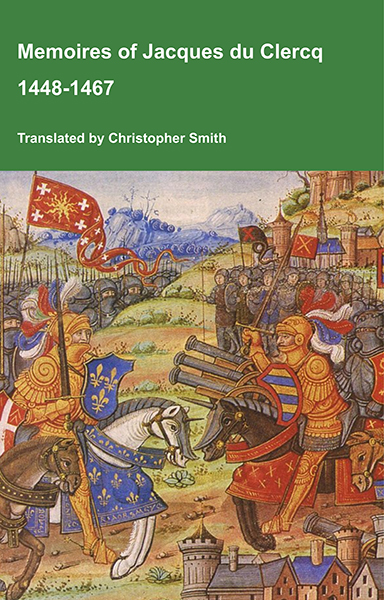
This is a translation of the 'Memoires of Jacques du Clercq', published in 1823 in two volumes, edited by Frederic, Baron de Reissenberg. In his introduction Reissenberg writes: 'Jacques du Clercq tells us that he was born in 1424, and that he was a licentiate in law and a counsellor to Philip the Good, Duke of Burgundy, in the castellany of Douai, Lille, and Orchies. It appears that he established his residence at Arras. In 1446, he married the daughter of Baldwin de la Lacherie, a gentleman who lived in Lille. We read in the fifth book of his Memoirs that his father, also named Jacques du Clercq, had married a lady of the Le Camelin family, from Compiègne. His ancestors, always attached to the counts of Flanders, had constantly served them, whether in their councils or in their armies.' The Memoires cover a period of nineteen years beginning in in 1448, ending in in 1467. It appears that the author had intended to extend the Memoirs beyond that date; no doubt illness or death prevented him from carrying out this plan. As Reissenberg writes the 'merit of this work lies in the simplicity of its narrative, in its tone of good faith, and in a certain air of frankness which naturally wins the reader’s confidence.' Du Clercq ranges from events of national and international importance, including events of the Wars of the Roses in England, to simple, everyday local events such as marriages, robberies, murders, trials and deaths, including that of his own father in Book 5; one of his last entries.
Available at Amazon in eBook and Paperback format.
John Evelyn's Diary. 14th May 1661. His Majesty [aged 30] was pleased to discourse with me concerning several particulars relating to our Society, and the planet Saturn, etc., as he sat at supper in the withdrawing-room to his bedchamber.
Samuel Pepys' Diary. 7th August 1666. In the evening comes Mr. Reeves, with a twelve-foote glasse, so I left the office and home, where I met Mr. Batelier with my wife, in order to our going to-morrow, by agreement, to Bow to see a dancing meeting. But, Lord! to see how soon I could conceive evil fears and thoughts concerning them; so Reeves and I and they up to the top of the house, and there we endeavoured to see the moon, and Saturne and Jupiter; but the heavens proved cloudy, and so we lost our labour, having taken pains to get things together, in order to the managing of our long glasse.
Samuel Pepys' Diary. 19th August 1666. Lord's Day. Up and to my chamber, and there began to draw out fair and methodically my accounts of Tangier, in order to shew them to the Lords. But by and by comes by agreement Mr. Reeves, and after him Mr. Spong, and all day with them, both before and after dinner, till ten o'clock at night, upon opticke enquiries, he bringing me a frame he closes on, to see how the rays of light do cut one another, and in a darke room with smoake, which is very pretty. He did also bring a lanthorne with pictures in glasse, to make strange things appear on a wall, very pretty. We did also at night see Jupiter and his girdle and satellites, very fine, with my twelve-foote glasse, but could not Saturne, he being very dark. Spong and I had also several fine discourses upon the globes this afternoon, particularly why the fixed stars do not rise and set at the same houre all the yeare long, which he could not demonstrate, nor I neither, the reason of.
On 25th October 1671 Iapetus was discovered by Giovanni Domenico Cassini, an Italian-born French astronomer. the first moon that Cassini discovered and the second of Saturn's moons to be discovered.
On 25th March 1655 Christian Huygens [aged 25] discovered Saturn's moon Titan; he named it Luna Saturni, literally Moon of Saturn, using a 2 inch telescope he and his brother had constructed in Feb 1656. It was the sixth moon discovered, the first being the Earth's moon, and the second to fifth, being the moons of Jupiter discovered by Galileo in Mar 1610.
In December 1690 John Flamsteed [aged 44] observed Uranus although he mistook it for a star.
On 28th December 1612 Galileo [aged 48] discovered Neptune although he thought it a star rather than a Planet and is not, therefore, credited with the discovery of Neptune which eventually occurred some two-hundred and fifty years later.