


 John Evelyn's Diary January 1689
 John Evelyn's Diary February 1689
 John Evelyn's Diary April 1689
 John Evelyn's Diary July 1689
 John Evelyn's Diary August 1689
 John Evelyn's Diary September 1689
 John Evelyn's Diary November 1689
John Evelyn's Diary 1689 is in John Evelyn's Diary 1680s.
7th January 1689. A long frost and deep snow; the Thames almost frozen over.
15th January 1689. I visited the Archbishop of Canterbury [aged 71], where I found the Bishops of St. Asaph [aged 61], Ely [aged 51], Bath and Wells [aged 51], Peterborough [aged 61], and Chichester [aged 65], the Earls of Aylesbury [aged 33] and Clarendon, Sir George Mackenzie [aged 53], Lord-Advocate of Scotland, and then came in a Scotch Archbishop, etc. After prayers and dinner, divers serious matters were discoursed, concerning the present state of the Public, and sorry I was to find there was as yet no accord in the judgments of those of the Lords and Commons who were to convene; some would have the Princess [aged 26] made Queen without any more dispute, others were for a Regency; there was a Tory party (then so called), who were for inviting his Majesty [aged 55] again upon conditions; and there were Republicans who would make the Prince of Orange [aged 38] like a Stadtholder. The Romanists were busy among these several parties to bring them into confusion: most for ambition or other interest, few for conscience and moderate resolutions. I found nothing of all this in this assembly of Bishops, who were pleased to admit me into their discourses; they were all for a Regency, thereby to salve their oaths, and so all public matters to proceed in his Majesty's name, by that to facilitate the calling of Parliament, according to the laws in being. Such was the result of this meeting.
15th January 1689. My Lord of Canterbury [aged 71] gave me great thanks for the advertisement I sent him in October, and assured me they took my counsel in that particular, and that it came very seasonably.
15th January 1689. I found by the Lord-Advocate [aged 53] that the Bishops of Scotland (who were indeed little worthy of that character, and had done much mischief in that Church) were now coming about to the true interest, in this conjuncture which threatened to abolish the whole hierarchy in that kingdom; and therefore the Scottish Archbishop [aged 55] and Lord-Advocate requested the Archbishop of Canterbury [aged 71] to use his best endeavors with the Prince [aged 55] to maintain the Church there in the same state, as by law at present settled.


15th January 1689. It now growing late, after some private discourse with his Grace [aged 71], I took my leave, most of the Lords being gone.
15th January 1689. The trial of the bishops was now printed.
15th January 1689. The great convention being assembled the day before, falling upon the question about the government, resolved that King James [aged 55] having by the advice of the Jesuits and other wicked persons endeavored to subvert the laws of the Church and State, and deserted the Kingdom, carrying away the seals, etc., without any care for the management of the government, had by demise abdicated himself and wholly vacated his right; they did therefore desire the Lords' concurrence to their vote, to place the crown on the next heir, the Prince of Orange [aged 38], for his life, then to the Princess [aged 26], his wife, and if she died without issue, to the Princess of Denmark [aged 23], and she failing, to the heirs of the Prince, excluding forever all possibility of admitting a Roman Catholic.
Note. The reference to Prince is somewhat abiguous. It may refer to King William III of England, Scotland and Ireland.

Anne Boleyn. Her Life as told by Lancelot de Carle's 1536 Letter.
In 1536, two weeks after the execution of Anne Boleyn, her brother George and four others, Lancelot du Carle, wrote an extraordinary letter that described Anne's life, and her trial and execution, to which he was a witness. This book presents a new translation of that letter, with additional material from other contemporary sources such as Letters, Hall's and Wriothesley's Chronicles, the pamphlets of Wynkyn the Worde, the Memorial of George Constantyne, the Portuguese Letter and the Baga de Secrets, all of which are provided in Appendices.
Available at Amazon in eBook and Paperback format.
27th January 1689. I dined at the Admiralty, where was brought in a child not twelve years old, the son of one Dr. Clench, of the most prodigious maturity of knowledge, for I cannot call it altogether memory, but something more extraordinary. Mr. Pepys [aged 55] and myself examined him, not in any method, but with promiscuous questions, which required judgment and discernment to answer so readily and pertinently. There was not anything in chronology, history, geography, the several systems of astronomy, courses of the stars, longitude, latitude, doctrine of the spheres, courses and sources of rivers, creeks, harbors, eminent cities, boundaries and bearings of countries, not only in Europe, but in any other part of the earth, which he did not readily resolve and demonstrate his knowledge of, readily drawing out with a pen anything he would describe. He was able not only to repeat the most famous things which are left us in any of the Greek or Roman histories, monarchies, republics, wars, colonies, exploits by sea and land, but all the sacred stories of the Old and New Testament; the succession of all the monarchies, Babylonian, Persian, Greek, Roman, with all the lower Emperors, Popes, Heresiarchs, and Councils, what they were called about, what they determined, or in the controversy about Easter, the tenets of the Gnostics, Sabellians, Arians, Nestorians; the difference between St. Cyprian and Stephen about re-baptism, the schisms. We leaped from that to other things totally different, to Olympic years, and synchronisms; we asked him questions which could not be resolved without considerable meditation and judgment, nay of some particulars of the Civil Laws, of the Digest and Code. He gave a stupendous account of both natural and moral philosophy, and even in metaphysics.
Having thus exhausted ourselves rather than this wonderful child, or angel rather, for he was as beautiful and lovely in countenance as in knowledge, we concluded with asking him if, in all he had read or heard of, he had ever met with anything which was like this expedition of the Prince of Orange [aged 38], with so small a force to obtain three great kingdoms without any contest. After a little thought, he told us that he knew of nothing which did more resemble it than the coming of Constantine the Great out of Britain, through France and Italy, so tedious a march, to meet Maxentius, whom he overthrew at Pons Milvius with very little conflict, and at the very gates of Rome, which he entered and was received with triumph, and obtained the empire, not of three kingdoms only, but of all the then known world. He was perfect in the Latin authors, spoke French naturally, and gave us a description of France, Italy, Savoy, Spain, ancient and modernly divided; as also of ancient Greece, Scythia, and northern countries and tracts: we left questioning further. He did this without any set or formal repetitions, as one who had learned things without book, but as if he minded other things, going about the room, and toying with a parrot there, and as he was at dinner (tanquam aliua agens, as it were) seeming to be full of play, of a lively, sprightly temper, always smiling, and exceedingly pleasant, without the least levity, rudeness, or childishness.


 Become a Member via our Buy Me a Coffee page to read more.
27th January 1689. His father assured us he never imposed anything to charge his memory by causing him to get things by heart, not even the rules of grammar; but his tutor (who was a Frenchman) read to him, first in French, then in Latin; that he usually played among other boys four or five hours every day, and that he was as earnest at his play as at his study. He was perfect in arithmetic, and now newly entered into Greek. In sum (horresco referens), I had read of divers forward and precocious youths, and some I have known, but I never did either hear or read of anything like to this sweet child, if it be right to call him child who has more knowledge than most men in the world. I counseled his father not to set his heart too much on this jewel, "Immodicis brevis est ætas, et rara senectus", as I myself learned by sad experience in my most dear child Richard [aged 36], many years since, who, dying before he was six years old, was both in shape and countenance and pregnancy of learning, next to a prodigy.
29th January 1689. The votes of the House of Commons being carried up by Mr. Hampden [aged 36], their chairman, to the Lords, I got a station by the Prince's [aged 55] lodgings at the door of the lobby to the House, and heard much of the debate, which lasted very long. Lord Derby [aged 34] was in the chair (for the House was resolved into a grand committee of the whole House); after all had spoken, it came to the question, which was carried by three voices against a Regency, which 51 were for, 54 against; the minority alleging the danger of dethroning Kings, and scrupling many passages and expressions in the vote of the Commons, too long to set down particularly. Some were for sending to his Majesty with conditions: others that the King could do no wrong, and that the maladministration was chargeable on his ministers. There were not more than eight or nine bishops, and but two against the Regency; the archbishop [aged 71] was absent, and the clergy now began to change their note, both in pulpit and discourse, on their old passive obedience, so as people began to talk of the bishops being cast out of the House. In short, things tended to dissatisfaction on both sides; add to this, the morose temper of the Prince of Orange [aged 38], who showed little countenance to the noblemen and others, who expected a more gracious and cheerful reception when they made their court. The English army also was not so in order, and firm to his interest, nor so weakened but that it might give interruption. Ireland was in an ill posture as well as Scotland. Nothing was yet done toward a settlement. God of his infinite mercy compose these things, that we may be at last a Nation and a Church under some fixed and sober establishment!


30th January 1689. The anniversary of King Charles I's MARTYRDOM; but in all the public offices and pulpit prayers, the collects, and litany for the King [aged 38] and Queen [aged 30] were curtailed and mutilated. Dr. Sharp [aged 43] preached before the Commons, but was disliked, and not thanked for his sermon.


31st January 1689. At our church (the next day being appointed a thanksgiving for deliverance by the Prince of Orange [aged 38], with prayers purposely composed), our lecturer preached in the afternoon a very honest sermon, showing our duty to God for the many signal deliverances of our Church, without touching on politics.
6th February 1689. The King's [aged 55] coronation day was ordered not to be observed, as hitherto it had been.
6th February 1689. The Convention of the Lords and Commons now declare the Prince [aged 38] and Princess [aged 26] of Orange King and Queen of England, France, and Ireland (Scotland being an independent kingdom), the Prince and Princess being to enjoy it jointly during their lives; but the executive authority to be vested in the Prince during life, though all proceedings to run in both names, and that it should descend to their issue, and for want of such, to the Princess Anne of Denmark [aged 24] and her issue, and in want of such, to the heirs of the body of the Prince, if he survive, and that failing, to devolve to the Parliament, as they should think fit. These produced a conference with the Lords, when also there was presented heads of such new laws as were to be enacted. It is thought on these conditions they will be proclaimed.


6th February 1689. There was much contest about the King's [aged 38] abdication, and whether he had vacated the government. The Earl of Nottingham [aged 41] and about twenty Lords, and many Bishops, entered their protests, but the concurrence was great against them.

Chronicle of a Bourgeois of Valenciennes
Récits d’un bourgeois de Valenciennes aka The Chronicle of a Bourgeois of Valenciennes is a vivid 14th-century vernacular chronicle written by an anonymous urban chronicler from Valenciennes in the County of Hainaut. It survives in a manuscript that describes local and regional history from about 1253 to 1366, blending chronology, narrative episodes, and eyewitness-style accounts of political, military, and social events in medieval France, Flanders, and the Low Countries. The work begins with a chronological framework of events affecting Valenciennes and its region under rulers such as King Philip VI of France and the shifting allegiances of local nobility. It includes accounts of conflicts, sieges, diplomatic manoeuvres, and the impact of broader struggles like the Hundred Years’ War on urban life in Hainaut. Written from the perspective of a burgher (bourgeois) rather than a monastery or royal court, the chronicle offers a rare lay viewpoint on high politics and warfare, reflecting how merchants, townspeople, and civic institutions experienced the turbulence of the 13th and 14th centuries. Its narrative style combines straightforward reporting of events with moral and civic observations, making it a valuable source for readers interested in medieval urban society, regional politics, and the lived experience of war and governance in pre-modern Europe.
Available at Amazon in eBook and Paperback format.
6th February 1689. The Princess [aged 26] hourly expected. Forces sending to Ireland, that kingdom being in great danger by the Earl of Tyrconnel's [aged 59] army, and expectations from France coming to assist them, but that King was busy in invading Flanders, and encountering the German Princes. It is likely that this will be the most remarkable summer for action, which has happened in many years.
21st February 1689. Dr. Burnet [aged 45] preached at St. James's on the obligation to walk worthy of God's particular and signal deliverance of the nation and church.


21st February 1689. I saw the new Queen [aged 26] and King [aged 38], with great acclamation and general good reception. Bonfires, bells, guns, etc. It was believed that both, especially the Princess, would have shown some (seeming) reluctance at least, of assuming her father's [aged 55] crown, and made some apology, testifying by her regret that he should by his mismanagement necessitate the nation to so extraordinary a proceeding, which would have shown very handsomely to the world, and according to the character given of her piety; consonant also to her husband's first declaration, that there was no intention of deposing the King, but of succoring the nation; but nothing of all this appeared; she came into Whitehall laughing and jolly, as to a wedding, so as to seem quite transported. She rose early the next morning, and in her undress, as it was reported, before her women were up, went about from room to room to see the convenience of Whitehall; lay in the same bed and apartment where the late Queen [aged 30] lay, and within a night or two sat down to play at basset, as the Queen, her predecessor used to do. She smiled upon and talked to everybody, so that no change seemed to have taken place at Court since her last going away, save that infinite crowds of people thronged to see her, and that she went to our prayers. This carriage was censured by many. She seems to be of a good nature, and that she takes nothing to heart: while the Prince, her husband, has a thoughtful countenance, is wonderfully serious and silent, and seems to treat all persons alike gravely, and to be very intent on affairs: Holland, Ireland, and France calling for his care.
21st February 1689. Divers Bishops and Noblemen are not at all satisfied with this so sudden assumption of the Crown, without any previous sending, and offering some conditions to the absent King; or on his not returning, or not assenting to those conditions, to have proclaimed him Regent; but the major part of both Houses prevailed to make them King and Queen immediately, and a crown was tempting. This was opposed and spoken against with such vehemence by Lord Clarendon (her own uncle), that it put him by all preferment, which must doubtless have been as great as could have been given him. My Lord of Rochester [aged 46], his brother, overshot himself, by the same carriage and stiffness, which their friends thought they might have well spared when they saw how it was like to be overruled, and that it had been sufficient to have declared their dissent with less passion, acquiescing in due time.


21st February 1689. The Archbishop of Canterbury [aged 72] and some of the rest, on scruple of conscience and to salve the oaths they had taken, entered their protests and hung off, especially the Archbishop, who had not all this while so much as appeared out of Lambeth [Map]. This occasioned the wonder of many who observed with what zeal they contributed to the Prince's [aged 38] expedition, and all the while also rejecting any proposals of sending again to the absent King [aged 55]; that they should now raise scruples, and such as created much division among the people, greatly rejoicing the old courtiers, and especially the Papists.
21st February 1689. Another objection was, the invalidity of what was done by a convention only, and the as yet unabrogated laws; this drew them to make themselves on the 22d a Parliament, the new King [aged 38] passing the act with the crown on his head. The lawyers disputed, but necessity prevailed, the government requiring a speedy settlement.
21st February 1689. Innumerable were the crowds, who solicited for, and expected offices; most of the old ones were turned out. Two or three white staves were disposed of some days before, as Lord Steward, to the Earl of Devonshire [aged 49]; Treasurer of the household, to Lord Newport; Lord Chamberlain to the King, to my Lord of Dorset [aged 46]; but there were as yet none in offices of the civil government save the Marquis of Halifax [aged 55] as Privy Seal. A council of thirty was chosen, Lord Derby [aged 34] president, but neither Chancellor nor Judges were yet declared, the new Great Seal not yet finished.


8th March 1689. Dr. Tillotson [aged 58], Dean of Canterbury, made an excellent discourse on Matt. v. 44, exhorting to charity and forgiveness of enemies; I suppose purposely, the new Parliament being furious about impeaching those who were obnoxious, and as their custom has ever been, going on violently, without reserve, or modification, while wise men were of opinion the most notorious offenders being named and excepted, an Act of Amnesty would be more seasonable, to pacify the minds of men in so general a discontent of the nation, especially of those who did not expect to see the government assumed without any regard to the absent King, or proving a spontaneous abdication, or that the birth of the Prince of Wales was an imposture; five of the Bishops also still refusing to take the new oath.
8th March 1689. In the meantime, to gratify the people, the hearth-tax was remitted forever; but what was intended to supply it, besides present great taxes on land, is not named.
8th March 1689. The King [aged 55] abroad was now furnished by the French King [aged 50] with money and officers for an expedition to Ireland. The great neglect in not more timely preventing that from hence, and the disturbances in Scotland, give apprehensions of great difficulties, before any settlement can be perfected here, while the Parliament dispose of the great offices among themselves. The Great Seal, Treasury and Admiralty put into commission of many unexpected persons, to gratify the more; so that by the present appearance of things (unless God Almighty graciously interpose and give success in Ireland and settle Scotland) more trouble seems to threaten the nation than could be expected. In the interim, the new King refers all to the Parliament in the most popular manner, but is very slow in providing against all these menaces, besides finding difficulties in raising men to send abroad; the former army, which had never seen any service hitherto, receiving their pay and passing their summer in an idle scene of a camp at Hounslow, unwilling to engage, and many disaffected, and scarce to be trusted.
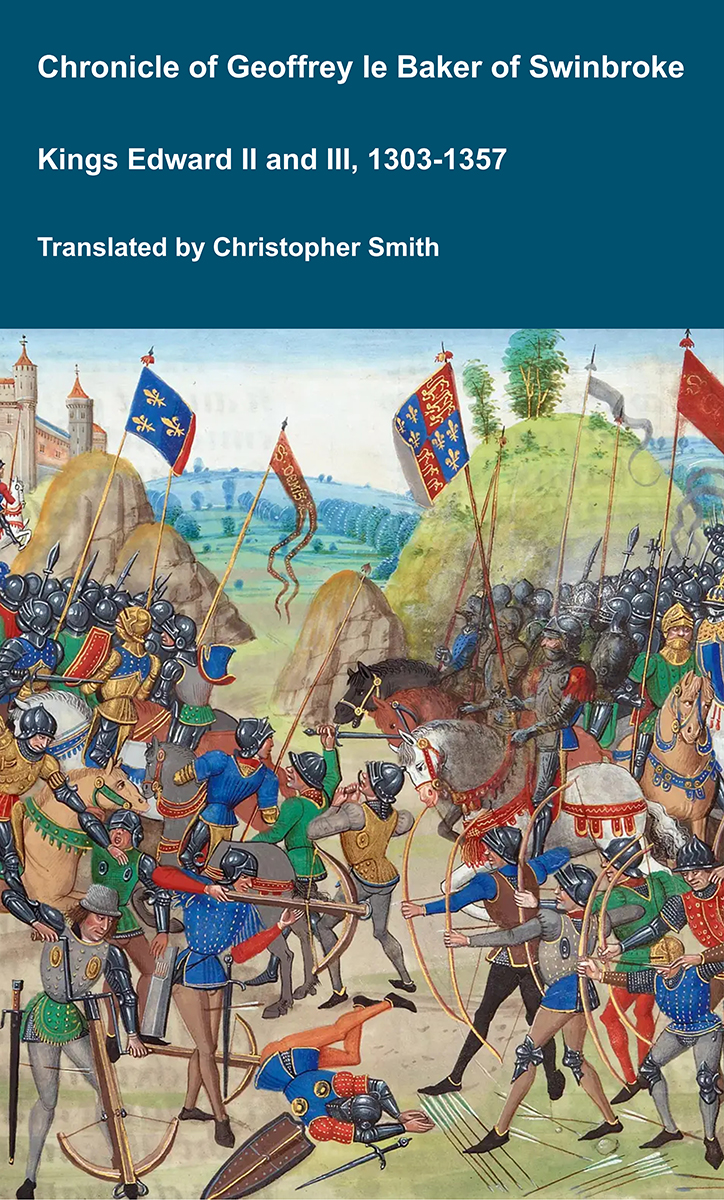
Chronicle of Geoffrey le Baker of Swinbroke
Baker was a secular clerk from Swinbroke, now Swinbrook, an Oxfordshire village two miles east of Burford. His Chronicle describes the events of the period 1303-1356: Gaveston, Bannockburn, Boroughbridge, the murder of King Edward II, the Scottish Wars, Sluys, Crécy, the Black Death, Winchelsea and Poitiers. To quote Herbert Bruce 'it possesses a vigorous and characteristic style, and its value for particular events between 1303 and 1356 has been recognised by its editor and by subsequent writers'. The book provides remarkable detail about the events it describes. Baker's text has been augmented with hundreds of notes, including extracts from other contemporary chronicles, such as the Annales Londonienses, Annales Paulini, Murimuth, Lanercost, Avesbury, Guisborough and Froissart to enrich the reader's understanding. The translation takes as its source the 'Chronicon Galfridi le Baker de Swynebroke' published in 1889, edited by Edward Maunde Thompson.
Available at Amazon in eBook and Paperback format.
29th March 1689. The new King [aged 38] much blamed for neglecting Ireland, now likely to be ruined by the Lord Tyrconnel [aged 59] and his Popish party, too strong for the Protestants. Wonderful uncertainty where King James [aged 55] was, whether in France or Ireland. The Scots seem as yet to favour King William, rejecting King James's letter to them, yet declaring nothing positively. Soldiers in England discontented. Parliament preparing the coronation oath. Presbyterians and Dissenters displeased at the vote for preserving the Protestant religion as established by law, without mentioning what they were to have as to indulgence.
29th March 1689. The Archbishop of Canterbury [aged 58] and four other Bishops refusing to come to Parliament, it was deliberated whether they should incur Praemunire; but it was thought fit to let this fall, and be connived at, for fear of the people, to whom these Prelates were very dear, for the opposition they had given to Popery.
29th March 1689. Court offices distributed among Parliament men. No considerable fleet as yet sent forth. Things far from settled as was expected, by reason of the slothful, sickly temper of the new King, and the Parliament's unmindfulness of Ireland, which is likely to prove a sad omission.
29th March 1689. The Confederates beat the French out of the Palatinate, which they had most barbarously ruined.
11th April 1689. I saw the procession to and from the Abbey Church of Westminster [Map], with the great feast in Westminster Hall [Map], at the coronation of King William and Queen Mary. What was different from former coronations, was some alteration in the coronation oath. Dr. Burnet [aged 45], now made Bishop of Sarum, preached with great applause. The Parliament men had scaffolds and places which took up the one whole side of the Hall [Map]. When the King [aged 38] and Queen [aged 26] had dined, the ceremony of the Champion, and other services by tenure were performed. The Parliament men were feasted in the Exchequer chamber, and had each of them a gold medal given them, worth five-and-forty shillings. On the one side were the effigies of the King and Queen inclining one to the other; on the reverse was Jupiter throwing a bolt at Phäeton the words, "Ne totus absumatur": which was but dull, seeing they might have had out of the poet something as apposite. The sculpture was very mean.
11th April 1689. Much of the splendor of the proceeding was abated by the absence of divers who should have contributed to it, there being but five Bishops, four Judges (no more being yet sworn), and several noblemen and great ladies wanting; the feast, however, was magnificent. The next day the House of Commons went and kissed their new Majesties' hands in the Banqueting House, Whitehall Palace [Map].
12th April 1689. I went with the Bishop of St. Asaph [aged 61] to visit my Lord of Canterbury [aged 58] at Lambeth [Map], who had excused himself from officiating at the coronation, which was performed by the Bishop of London [aged 57], assisted by the Archbishop of York [aged 74]. We had much private and free discourse with his Grace concerning several things relating to the Church, there being now a bill of comprehension to be brought from the Lords to the Commons. I urged that when they went about to reform some particulars in the Liturgy, Church discipline, Canons, etc., the baptizing in private houses without necessity might be reformed, as likewise so frequent burials in churches; the one proceeding much from the pride of women, bringing that into custom which was only indulged in case of imminent danger, and out of necessity during the rebellion, and persecution of the clergy in our late civil wars; the other from the avarice of ministers, who, in some opulent parishes, made almost as much of permission to bury in the chancel and the church, as of their livings, and were paid with considerable advantage and gifts for baptizing in chambers. To this they heartily assented, and promised their endeavor to get it reformed, utterly disliking both practices as novel and indecent.

12th April 1689. We discoursed likewise of the great disturbance and prejudice it might cause, should the new oath, now on the anvil, be imposed on any, save such as were in new office, without any retrospect to such as either had no office, or had been long in office, who it was likely would have some scruples about taking a new oath, having already sworn fidelity to the government as established by law. This we all knew to be the case of my Lord Archbishop of Canterbury [aged 58], and some other persons who were not so fully satisfied with the Convention making it an abdication of King James, to whom they had sworn allegiance.
12th April 1689. King James [aged 55] was now certainly in Ireland with the Marshal d'Estrades, whom he made a Privy Councillor; and who caused the King to remove the Protestant Councillors, some whereof, it seems, had continued to sit, telling him that the King of France [aged 50], his master, would never assist him if he did not immediately do it; by which it is apparent how the poor Prince is managed by the French.
12th April 1689. Scotland declares for King William [aged 38] and Queen Mary [aged 26], with the reasons of their setting aside King James [aged 55], not as abdicating, but forfeiting his right by maladministration; they proceeded with much more caution and prudence than we did, who precipitated all things to the great reproach of the nation, all which had been managed by some crafty, ill-principled men. The new Privy Council have a Republican spirit, manifestly undermining all future succession of the Crown and prosperity of the Church of England, which yet I hope they will not be able to accomplish so soon as they expect, though they get into all places of trust and profit.
Chronicle of a Bourgeois of Valenciennes
Récits d’un bourgeois de Valenciennes aka The Chronicle of a Bourgeois of Valenciennes is a vivid 14th-century vernacular chronicle written by an anonymous urban chronicler from Valenciennes in the County of Hainaut. It survives in a manuscript that describes local and regional history from about 1253 to 1366, blending chronology, narrative episodes, and eyewitness-style accounts of political, military, and social events in medieval France, Flanders, and the Low Countries. The work begins with a chronological framework of events affecting Valenciennes and its region under rulers such as King Philip VI of France and the shifting allegiances of local nobility. It includes accounts of conflicts, sieges, diplomatic manoeuvres, and the impact of broader struggles like the Hundred Years’ War on urban life in Hainaut. Written from the perspective of a burgher (bourgeois) rather than a monastery or royal court, the chronicle offers a rare lay viewpoint on high politics and warfare, reflecting how merchants, townspeople, and civic institutions experienced the turbulence of the 13th and 14th centuries. Its narrative style combines straightforward reporting of events with moral and civic observations, making it a valuable source for readers interested in medieval urban society, regional politics, and the lived experience of war and governance in pre-modern Europe.
Available at Amazon in eBook and Paperback format.
21st April 1689. This was one of the most seasonable springs, free from the usual sharp east winds that I have observed since the year 1660 (the year of the Restoration), which was much such an one.
26th April 1689. I heard the lawyers plead before the Lords the writ of error in the judgment of Oates [aged 39], as to the charge against him of perjury, which after debate they referred to the answer of Holloway, etc., who were his judges. I then went with the Bishop of St. Asaph [aged 61] to the Archbishop [aged 72] at Lambeth [Map], where they entered into discourse concerning the final destruction of Antichrist, both concluding that the third trumpet and vial were now pouring out. My Lord St. Asaph considered the killing of the two witnesses, to be the utter destruction of the Cevennes Protestants by the French and Duke of Savoy, and the other the Waldenses and Pyrenean Christians, who by all appearance from good history had kept the primitive faith from the very Apostles' time till now. The doubt his Grace suggested was, whether it could be made evident that the present persecution had made so great a havoc of those faithful people as of the other, and whether there were not yet some among them in being who met together, it being stated from the text, Apoc. xi., that they should both be slain together. They both much approved of Mr. Mede's way of interpretation, and that he only failed in resolving too hastily on the King of Sweden's (Gustavus Adolphus) success in Germany. They agreed that it would be good to employ some intelligent French minister to travel as far as the Pyrenees to understand the present state of the Church there, it being a country where hardly anyone travels.
26th April 1689. There now came certain news that King James [aged 55] had not only landed in Ireland, but that he had surprised Derry aka Londonderry, and was become master of that kingdom, to the great shame of our government, who had been so often solicited to provide against it by timely succor, and which they might so easily have done. This is a terrible beginning of more troubles, especially should an army come thence into Scotland, people being generally disaffected here and everywhere else, so that the seamen and landmen would scarce serve without compulsion.
26th April 1689. A new oath was now fabricating for all the clergy to take, of obedience to the present Government, in abrogation of the former oaths of allegiance, which it is foreseen many of the bishops and others of the clergy will not take. The penalty is to be the loss of their dignity and spiritual preferment. This is thought to have been driven on by the Presbyterians, our new governors. God in mercy send us help, and direct the counsels to his glory and good of his Church!
26th April 1689. Public matters went very ill in Ireland: confusion and dissensions among ourselves, stupidity, inconstancy, emulation, the governors employing unskillful men in greatest offices, no person of public spirit and ability appearing,-threaten us with a very sad prospect of what may be the conclusion, without God's infinite mercy.
26th April 1689. A fight by Admiral Herbert [aged 41] with the French, he imprudently setting on them in a creek as they were landing men in Ireland, by which we came off with great slaughter and little honor-so strangely negligent and remiss were we in preparing a timely and sufficient fleet. The Scots Commissioners offer the crown to the new King and Queen on conditions. Act of Poll money came forth, sparing none. Now appeared the Act of Indulgence for the Dissenters, but not exempting them from paying dues to the Church of England clergy, or serving in office according to law, with several other clauses. A most splendid embassy from Holland to congratulate the King [aged 38] and Queen [aged 26] on their accession to the crown.
4th June 1689. A solemn fast for success of the fleet, etc.
6th June 1689. I dined with the Bishop of Asaph [aged 61]; Monsieur Capellus, the learned son of the most learned Ludovicus, presented to him his father's works, not published till now.
7th June 1689. I visited the Archbishop of Canterbury [aged 72], and stayed with him till about seven o'clock. He read to me the Pope's excommunication of the French King [aged 50].
9th June 1689. Visited Dr. Burnet [aged 45], now Bishop of Sarum; got him to let Mr. Kneller [aged 42] draw his picture.
16th June 1689. King James's [aged 55] declaration was now dispersed, offering pardon to all, if on his landing, or within twenty days after, they should return to their obedience.
16th June 1689. Our fleet not yet at sea, through some prodigious sloth, and men minding only their present interest; the French riding masters at sea, taking many great prizes to our wonderful reproach. No certain news from Ireland; various reports of Scotland; discontents at home. The King of Denmark [aged 43] at last joins with the Confederates, and the two Northern Powers are reconciled. The East India Company likely to be dissolved by Parliament for many arbitrary actions. Oates acquitted of perjury, to all honest men's admiration.
Jean de Waurin's Chronicle of England Volume 6 Books 3-6: The Wars of the Roses
Jean de Waurin was a French Chronicler, from the Artois region, who was born around 1400, and died around 1474. Waurin’s Chronicle of England, Volume 6, covering the period 1450 to 1471, from which we have selected and translated Chapters relating to the Wars of the Roses, provides a vivid, original, contemporary description of key events some of which he witnessed first-hand, some of which he was told by the key people involved with whom Waurin had a personal relationship.
Available at Amazon in eBook and Paperback format.
23rd June 1689. An extraordinary drought, to the threatening of great wants as to the fruits of the earth.
8th July 1689. I sat for my picture to Mr. Kneller [aged 42], for Mr. Pepys [aged 56], late Secretary to the Admiralty, holding my "Sylva" in my right hand. It was on his long and earnest request, and is placed in his library. Kneller never painted in a more masterly manner.
11th July 1689. I dined at Lord Clarendon's, it being his lady's wedding day, when about three in the afternoon there was an unusual and violent storm of thunder, rain, and wind; many boats on the Thames were overwhelmed, and such was the impetuosity of the wind as to carry up the waves in pillars and spouts most dreadful to behold, rooting up trees and ruining some houses.
16th July 1689. I went to Hampton Court [Map] about business, the Council being there. A great apartment and spacious garden with fountains was beginning in the park at the head of the canal.
19th July 1689. The Marshal de Schomberg [aged 73] went now as General toward Ireland, to the relief of Derry aka Londonderry. Our fleet lay before Brest. The Confederates passing the Rhine, besiege Bonn and Mayence, to obtain a passage into France. A great victory gotten by the Muscovites, taking and burning Perecop. A new rebel against the Turks threatens the destruction of that tyranny. All Europe in arms against France, and hardly to be found in history so universal a face of war.
19th July 1689. The Convention (or Parliament as some called it) sitting, exempt the Duke of Hanover [aged 29] from the succession to the crown, which they seem to confine to the present new King [aged 38], his wife [aged 27], and Princess Anne of Denmark [aged 24], who is so monstrously swollen, that it is doubted whether her being thought with child may prove a TYMPANY only, so that the unhappy family of the Stuarts seems to be extinguishing; and then what government is likely to be next set up is unknown, whether regal and by election, or otherwise, the Republicans and Dissenters from the Church of England evidently looking that way.

William of Worcester's Chronicle of England
William of Worcester, born around 1415, and died around 1482 was secretary to John Fastolf, the renowned soldier of the Hundred Years War, during which time he collected documents, letters, and wrote a record of events. Following their return to England in 1440 William was witness to major events. Twice in his chronicle he uses the first person: 1. when writing about the murder of Thomas, 7th Baron Scales, in 1460, he writes '… and I saw him lying naked in the cemetery near the porch of the church of St. Mary Overie in Southwark …' and 2. describing King Edward IV's entry into London in 1461 he writes '… proclaimed that all the people themselves were to recognize and acknowledge Edward as king. I was present and heard this, and immediately went down with them into the city'. William’s Chronicle is rich in detail. It is the source of much information about the Wars of the Roses, including the term 'Diabolical Marriage' to describe the marriage of Queen Elizabeth Woodville’s brother John’s marriage to Katherine, Dowager Duchess of Norfolk, he aged twenty, she sixty-five or more, and the story about a paper crown being placed in mockery on the severed head of Richard, 3rd Duke of York.
Available at Amazon in eBook and Paperback format.
19th July 1689. The Scots have now again voted down Episcopacy there. Great discontents through this nation at the slow proceedings of the King [aged 38], and the incompetent instruments and officers he advances to the greatest and most necessary charges.
23rd August 1689. Came to visit me Mr. Firmin.
25th August 1689. Hitherto it has been a most seasonable summer. Derry aka Londonderry relieved after a brave and wonderful holding out.
21st September 1689. I went to visit the Archbishop of Canterbury [aged 72] since his suspension, and was received with great kindness. A dreadful fire happened in Southwark [Map].
2nd October 1689. Came to visit us the Marquis de Ruvignè, and one Monsieur le Coque, a French refugee, who left great riches for his religion; a very learned, civil person; he married the sister of the Duchess de la Force. Ottobone [aged 79], a Venetian Cardinal, eighty years old, made Pope.
31st October 1689. My birthday, being now sixty-nine years old. Blessed Father, who hast prolonged my years to this great age, and given me to see so great and wonderful revolutions, and preserved me amid them to this moment, accept, I beseech thee, the continuance of my prayers and thankful acknowledgments, and grant me grace to be working out my salvation and redeeming the time, that thou mayst be glorified by me here, and my immortal soul saved whenever thou shalt call for it, to perpetuate thy praises to all eternity, in that heavenly kingdom where there are no more changes or vicissitudes, but rest, and peace, and joy, and consummate felicity, forever. Grant this, O heavenly Father, for the sake of Jesus thine only Son and our Savior. Amen!
5th November 1689. The Bishop of St. Asaph [aged 62], Lord Almoner, preached before the King [aged 39] and Queen [aged 27], the whole discourse being an historical narrative of the Church of England's several deliverances, especially that of this anniversary, signalized by being also the birthday of the Prince of Orange, his marriage (which was on the 4th), and his landing at Torbay this day. There was a splendid ball and other rejoicings.
10th November 1689. After a very wet season, the winter came on severely.
17th November 1689. Much wet, without frost, yet the wind north and easterly. A Convocation of the Clergy meet about a reformation of our Liturgy, Canons, etc., obstructed by others of the clergy.
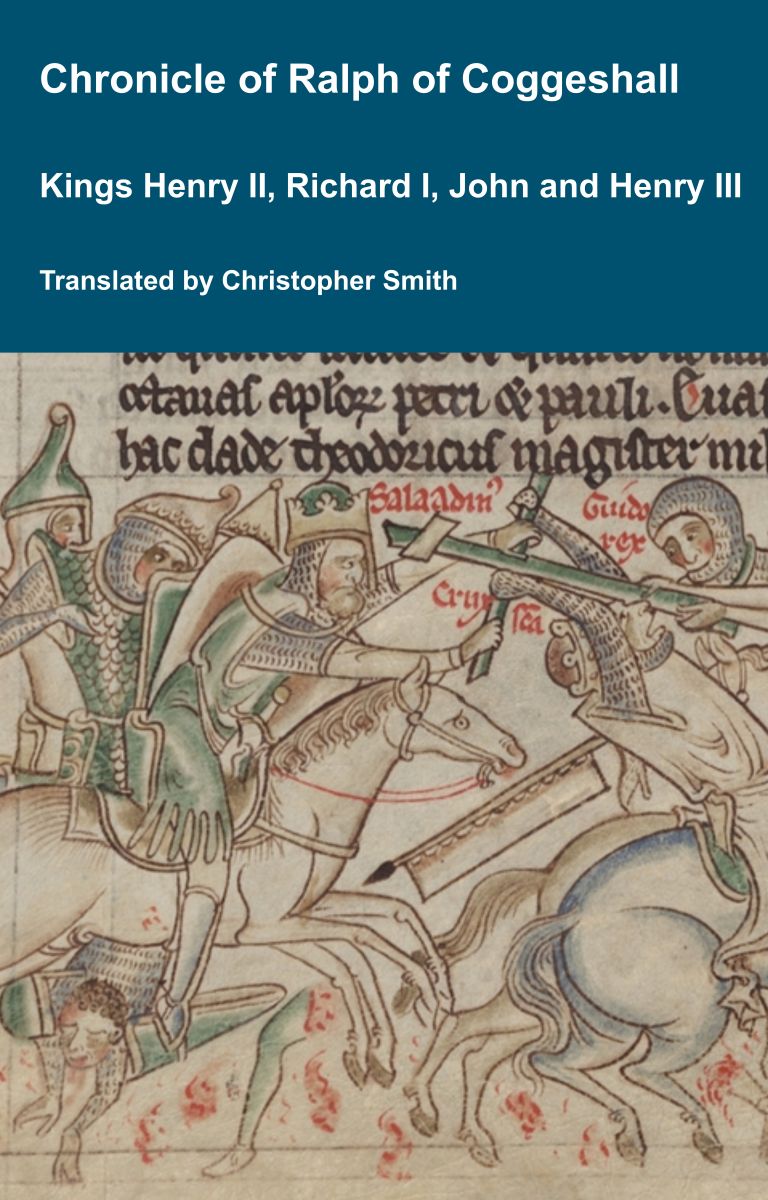
Chronicle of Abbot Ralph of Coggeshall
The Chronicle of Abbot Ralph of Coggeshall (Chronicon Anglicanum) is an indispensable medieval history that brings to life centuries of English and European affairs through the eyes of a learned Cistercian monk. Ralph of Coggeshall, abbot of the Abbey of Coggeshall in Essex in the early 13th century, continued and expanded his community’s chronicle, documenting events from the Norman Conquest of 1066 into the tumultuous reign of King Henry III. Blending eyewitness testimony, careful compilation, and the monastic commitment to record-keeping, this chronicle offers a rare narrative of political intrigue, royal power struggles, and social upheaval in England and beyond. Ralph’s work captures the reigns of pivotal figures such as Richard I and King John, providing invaluable insights into their characters, decisions, and the forces that shaped medieval rule. More than a simple annal, Chronicon Anglicanum conveys the texture of medieval life and governance, making it a rich source for scholars and readers fascinated by English history, monastic authorship, and the shaping of the medieval world.
Available at Amazon in eBook and Paperback format.
27th November 1689. I went to London with my family, to winter at Soho, in the great square.
