

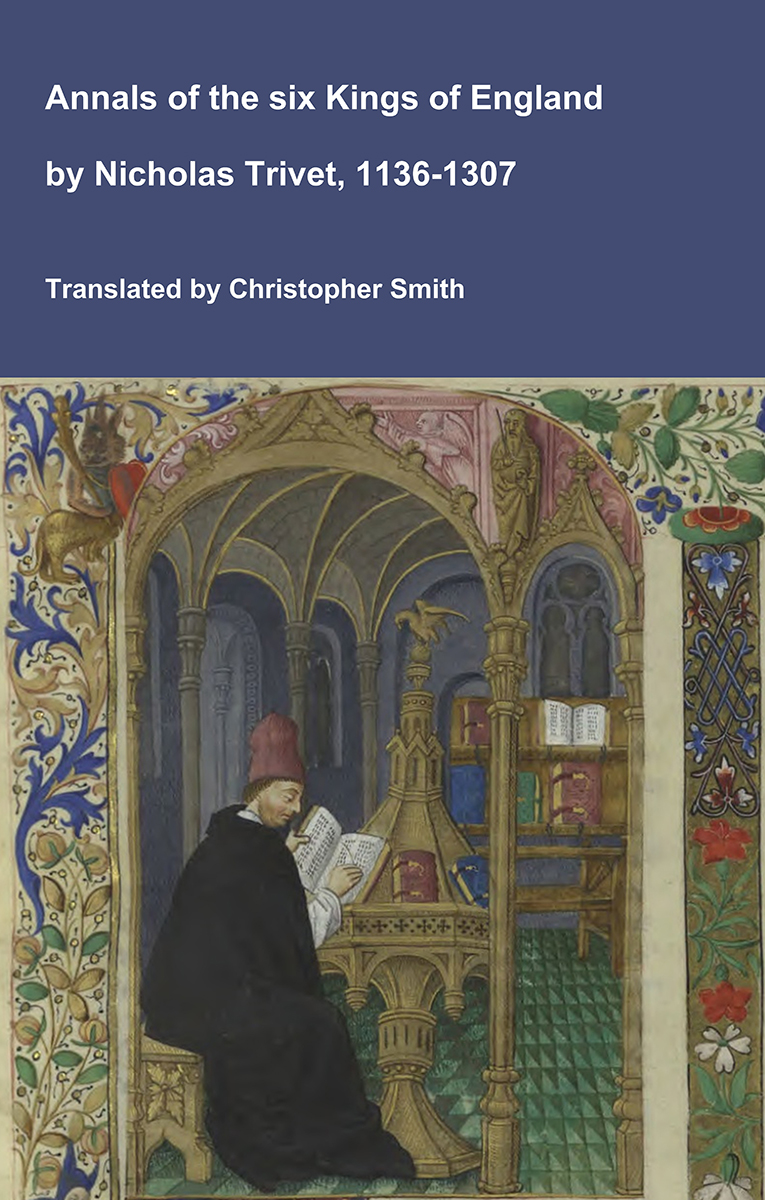
Annals of the six Kings of England by Nicholas Trivet
Translation of the Annals of the Six Kings of England by that traces the rise and rule of the Angevin aka Plantagenet dynasty from the mid-12th to early 14th century. Written by the Dominican scholar Nicholas Trivet, the work offers a vivid account of English history from the reign of King Stephen through to the death of King Edward I, blending political narrative with moral reflection. Covering the reigns of six monarchs—from Stephen to Edward I—the chronicle explores royal authority, rebellion, war, and the shifting balance between crown, church, and nobility. Trivet provides detailed insight into defining moments such as baronial conflicts, Anglo-French rivalry, and the consolidation of royal power under Edward I, whose reign he describes with particular immediacy. The Annals combines careful year-by-year reporting with thoughtful interpretation, presenting history not merely as a sequence of events but as a moral and political lesson. Ideal for readers interested in medieval history, kingship, and the origins of the English state, this chronicle remains a valuable and accessible window into the turbulent world of the Plantagenet kings.
Available at Amazon in eBook and Paperback format.
In 1690 Colonel William Cosby was born.
On 24th August 1705 Colonel William Cosby (age 15) was promoted to Cornet of the 5th Dragoon Guards.
In 1710 Colonel William Cosby (age 20) joined the army in Spain.
In 1711 Colonel William Cosby (age 21) and Grace Montagu (age 21) were married. They had five children.

After 1711 [his brother-in-law] George Montagu 1st Earl Halifax (age 27) and Mary Lumley Countess Halifax (age 20) were married. She the daughter of Richard Lumley 1st Earl Scarborough (age 61) and Frances Jones Countess Scarborough (age 43). They were fifth cousin once removed.
On 15th April 1711 Colonel William Cosby (age 21) was promoted to Captain of the 2nd Dragoon Guards, Harvey's Regiment of Horse.
In 1715 [his brother-in-law] George Montagu 1st Earl Halifax (age 31) was created 1st Earl Halifax. Mary Lumley Countess Halifax (age 24) by marriage Countess Halifax.

On 19th May 1715 Charles Montagu 1st Earl Halifax (age 54) died. Earl Halifax extinct. His nephew [his brother-in-law] George (age 31) succeeded 2nd Baron Halifax.
On 24th December 1717 Colonel William Cosby (age 27) was promoted to Colonel of the Royal Regiment of Ireland. The next year, this regiment was transferred to Menorca, in the Balearic Islands. Cosby acted as governor of Menorca from 1718.
In 1721 [his daughter] Elizabeth Cosby was born to Colonel William Cosby (age 31). She married March 1734 Augustus Fitzroy, son of Charles Fitzroy 2nd Duke Grafton and Henrietta Somerset Duchess Grafton, and had issue.

Chronicle of a Bourgeois of Valenciennes
Récits d’un bourgeois de Valenciennes aka The Chronicle of a Bourgeois of Valenciennes is a vivid 14th-century vernacular chronicle written by an anonymous urban chronicler from Valenciennes in the County of Hainaut. It survives in a manuscript that describes local and regional history from about 1253 to 1366, blending chronology, narrative episodes, and eyewitness-style accounts of political, military, and social events in medieval France, Flanders, and the Low Countries. The work begins with a chronological framework of events affecting Valenciennes and its region under rulers such as King Philip VI of France and the shifting allegiances of local nobility. It includes accounts of conflicts, sieges, diplomatic manoeuvres, and the impact of broader struggles like the Hundred Years’ War on urban life in Hainaut. Written from the perspective of a burgher (bourgeois) rather than a monastery or royal court, the chronicle offers a rare lay viewpoint on high politics and warfare, reflecting how merchants, townspeople, and civic institutions experienced the turbulence of the 13th and 14th centuries. Its narrative style combines straightforward reporting of events with moral and civic observations, making it a valuable source for readers interested in medieval urban society, regional politics, and the lived experience of war and governance in pre-modern Europe.
Available at Amazon in eBook and Paperback format.
On 13th January 1732 Colonel William Cosby (age 42) was appointed "Captain General & Governor in Chief of the Provinces of New York, New Jersey and Territories depending thereon in America".
On 2nd January 1734 Colonel William Cosby (age 44) was granted 22,000 acres on the Mohawk River, in what is now Herkimer County, New York. The land was named Cosby's Manor in 1736, and sold in 1772 to Philip Schuyler and four other proprietors.
In March 1734 [his son-in-law] Augustus Fitzroy (age 17) and [his daughter] Elizabeth Cosby (age 13) were married. He the son of Charles Fitzroy 2nd Duke Grafton (age 50) and Henrietta Somerset Duchess Grafton.
On 29th September 1735 Colonel William Cosby (age 45) was promoted to Vice-Admiral.
On 30th November 1735 Colonel William Cosby (age 45) was promoted to Brigadier-General.

On 10th March 1736 Colonel William Cosby (age 46) died of tuberculosis between 1 and 2 pm, in the Governor's House at Fort George, New York, today's Battery Park, New York City. He was initially buried in a vault at Fort George's chapel. But in 1788, his remains were moved to an unmarked grave at St Paul Church's Cemetery, New York, together with the remains of the Earl of Bellomont, who served as New York governor between 1698 and 1701.
On 25th December 1767 [his former wife] Grace Montagu (age 77) died.