

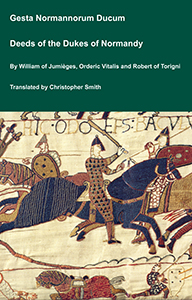
The Deeds of the Dukes of Normandy
The Gesta Normannorum Ducum [The Deeds of the Dukes of Normandy] is a landmark medieval chronicle tracing the rise and fall of the Norman dynasty from its early roots through the pivotal events surrounding the Norman Conquest of England. Originally penned in Latin by the monk William of Jumièges shortly before 1060 and later expanded at the behest of William the Conqueror, the work chronicles the deeds, politics, battles, and leadership of the Norman dukes, especially William’s own claim to the English throne. The narrative combines earlier historical sources with firsthand information and oral testimony to present an authoritative account of Normandy’s transformation from a Viking settlement into one of medieval Europe’s most powerful realms. William’s history emphasizes the legitimacy, military prowess, and governance of the Norman line, framing their expansion, including the conquest of England, as both divinely sanctioned and noble in purpose. Later chroniclers such as Orderic Vitalis and Robert of Torigni continued the history, extending the coverage into the 12th century, providing broader context on ducal rule and its impact. Today this classic work remains a foundational source for understanding Norman identity, medieval statesmanship, and the historical forces that reshaped England and Western Europe between 800AD and 1100AD.
Available at Amazon in eBook and Paperback format.
Paternal Family Tree: Wuffingas
Around 636 [her father] King Anna of East Anglia succeeded King East Anglia.
Around 636 Æthelthryth Wuffingas Queen Consort Deira and Northumbria was born to [her father] King Anna of East Anglia.
On 20th January 640 King Eadbald of Kent died. His son [her future brother-in-law] Eorcenberht succeeded King of Kent. [her sister] Seaxburh Wuffingas Queen Consort Kent by marriage Queen Consort Kent.
Around 652 Tondberct Gwyre and Æthelthryth Wuffingas Queen Consort Deira and Northumbria (age 16) were married. She the daughter of King Anna of East Anglia.
In 654 King Penda of Mercia defeated the East Anglian army at the Battle of Bulcamp at Bulcamp, Blythburgh. [her father] King Anna of East Anglia and his son [her brother] Jurmin Wuffingas were killed. Anna's son His uncle [her uncle] Æthelhere succeeded King East Anglia.
In 655 Æthelthryth Wuffingas Queen Consort Deira and Northumbria (age 19) retired to retired after the death of her husband.
In 655 [her husband] Tondberct Gwyre died.
After 655 King Ecgfrith of Northumbria (age 10) and Æthelthryth Wuffingas Queen Consort Deira and Northumbria (age 19) were married. She the daughter of King Anna of East Anglia. He the son of King Oswiu of Northumbria (age 43) and Eanflæd Queen Consort Bernicia (age 28).
Bede. 660. [her husband] King Egfrid (age 15) took to wife, Etheldrida (age 24), the daughter of [her father] Anna, king of the East Angles, of whom mention has been often made; a man very religious, and in all respects renowned for his inward disposition and actions. She had before been given in marriage to another, viz. to [her former husband] Tonbert, chief of the Southern Girvii; but he died soon after he had received her, and she was given to the aforesaid king. Though she lived with him twelve years, yet she preserved the glory of perfect virginity, as I was informed by Bishop Wilfrid, of blessed memory, of whom I inquired, because some questioned the truth thereof; and he told me that he was an undoubted witness of her virginity, forasmuch as Egfrid promised he would give many lands and much money, if he could persuade the queen to consent to pay the marriage duty, for he knew the queen loved no man so much as himself; and it is not to be doubted that the same might in one instance take place in our age, which true histories tell us happened several times in former ages, through the assistance of the same Lord who has promised to continue with us unto the end of the world; for the miraculous circumstance that her flesh, being buried, could not suffer corruption, is a token that she had not been defiled by familiarity with man.
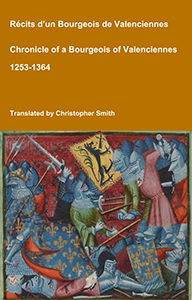
Chronicle of a Bourgeois of Valenciennes
Récits d’un bourgeois de Valenciennes aka The Chronicle of a Bourgeois of Valenciennes is a vivid 14th-century vernacular chronicle written by an anonymous urban chronicler from Valenciennes in the County of Hainaut. It survives in a manuscript that describes local and regional history from about 1253 to 1366, blending chronology, narrative episodes, and eyewitness-style accounts of political, military, and social events in medieval France, Flanders, and the Low Countries. The work begins with a chronological framework of events affecting Valenciennes and its region under rulers such as King Philip VI of France and the shifting allegiances of local nobility. It includes accounts of conflicts, sieges, diplomatic manoeuvres, and the impact of broader struggles like the Hundred Years’ War on urban life in Hainaut. Written from the perspective of a burgher (bourgeois) rather than a monastery or royal court, the chronicle offers a rare lay viewpoint on high politics and warfare, reflecting how merchants, townspeople, and civic institutions experienced the turbulence of the 13th and 14th centuries. Its narrative style combines straightforward reporting of events with moral and civic observations, making it a valuable source for readers interested in medieval urban society, regional politics, and the lived experience of war and governance in pre-modern Europe.
Available at Amazon in eBook and Paperback format.
Around 664 [her brother-in-law] Ealhfrith King Deira (age 34) died. His half brother [her husband] Ecgfrith (age 19) succeeded King Deira. Æthelthryth Wuffingas Queen Consort Deira and Northumbria (age 28) by marriage Queen Consort Deira.
Before 14th July 664 [her brother-in-law] King Eorcenberht of Kent and [her sister] Seaxburh Wuffingas Queen Consort Kent were married. She the daughter of [her father] King Anna of East Anglia. He the son of King Eadbald of Kent and Emma Austrasia Queen Consort Kent.
Bede. She had long requested the [her husband] king (age 25), that he would permit her to lay aside worldly cares, and to serve only the true King, Christ, in a monastery; and having at length with difficulty prevailed, she went as a nun into the monastery of the Abbess Ebba, who was aunt to King Egfrid, at the place called the city Coludi [Map], having taken the veil from the hands of the aforesaid Bishop Wilfrid; but a year after she was herself made abbess in the country called Ely, where, having built a monastery [Map], she began, by works and examples of a heavenly life, to be the virgin mother of very many virgins dedicated to God. It is reported of her, that from the time of her entering into the monastery, she never wore any linen but only woollen garments, and would rarely wash in any hot bath, unless just before any of the great festivals, as Easter, Whitsuntide, and the Epiphany, and then she did it last of all, after having, with the assistance of those about her, first washed the other servants of God there present; besides, she seldom did eat above once a day, excepting on the great solemnities, or some other urgent occasion, unless some considerable distemper obliged her. From the time of matins she continued in the church at prayer till it was day; some also say, that by the spirit of prophecy, she, in the presence of all, not only foretold the pestilence of which she was to die, but also the number of those that should be then snatched away out of her monastery. She was taken to our Lord, in the midst of her flock, seven years after she had been made abbess; and, as she had ordered, was buried among them, in such manner as she had died, in a wooden coffin.
On 15th February 670 [her father-in-law] King Oswiu of Northumbria (age 58) died. He was buried at Whitby Abbey [Map] - see Bede. In 670 His son [her husband] Ecgfrith (age 25) succeeded King Northumbria. Æthelthryth Wuffingas Queen Consort Deira and Northumbria (age 34) by marriage Queen Consort Northumbria.
Anglo-Saxon Chronicle. 673. This year died [her nephew] Egbert, King of Kent; and the same year there was a synod at Hertford [Map]; and St. Etheldritha (age 37) began that monastery at Ely [Map].
In 675 King Æthelred of Mercia succeeded King Mercia. [her sister-in-law] Osthryth Bernicia Queen Consort Mercia by marriage Queen Consort Mercia.
Around 679 King Æthelred of Mercia defeated the Northumbrian army led by [her husband] King Ecgfrith of Northumbria (age 34) at the Battle of the Trent somehere in Lindsey [Map]. [her brother-in-law] King Aelfwine of Deira was killed.
Anglo-Saxon Chronicle. 679. This year [her brother-in-law] Elwin was slain, by the river Trent, on the spot where [her husband] Everth (age 34) and Ethelred fought. This year also died St. Etheldritha (age 43); and the monastery of Coldingiham [Map] was destroyed by fire from heaven.
Bede. She was succeeded in the office of abbess by her sister [her sister] Sexberga, who had been wife to [her former brother-in-law] Erconbert, king of Kent; who, when her sister had been buried sixteen years, thought fit to take up her bones, and putting them into a new coffin, to translate them into the church. Accordingly she ordered some of the brothers to provide a stone to make a coffin of; they accordingly went on board ship, because the country of Ely is on every side encompassed with the sea or marshes, and has no large stones, and came to a small abandoned city, not far from thence, which, in the language of the English, is called Grantchester [Map], and presently, near the city walls, they found a white marble coffin, most beautifully wrought, and neatly covered with a lid of the same sort of stone. Concluding therefore that God had prospered their journey, they returned thanks to him, and carried it to the monastery.
On 23rd June 679 [her sister] Seaxburh Wuffingas Queen Consort Kent was appointed Abbot Ely.
On 20th May 685 Bridei III Picts (age 57) defeated the Northumbrian army at the Battle of Dun Nechtain.
[her former husband] King Ecgfrith of Northumbria (age 40) was killed at Dunnichen, Angus. His half brother [her former brother-in-law] Aldfrith succeeded King Northumbria.
The Deeds of the Dukes of Normandy
The Gesta Normannorum Ducum [The Deeds of the Dukes of Normandy] is a landmark medieval chronicle tracing the rise and fall of the Norman dynasty from its early roots through the pivotal events surrounding the Norman Conquest of England. Originally penned in Latin by the monk William of Jumièges shortly before 1060 and later expanded at the behest of William the Conqueror, the work chronicles the deeds, politics, battles, and leadership of the Norman dukes, especially William’s own claim to the English throne. The narrative combines earlier historical sources with firsthand information and oral testimony to present an authoritative account of Normandy’s transformation from a Viking settlement into one of medieval Europe’s most powerful realms. William’s history emphasizes the legitimacy, military prowess, and governance of the Norman line, framing their expansion, including the conquest of England, as both divinely sanctioned and noble in purpose. Later chroniclers such as Orderic Vitalis and Robert of Torigni continued the history, extending the coverage into the 12th century, providing broader context on ducal rule and its impact. Today this classic work remains a foundational source for understanding Norman identity, medieval statesmanship, and the historical forces that reshaped England and Western Europe between 800AD and 1100AD.
Available at Amazon in eBook and Paperback format.
Bede. As soon, therefore, as he was recovered, he sold him at London, to a Freson, but he could not be bound by him the whole way as he was led along; but though his enemies put several sorts of bonds on him, they were all loosed. The buyer, perceiving that he could in no way be bound, gave him leave to ransom himself if he could; now it was at the third hour (nine in the morning) when the masses were wont to be said, that his bonds were generally loosed. He, having taken an oath that he would either return, or send him the money for his ransom, went into Kent to [her nephew] King Lothaire, who was son to the [her sister] sister of Queen Etheldrida, above spoken of, for he had once been her servant. From him he obtained the price of his ransom, and as he had promised, sent it to his master.
Bede. The body of the holy virgin and spouse of Christ, when her grave was opened, being brought into sight, was found as free from corruption as if she had died and been buried on that very day; as the aforesaid Bishop Wilfrid, and many others that know it, can testify. But the physician, Cynefrid, who was present at her death, and when she was taken up out of the grave, was wont of more certain knowledge to relate, that in her sickness she had a very great swelling under her jaw. "And I was ordered," said he, "to lay open that swelling, to let out the noxious matter in it, which I did, and she seemed to be somewhat more easy for two days, so that many thought she might recover from her distemper; but the third day the former pains returning, she was soon snatched out of the world, and exchanged all pain and death for everlasting life and health. And when so many years after her bones were to be taken out of the grave, a pavilion being spread over it, all the congregation of brothers were on the one side and of sisters on the other, standing about it singing, and the abbess, with a few, being gone to take up and wash the bones, on a sudden we heard the abbess within loudly cry out, ' Glory be to the name of the Lord.' Not long after they called me in, opening the door of the pavilion, where I found the body of the holy virgin taken out of the grave and laid on a bed, as if it had been asleep; then taking off the veil from the face, they also showed the incision which I had made, healed up; so that, to my great astonishment, instead of the open gaping wound with which she had been buried, there then appeared only an extraordinarily slender scar.
Bede. He had his episcopal see in the place called Litchfield [Map], in which he also died, and was buried, and where the see of the succeeding bishops of that province still continues. He had built himself a habitation not far from the church wherein he was wont to pray and read with seven or eight of the brethren, as often as he had any spare time from the labour and ministry of the word. When he had most gloriously governed the church in that province two years and a half, the Divine Providence so ordaining, there came round a season like that of which Ecclesiastes says, "That there is a time to cast stones, and a time to gather them;" for there happened a mortality sent from heaven, which, by means of the death of the flesh, translated the stones of the church from their earthly places to the heavenly building. And when, after many of the church of that most reverend prelate had been taken out of the flesh, his hour also drew near wherein he was to pass out of this world to our Lord, it happened one day that he was in the aforesaid dwelling with only one brother, called Owini, his other companion being upon some reasonable occasion returned to the church. Now Owini was a monk of great merit, having forsaken the world with the pure intention of obtaining the heavenly reward; worthy in all respects to have the secrets of our Lord revealed to him, and worthy to have credit given by his hearers to what he said, for he came with Queen Etheldrid from the province of the East Angles, and was her prime minister, and governor of her family. As the fervour of his faith increased, resolving to renounce the world, he did not go about it slothfully, but so fully forsook the things of this world, that, quitting all he had, clad in a plain garment, and carrying an axe and hatchet in his hand, he came to the monastery of that most reverend prelate, called Lestingau; denoting, that he did not go to the monastery to live idle, as some do, but to labour, which he also confirmed by practice; for as he was less capable of meditating on the Holy Scriptures, he the more earnestly applied himself to the labour of his hands. In short, he was received by the bishop into the house aforesaid, and there entertained with the brethren, and whilst they were engaged within in reading, he was without, doing such things as were necessary.
 Become a Member via our Buy Me a Coffee page to read more.
Great x 3 Grandfather: Wehha Wuffingas
Great x 2 Grandfather: Wuffa King East Anglia
Great x 1 Grandfather: Tytila King East Anglia
GrandFather: Eni Wuffingas
Father: King Anna of East Anglia