

Abbot John Whethamstede’s Chronicle of the Abbey of St Albans
Abbot John Whethamstede's Register aka Chronicle of his second term at the Abbey of St Albans, 1451-1461, is a remarkable text that describes his first-hand experience of the beginning of the Wars of the Roses including the First and Second Battles of St Albans, 1455 and 1461, respectively, their cause, and their consequences, not least on the Abbey itself. His text also includes Loveday, Blore Heath, Northampton, the Act of Accord, Wakefield, and Towton, and ends with the Coronation of King Edward IV. In addition to the events of the Wars of the Roses, Abbot John, or his scribes who wrote the Chronicle, include details in the life of the Abbey such as charters, letters, land exchanges, visits by legates, and disputes, which provide a rich insight into the day-to-day life of the Abbey, and the challenges faced by its Abbot.
Available at Amazon in eBook and Paperback format.
Paternal Family Tree: Iclingas
Ceolred King Mercia was born to [his father] King Æthelred of Mercia.
In 675 [his father] King Æthelred of Mercia succeeded King Mercia. Osthryth Bernicia Queen Consort Mercia by marriage Queen Consort Mercia.
Around 679 [his father] King Æthelred of Mercia defeated the Northumbrian army led by King Ecgfrith of Northumbria (age 34) at the Battle of the Trent somehere in Lindsey [Map]. King Aelfwine of Deira was killed.
After 704 [his father] King Æthelred of Mercia died.
Bede. In the fourth year of the reign of Osred (age 12), Coenred, who had for some time nobly governed the kingdom of the Mercians, much more nobly quitted the sceptre of his kingdom. For he went to Rome, Italy [Map], and there receiving the tonsure and becoming a monk, when Constantine (age 45) was pope, he continued to his last hour in prayer and fasting and alms-deeds at the threshold of the Apostles. He was succeeded in the throne by Ceolred, the son of [his father] Ethelred, who had governed the kingdom before Coenred. With him went the son of Sighere, the king of the East Saxons whom we mentioned before, by name Offa, a youth of a most pleasing age and comeliness, and greatly desired by all his nation to have and to hold the sceptre of the kingdom. He, with like devotion, quitted wife, and lands, and kindred and country, for Christ and for the Gospel, that he might "receive an hundred-fold in this life, and in the world to come life everlasting." He also, when they came to the holy places at Rome, received the tonsure, and ending his life in the monastic habit, attained to the vision of the blessed Apostles in Heaven, as he had long desired.
The same year that they departed from Britain, the great bishop, Wilfrid, ended his days in the province called Inundalum [Map], after he had been bishop forty-five years. His body, being laid in a coffin, was carried to his monastery, which is called Inhrypum, and buried in the church of the blessed Apostle Peter, with the honour due to so great a prelate. Concerning whose manner of life, let us now turn back, and briefly make mention of the things which were done. Being a boy of a good disposition, and virtuous beyond his years, he conducted himself so modestly and discreetly in all points, that he was deservedly beloved, respected, and cherished by his elders as one of themselves. At fourteen years of age he chose rather the monastic than the secular life; which, when he had signified to his father, for his mother was dead, he readily consented to his godly wishes and desires, and advised him to persist in that wholesome purpose. Wherefore he came to the isle of Lindisfarne [Map], and there giving himself to the service of the monks, he strove diligently to learn and to practise those things which belong to monastic purity and piety; and being of a ready wit, he speedily learned the psalms and some other books, having not yet received the tonsure, but being in no small measure marked by those virtues of humility and obedience which are more important than the tonsure; for which reason he was justly loved by his elders and his equals. Having served God some years in that monastery, and being a youth of a good understanding, he perceived that the way of virtue delivered by the Scots was in no wise perfect, and he resolved to go to Rome, to see what ecclesiastical or monastic rites were in use at the Apostolic see. When he told the brethren, they commended his design, and advised him to carry out that which he purposed. He forthwith went to Queen Eanfled, for he was known to her, and it was by her counsel and support that he had been admitted into the aforesaid monastery, and he told her of his desire to visit the threshold of the blessed Apostles. She, being pleased with the youth's good purpose, sent him into Kent, to King Earconbert,8 who was her uncle's son, requesting that he would send him to Rome, Italy [Map] in an honourable manner. At that time, Honorius, one of the disciples of the blessed Pope Gregory (age 41), a man very highly instructed in ecclesiastical learning, was archbishop there. When he had tarried there for a space, and, being a youth of an active spirit, was diligently applying himself to learn those things which came under his notice, another youth, called Biscop, surnamed Benedict, of the English nobility, arrived there, being likewise desirous to go to Rome, of whom we have before made mention.
Anglo-Saxon Chronicle. 709. This year died Aldhelm (age 70), who was bishop by Westwood. The land of the West-Saxons was divided into two bishoprics in the first days of Bishop Daniel; who held one whilst Aldhelm held the other. Before this it was only one. Forthere succeeded to Aldhelm; and Ceolred succeeded to the kingdom of Mercia. And Cenred went to Rome; and Offa with him. And Cenred was there to the end of his life. The same year died Bishop Wilferth, at Oundle [Map], but his body was carried to Ripon [Map]. He was the bishop whom King Everth compelled to go to Rome.
In 709 Ceolred King Mercia succeeded King Mercia.
In 709 King Coenred of Mercia Abdicated as King Mercia in favour of Ceolred King Mercia. His first cousin Ceolred succeeded King Mercia.
In 715 Ceolred King Mercia and King Ine of Wessex (age 45) were defeated by an unknown army during the 715 Battle of Wanborough at Adam's Grave [Map].
Anglo-Saxon Chronicle. 715. This year Ina (age 45) and Ceolred fought at Wanborough;24 [possibly Wednesbury, Staffordshire [Map], Wanborough, Wiltshire [Map] or Woden's Barrow aka Adam's Grave [Map]] and King Dagobert (age 16) departed this life.
Note 24. Wothnesbeorhge, Ethelw.; Wonsdike, Malmsb.; Wonebirih, H. Hunt; Wodnesbeorh, Flor.; Wodnesbirch, M. West. There is no reason, therefore, to transfer the scene of action to Woodbridge, as some have supposed from an erroneous reading.
Before 716 Ceolred King Mercia and Werburga Queen Mercia were married. He the son of King Æthelred of Mercia.
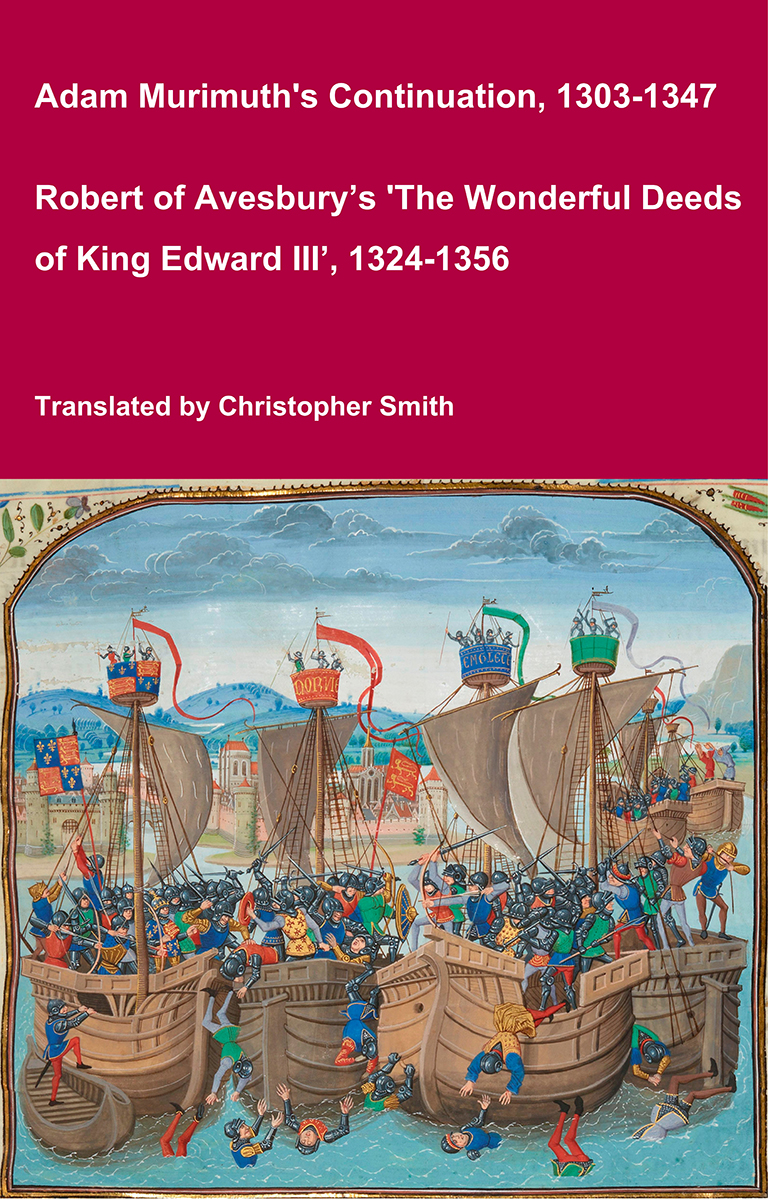
Adam Murimuth's Continuation and Robert of Avesbury’s 'The Wonderful Deeds of King Edward III'
This volume brings together two of the most important contemporary chronicles for the reign of Edward III and the opening phases of the Hundred Years’ War. Written in Latin by English clerical observers, these texts provide a vivid and authoritative window into the political, diplomatic, and military history of fourteenth-century England and its continental ambitions. Adam Murimuth Continuatio's Chronicarum continues an earlier chronicle into the mid-fourteenth century, offering concise but valuable notices on royal policy, foreign relations, and ecclesiastical affairs. Its annalistic structure makes it especially useful for establishing chronology and tracing the development of events year by year. Complementing it, Robert of Avesbury’s De gestis mirabilibus regis Edwardi tertii is a rich documentary chronicle preserving letters, treaties, and official records alongside narrative passages. It is an indispensable source for understanding Edward III’s claim to the French crown, the conduct of war, and the mechanisms of medieval diplomacy. Together, these works offer scholars, students, and enthusiasts a reliable and unembellished account of a transformative period in English and European history. Essential for anyone interested in medieval chronicles, the Hundred Years’ War, or the reign of Edward III.
Available at Amazon in eBook and Paperback format.
In 716 Ceolred King Mercia died. He was buried at Lichfield Cathedral [Map]. His great uncle Eowa succeeded King Mercia.
Anglo-Saxon Chronicle. 716. This year Osred (age 19), king of the Northumbrians, was slain near the southern borders. He reigned eleven winters after Ealdferth. Cenred then succeeded to the government, and held it two years; then Osric, who held it eleven years. This same year died Ceolred, king of the Mercians. His body lies at Lichfield [Map]; but that of [his father] Ethelred, the son of [his grandfather] Penda, at Bardney [Map]. Ethelbald then succeeded to the kingdom of Mercia, and held it one and forty winters. Ethelbald was the son of Alwy, Alwy of Eawa, Eawa of Webba, whose genealogy is already written. The venerable Egbert (age 77) about this time converted the monks of Iona to the right faith, in the regulation of Easter, and the ecclesiastical tonsure.
In 782 [his former wife] Werburga Queen Mercia died.
Great x 2 Grandfather: Creoda King Mercia
Great x 1 Grandfather: Pybba King Mercia
GrandFather: King Penda of Mercia
Father: King Æthelred of Mercia