


The True Chronicles of Jean le Bel Volume 1 Chapters 1-60 1307-1342
The True Chronicles of Jean le Bel offer one of the most vivid and immediate accounts of 14th-century Europe, written by a knight who lived through the events he describes, and experienced some of them first hand. Covering the early decades of the Hundred Years’ War, this remarkable chronicle follows the campaigns of Edward III of England, the politics of France and the Low Countries, and the shifting alliances that shaped medieval warfare. Unlike later historians, Jean le Bel writes with a strong sense of eyewitness authenticity, drawing on personal experience and the testimony of fellow soldiers. His narrative captures not only battles and sieges, but also the realities of military life, diplomacy, and the ideals of chivalry that governed noble society. A key source for Jean Froissart, Le Bel’s chronicle stands on its own as a compelling and insightful work, at once historical record and literary achievement. This translation builds on the 1905 edition published in French by Jules Viard, adding extensive translations from other sources Rymer's Fœdera, the Chronicles of Adam Murimuth, William Nangis, Walter of Guisborough, a Bourgeois of Valenciennes, Geoffrey le Baker of Swinbroke and Richard Lescot to enrich the original text and Viard's notes.
Available at Amazon in eBook and Paperback format.
Paternal Family Tree: Wuffingas
Saint Wihtburh Wuffingas was born to [her father] King Anna of East Anglia (possibly).
Around 636 [her father] King Anna of East Anglia succeeded King East Anglia.
On 20th January 640 King Eadbald of Kent died. His son [her future brother-in-law] Eorcenberht succeeded King of Kent. [her sister] Seaxburh Wuffingas Queen Consort Kent by marriage Queen Consort Kent.
Around 652 [her brother-in-law] Tondberct Gwyre and [her sister] Æthelthryth Wuffingas Queen Consort Deira and Northumbria (age 16) were married. She the daughter of [her father] King Anna of East Anglia.
In 654 King Penda of Mercia defeated the East Anglian army at the Battle of Bulcamp at Bulcamp, Blythburgh. [her father] King Anna of East Anglia and his son [her brother] Jurmin Wuffingas were killed. Anna's son His uncle [her uncle] Æthelhere succeeded King East Anglia.
After her father's death in 654 Saint Wihtburh Wuffingas decided to build a convent at East Dereham. A traditional story relates that while she was building the convent, she had nothing but dry bread to give to the workmen. She prayed to the Virgin Mary and was told to send her maids to a local well each morning. There they found two wild does which were gentle enough to be milked; they provided nutritious drink for the workers. This allowed the workers to be fed.
After 655 [her brother-in-law] King Ecgfrith of Northumbria (age 10) and [her sister] Æthelthryth Wuffingas Queen Consort Deira and Northumbria (age 19) were married. She the daughter of [her father] King Anna of East Anglia. He the son of King Oswiu of Northumbria (age 43) and Eanflæd Queen Consort Bernicia (age 28).
Around 664 Ealhfrith King Deira (age 34) died. His half brother [her brother-in-law] Ecgfrith (age 19) succeeded King Deira. [her sister] Æthelthryth Wuffingas Queen Consort Deira and Northumbria (age 28) by marriage Queen Consort Deira.
Before 14th July 664 [her brother-in-law] King Eorcenberht of Kent and [her sister] Seaxburh Wuffingas Queen Consort Kent were married. She the daughter of [her father] King Anna of East Anglia. He the son of King Eadbald of Kent and Emma Austrasia Queen Consort Kent.
On 15th February 670 King Oswiu of Northumbria (age 58) died. He was buried at Whitby Abbey [Map] - see Bede. In 670 His son [her brother-in-law] Ecgfrith (age 25) succeeded King Northumbria. [her sister] Æthelthryth Wuffingas Queen Consort Deira and Northumbria (age 34) by marriage Queen Consort Northumbria.
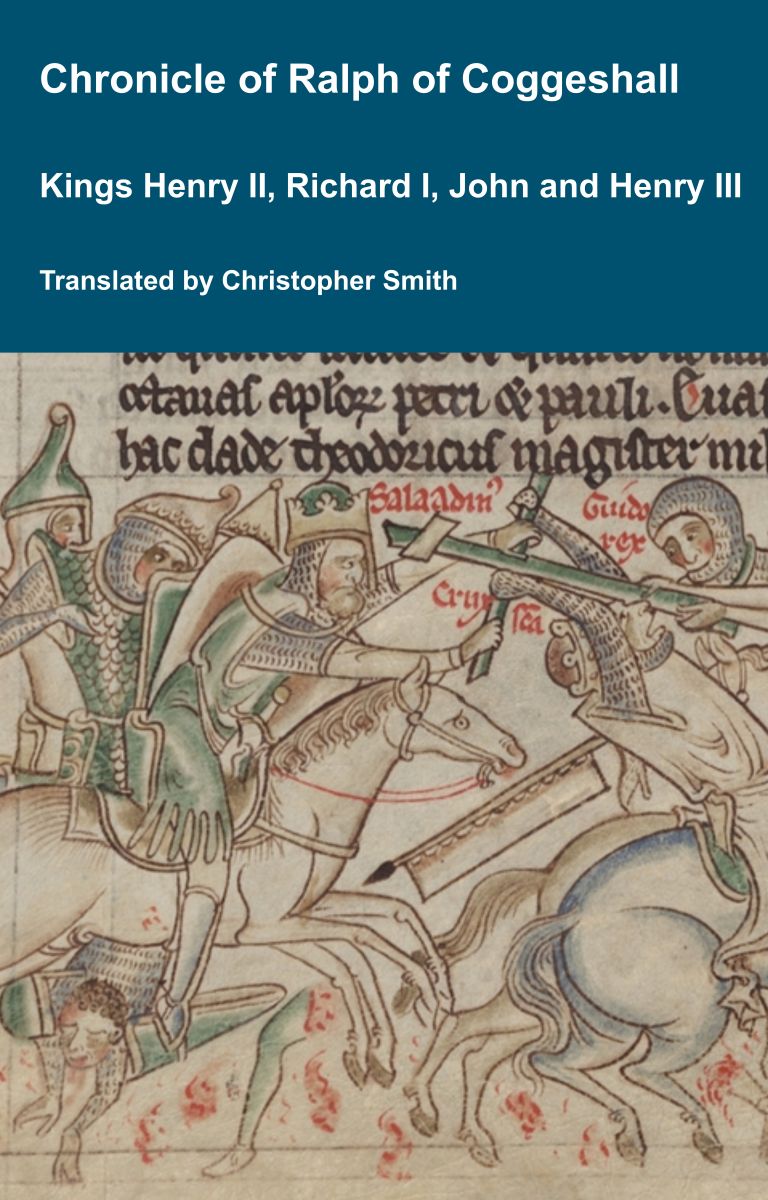
Chronicle of Abbot Ralph of Coggeshall
The Chronicle of Abbot Ralph of Coggeshall (Chronicon Anglicanum) is an indispensable medieval history that brings to life centuries of English and European affairs through the eyes of a learned Cistercian monk. Ralph of Coggeshall, abbot of the Abbey of Coggeshall in Essex in the early 13th century, continued and expanded his community’s chronicle, documenting events from the Norman Conquest of 1066 into the tumultuous reign of King Henry III. Blending eyewitness testimony, careful compilation, and the monastic commitment to record-keeping, this chronicle offers a rare narrative of political intrigue, royal power struggles, and social upheaval in England and beyond. Ralph’s work captures the reigns of pivotal figures such as Richard I and King John, providing invaluable insights into their characters, decisions, and the forces that shaped medieval rule. More than a simple annal, Chronicon Anglicanum conveys the texture of medieval life and governance, making it a rich source for scholars and readers fascinated by English history, monastic authorship, and the shaping of the medieval world.
Available at Amazon in eBook and Paperback format.
In 673 [her sister] Æthelthryth Wuffingas Queen Consort Deira and Northumbria (age 37) founded Ely Abbey [Map] and was appointed Abbot Ely.
On 23rd June 679 [her sister] Seaxburh Wuffingas Queen Consort Kent was appointed Abbot Ely.
On 23rd June 679 [her sister] Æthelthryth Wuffingas Queen Consort Deira and Northumbria (age 43) died. She was buried at Ely Abbey [Map].
Around 699 [her sister] Seaxburh Wuffingas Queen Consort Kent died. She was buried at Ely Abbey [Map].
In 743 Saint Wihtburh Wuffingas died.
In 798 Saint Wihtburh's remains were dug up and found not to have decayed. This was considered a miracle and her remains were re-interred in the church which she had built in East Dereham. The church became a place of pilgrimage, with people visiting Wihtburh's tomb.
In 974 Brithnoth, the abbot of Ely stole her remains so that he could profit from the pilgrims' visits. A spring had arose in Saint Wihtburh's violated tomb. The water in this spring was considered to be compensation for the loss of their saint; pilgrims continued to come to from the spring. The spring has never run dry.
Around 1250. St Withburga's Church, Holkham [Map]. The tower circa 13th Century. The rest of the church extensively rebuilt in 1767. It is now located in the grounds of Holkham Hall, Norfolk. It was built on a mound which may pre-date the church and may represent high ground near to the coast which is now further from the church as a consequence of land reclamation. The church is uniquely dedicated to Saint Wihtburh Wuffingas.


Great x 3 Grandfather: Wehha Wuffingas
Great x 2 Grandfather: Wuffa King East Anglia
Great x 1 Grandfather: Tytila King East Anglia
GrandFather: Eni Wuffingas
Father: King Anna of East Anglia