

Chronicle of a Bourgeois of Valenciennes
Récits d’un bourgeois de Valenciennes aka The Chronicle of a Bourgeois of Valenciennes is a vivid 14th-century vernacular chronicle written by an anonymous urban chronicler from Valenciennes in the County of Hainaut. It survives in a manuscript that describes local and regional history from about 1253 to 1366, blending chronology, narrative episodes, and eyewitness-style accounts of political, military, and social events in medieval France, Flanders, and the Low Countries. The work begins with a chronological framework of events affecting Valenciennes and its region under rulers such as King Philip VI of France and the shifting allegiances of local nobility. It includes accounts of conflicts, sieges, diplomatic manoeuvres, and the impact of broader struggles like the Hundred Years’ War on urban life in Hainaut. Written from the perspective of a burgher (bourgeois) rather than a monastery or royal court, the chronicle offers a rare lay viewpoint on high politics and warfare, reflecting how merchants, townspeople, and civic institutions experienced the turbulence of the 13th and 14th centuries. Its narrative style combines straightforward reporting of events with moral and civic observations, making it a valuable source for readers interested in medieval urban society, regional politics, and the lived experience of war and governance in pre-modern Europe.
Available at Amazon in eBook and Paperback format.
Ancient Crosses and Other Antiquities in the West of Cornwall is in Victorian Books.
Ancient Crosses and Other Antiquities in the West of Cornwall Drawn and Engraved by J. T. Blight (age 20). 1856.
It is generally supposed that cromlechs were erected by the Ancients for the purpose of distinguishing the burial-places of their chiefs, or of other celebrated individuals. Paulinus and Agricola, in their several descents on the island of Anglesea, found Druidical circles and cromlechs there; and this mode of burial continued to be practised for some time after. We find that when Vortimer defeated Hengist and Horsa at Aylesford, in Kent, where both Horsa, and Catigern the British chief, perished, the fine cromlech, now called "Kit's Cotty House [Map]," was erected over the remains of the latter by his sorrowful countrymen. They may also have been used by the Druids for religious purposes; as similar structures are at the present time in India. For an account of these, we are indebted to W. J. Henwood, Esq., F.R.S., F.G.S., &c. After noticing the rock-basins, &c, which he observed there, he thus speaks of the cromlechs: — "In front of one of the Temples are two small cromlechs of slate: the larger is an oblong square, about 5 feet in length and 2½ feet in breadth, and is supported at a height of rather less than 3 feet, horizontally, on six stones; the smaller is triangular, and is perhaps 2½ feet wide; but instead of being flat it is supported at an angle of about 30 degrees from the horizon, in such a manner, that one corner is the lowest part, and one edge — the highest — is level; the props being applied to the inclined sides only, shelter the interior for about two-thirds of its circumference, but leave the rest open. The flat-topped cromlechs are used in differently as altars or as seats: for I have observed rice and flowers, as offerings, often laid on them; and just as frequently I have seen the natives sitting and resting their burdens on them: the inclined ones are employed only as receptacles for small rudely-made iron lamps, which are always lighted when religious rites are being solemnized. Level-topped cromlechs are frequently found alone; but I do not recollect an instance, amongst the scores I have seen, of an inclined one without a flat one in its neighbourhood."1
Note 1. Proceedings of the Royal Institution of Cornwall, 1855.

There are five of these ancient monuments in the west of Cornwall, all in a good state of preservation. The remains of one may be seen in a field about half-a-mile from the Lanyon cromlech [Map], and of another at Bosprennis, in Zennor [Map]. There are two other cromlechs beyond the limits of our inquiries, - one at Trevethy [Map], in St. Cleer, and another, now fallen, at Coit, in St. Columb.
The cover-stone of the Lanyon cromlech [Map] is 18½ feet long and 9 feet wide; from the under part of this stone to the ground it measures 5 feet. Borlase, and others who have followed him, state, that this cromlech is high enough for a man on horse back to pass under it. The Carwynen [Map] cromlech is less than that of Lanyon.
The Zennor cromlech is the largest in the county: the supporters are about 9 feet high, — the cover-stone, 18 feet long and 10½ feet wide.


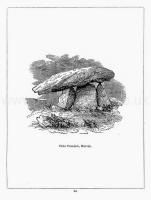
The top-stone of Chûn cromlech [Map] is nearly 13 feet long and 11½ feet wide, — its elevation is about 4 feet.

CIRCLES.
Besides the circle at Boscawen-un [Map] (p. 65), there are several others in the neighbourhood: as at Boskednan, in Gulval; Tregaseal, St. Just; and the Dawns Mên, commonly called "the Merry Maidens," at Rosemoddress, in St. Burian; &c. They are supposed to have been connected with the religious rites of the Druids. Near the circle last named are the two large pillars called "the Pipers."
Note. Druidical Circle at Boscawen-un [Map], St. Burian. The stone within the circle, which is in a slanting position, measures 8 feet in length. The Btones which compose the circle are at irregular distances, some being 8 and others 12 feet asunder; they are from 4 to 5 feet high. This circle consists of nineteen stones, and is about 73 feet in diameter.
HOLED STONES.
The holed stones, of which a specimen is given at p. 67, have also been attributed to the Druids, but for what particular rite they were appropriated is uncertain.
INSCRIBED STONES.
The Mên Scryfa (p. 67) is, according to Borlase, one of the oldest monuments we have in Cornwall. The inscription, Rialobranus Cunovali films, signifies that Rialobran the son of Cunoval was buried here.
Henrici Quinti, Angliæ Regis, Gesta, is a first-hand account of the Agincourt Campaign, and subsequent events to his death in 1422. The author of the first part was a Chaplain in King Henry's retinue who was present from King Henry's departure at Southampton in 1415, at the siege of Harfleur, the battle of Agincourt, and the celebrations on King Henry's return to London. The second part, by another writer, relates the events that took place including the negotiations at Troye, Henry's marriage and his death in 1422.
Available at Amazon in eBook and Paperback format.
The inscribed stone at Bleu Bridge1 was formerly in a horizontal position, and formed the stepping-stone of the bridge. The words of the inscription at length would be, — Quenatavus Icdinui filius.
Another inscribed stone was found at Carnsew, Hayle, in 1843, an engraving and an account of which will be found in the Guide to Penzance.
Note 1. "Bleu" signifies Parish.