

Henrici Quinti, Angliæ Regis, Gesta, is a first-hand account of the Agincourt Campaign, and subsequent events to his death in 1422. The author of the first part was a Chaplain in King Henry's retinue who was present from King Henry's departure at Southampton in 1415, at the siege of Harfleur, the battle of Agincourt, and the celebrations on King Henry's return to London. The second part, by another writer, relates the events that took place including the negotiations at Troye, Henry's marriage and his death in 1422.
Available at Amazon in eBook and Paperback format.
Antiquity 1952 Volume 26 is in Antiquity.
Ringham Low [Map]: The Rediscovery of a Derbyshire Chambered Tomb1
Ringham Low (Monyash) was recorded by Bateman in the mid-19th century as a barrow of considerable size and importance2 (Fig. 1). Не shows plans of the barrow and of four of the chambers which it contained. At that time continuous stone-robbing was taking place, so that, when Ward wrote forty years later3, the chambers had all been destroyed. Since then, the location of the site itself has been forgotten and it could not be discovered by Phillips4. Recently, local enquiries revealed, however, that a few fields lying to the east of Ricklow Dale still bear the name Ringham Low. Within these, about 650 yards to the east of Ricklow Dale and 450 yards to the north of Lathkilldale, the o.s. shows a small plantation with tumuli (MR 170/655), which must clearly be Bateman's site. The barrow lies partly beneath this plantation, partly to the north. To the north of the plantation, the barrow has almost completely disappeared, and no signs of chambers remain. Within the walled plantation, the stony ground is covered with undergrowth and any structures are now indefinite. Confusion has probably arisen as Bateman records Ricklow Dale as lying to the east of the barrow; in fact the barrow lies to the east of the dale.
Note 1. This note is published in anticipation of a general paper on the Peak collective tombs, which has been delayed by the authors' absence abroad. It is hoped that other field-workers wil now have an opportunity to give the site the thorough examination which it deserves.
Note 2. T. Bateman, Vestiges, p. 103, and Ten Years Diggings, p. 94, et seq.
Note 3. V.C.H. Derbyshire, Vol. 1, J. Ward, 'Early Man', pp. 165-8.
Note 4. Ordnance Map of the Trent Basin showing distribution of long barrows, megaliths and habitation sites, pp. 10, 17 and 22. It should be noted that the map requires modification as the site is to the east of Monyash.
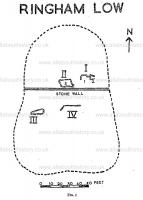
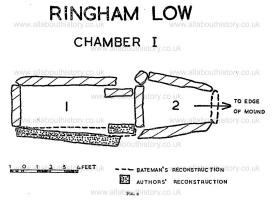
Daniel4 dismisses Ringham Low as a group of large cists, but it seems more likely that one at least of the structures is a chambered tomb of the usual Peak type6. This chamber (FIG. 2) consists of two cells, containing six skeletons; it had already been disturbed when Bateman planned it, and the south wall of cell I was missing. Bateman attempts to reconstruct the chamber but he gives no evidence for his plan. He makes cell 1 rectangular and cell 2 wedge-shaped; it would seem more reasonable to reconstruct the south wall of cell 1 on the analogy of the north wall, where one long slab overlaps a much shorter one. This would give a slightly tapering chamber entered through two pillar-stones closely comparable with the chambers at Minninglow and at Five Wells". Cell 2, which is towards the border of the mound, may be a subsidiary chamber, or, as the authors hope to show in a general discussion on these tombs, tae remains of a passage. Bateman does riot give the heights of the individual stones, but he does give the depth of each cell; in the case of cell т, 3 feet 6 inches, and of cell 2, only 2 feet. 'These measurements, which presumably show the average height of tae side-walls in each case, would make both cells very low, but they may have been built up with dry-stone walling.
Note 5. G. E. Daniel, The Prehistoric Chamber Tombs of England and Wales, p. 183.
Note 6. The type, single-celled, wedge-shaped and entered between two pillar-stones from a passage was discussed by Ward, writing on Five Wells (J. Ward, Relig. and Ill. Arch., N.S. VII, p. 229-42). Daniel, relying exclusively on plans, has obscured several important features, The whole question will be discussed at length in the paper already referred to. It should be added that the Bridestones [Map] has no morphological claim to a place in the Peak group.
Two leaf-shaped arrowheads were found in cell 1 in association with four of tae skeletons, and three were also found in the interstices between the paving stones of Chamber п. This chamber contained twelve bodies and is clearly a second collective tomb, but it is not possible to make anything of Bateman's plan and description. There were no other finds of interest in the barrow, but similar arrowheads were also found dy Ward at Harborough?, and are common in megalithic tombs. In short, Chamber 1 at Ringham Low provides another example of the type of collective tomb characteristic of the Peak, and it may be that careful excavation would reveal the original orm of tae barrow and its chambers.
Leslie And Elizabeth Alcock.