

This is a translation of the 'Memoires of Jacques du Clercq', published in 1823 in two volumes, edited by Frederic, Baron de Reissenberg. In his introduction Reissenberg writes: 'Jacques du Clercq tells us that he was born in 1424, and that he was a licentiate in law and a counsellor to Philip the Good, Duke of Burgundy, in the castellany of Douai, Lille, and Orchies. It appears that he established his residence at Arras. In 1446, he married the daughter of Baldwin de la Lacherie, a gentleman who lived in Lille. We read in the fifth book of his Memoirs that his father, also named Jacques du Clercq, had married a lady of the Le Camelin family, from Compiègne. His ancestors, always attached to the counts of Flanders, had constantly served them, whether in their councils or in their armies.' The Memoires cover a period of nineteen years beginning in in 1448, ending in in 1467. It appears that the author had intended to extend the Memoirs beyond that date; no doubt illness or death prevented him from carrying out this plan. As Reissenberg writes the 'merit of this work lies in the simplicity of its narrative, in its tone of good faith, and in a certain air of frankness which naturally wins the reader’s confidence.' Du Clercq ranges from events of national and international importance, including events of the Wars of the Roses in England, to simple, everyday local events such as marriages, robberies, murders, trials and deaths, including that of his own father in Book 5; one of his last entries.
Available at Amazon in eBook and Paperback format.
Archaeologia Cambrensis 1876 Pages 51-66 is in Archaeologia Cambrensis 1876.
Copper Cakes, etc, Castellor, Anglesey
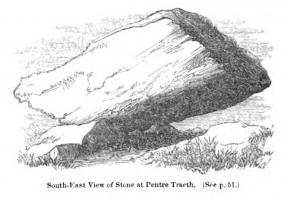
Fro the railway-station at Ty-Croes, in the county of Anglesey, a person much interested in the antiquities of the island may enjoy a walk in the direction opposite to that of Barclodiad-y-Gawres (vol. x, 3 series). At a short distance north-east of the church and village of Llanvaelog, on a farm called Ty-Newydd, he would find still conspicuous on its three supports the cromlech so well described in the January number of the Archaologia Cambrensis, 1864. From which point, taking a westerly course towards the river Crigyll, where it is crossed by the railway embankment, he might observe, west of a farmhouse, called Pentre-Traeth, on low marshy ground sometimes inundated by the sea, remains noticed on the Ordnance Map as a cromlech [Pentre Traeth Burial Chamber [Map]], but which may be described as a scattered tumulus, or carnedd, with its chamber, or most probably chambers, laid open and destroyed. On their south-western side, seemingly dismounted from its position as the cap-stone of a low cist or cell, a cumbrous block, 22½ feet in circumference, and 3¼ ft. thick (see cut, p. 66), is so curiously poised on a ridge of earth and smaller stones as to give the appearance, from several points of view, of a larger part being out-balanced by a smaller one. That grave-stones of this magnitude, with the additional coverings of tumuli or superimposed carneddau, should have been regarded in a rude age as lasting protections to the ashes placed beneath them is not surprising. What remains of the Pentre-Traeth tumulus has a circumference of 110 feet, and stands about 2 feet above the surrounding plain. Near to its base are from twelve to sixteen large stones, many of them apparently dislodged from their original positions, and afterwards regarded as too heavy for re- moval to the inevitable stone wall, which here crosses the meadow. A few traces of an entrance passage from the south-east are still visible. These remains and the Cruglas at Malldraeth described in a former number of the Archæologia Cambrensis, suggest an inquiry of some interest. It has been affirmed that considerable portions of the British coast have been elevated since the Roman period. During high tides the sea flows up to the Pentre-Traeth remains, and the sepulchral mound at Malldraeth, called the Cruglas, would be surrounded by its inundations if unprotected by modern embankments. I am unable to decide whether the Pentre-Traeth antiquity is the one alluded to by Mr. Pennant, where, advocating the sepulchral origin of these structures, he states that several cromlechs existed in his day "quite bedded in the carnedd or heap of stones, instances of which might be produced in Llanfaelog, in this island, etc." (Tour in Wales, vol. ii, p. 238.)
From hence he may, if an angler, fish his way up the Crigyll, an excellent trout stream, until he finds himself on the outskirts of a farm, called Wænfynydd, in the parish of Llechylched, where, on two rudely cultivated fields on the south-eastern side of the river, with a dreary prospect on either side, a few vestiges are to be seen of the once populous village of Castellor, one of the Castellors or Castell-iors noticed by Mr. Rowlands in his Mona Antigua. Ten or a dozen widely dispersed hut foundations are almost the only traces of its former existence. Castellor has for a long period been deserted by its inhabitants, and its position, strangely omitted on the Ordnance Map, is almost unknown. Even the old parish church of Llechylched (Arch. Camb., 1862, p. 118), which stands within two fields of it, participates in the surrounding desolation, its shattered roof and naked rafters proclaiming that church and population have retired to a more cheerful district. Many of the following particulars relating to the spot have been contributed by Mr. Robert Williams, the present occupier of Waenfynydd, who, at the commencement of his tenancy some forty-five years ago, was principally instrumental in digging up the ruins of Castellor. From the first field adjoining the river which rises from its south-eastern bank with a rocky ascent of about 18 ft., from sixteen to twenty hut remains were dug up and removed. The floors of these were in every instance flagged, and the lower courses of their walls on the outside generally consisted of large stones set endwise, the interstices and the inner faces of the walls being worked with earth and smaller stones, the whole forming a thick bank impervious to air, and capable of sustaining considerable roof pressure. These cots or cyttiau, I venture to suggest, may have been roofed over with cronglwydi (roof-hurdles) wattled to each other and well-coated with heather, rushes, sods, or clay, constituting a light roof suitable to the walls, and strong because circular. The original import of the word cronglwyd being a convex, concave, or a curved hurdle, I have thought it possible that hurdles so named were, in the first instance, designed for and adapted to a circular building with a conical or a dome-shaped roof. Part of a wall, 4 feet wide, which extended along the upper slope of the field, seemingly one of the ordinary defences of early villages in Anglesey, was carted away with the exception of a corner or terminal stone 8 feet long, now prostrate, but when first observed stood inan erect position.
Two stones of a cromlech [Waenfynydd aka Castellor Burial Chamber [Map]], the largest of which measures superficially 9 feet by 5½ feet, and is 3 feet thick, are at present the only perceptible antiquities on this field with the exception of the large stone mentioned above. The capstone of the cromlech, 15 feet long, was broken up many years ago. On the second field, separated from the first by a farm wall, seven or eight low circles, with several lines of upright stones, mark the sites of early habitations not fully obliterated, and also of structures, concerning the purpose of which it is vain to speculate.