

William of Worcester's Chronicle of England
William of Worcester, born around 1415, and died around 1482 was secretary to John Fastolf, the renowned soldier of the Hundred Years War, during which time he collected documents, letters, and wrote a record of events. Following their return to England in 1440 William was witness to major events. Twice in his chronicle he uses the first person: 1. when writing about the murder of Thomas, 7th Baron Scales, in 1460, he writes '… and I saw him lying naked in the cemetery near the porch of the church of St. Mary Overie in Southwark …' and 2. describing King Edward IV's entry into London in 1461 he writes '… proclaimed that all the people themselves were to recognize and acknowledge Edward as king. I was present and heard this, and immediately went down with them into the city'. William’s Chronicle is rich in detail. It is the source of much information about the Wars of the Roses, including the term 'Diabolical Marriage' to describe the marriage of Queen Elizabeth Woodville’s brother John’s marriage to Katherine, Dowager Duchess of Norfolk, he aged twenty, she sixty-five or more, and the story about a paper crown being placed in mockery on the severed head of Richard, 3rd Duke of York.
Available at Amazon in eBook and Paperback format.
Archaeologia Cambrensis 1887 Page 349 is in Archaeologia Cambrensis 1887.
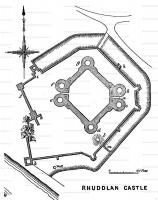
At Rhuddlan the Archdeacon guided the Association in its perambulation of the Castle, and pointed out the principal features; after which he read a brief epitome of the chief events bearing on the history of the place from the time of King Offa's victory on the adjoining marsh, in A.D. 795, down to the dismantling of the Castle by order of the Parliament in 1646. The accompanying plan, enlarged from that in the New Ordnance Survey, will show the arrangement of the fortress and its defences. Placed on the bank of a tidal river, and forming one of the keys of Snowdonia, it was always a point of strategic importance, and sustained a remarkable series of sieges, captures, and recaptures, during the Welsh wars, and its massive walls and simple military character are well in character with those conditions. The main entrance was at a, between the two round towers, b and c; and it was approached by a drawbridge over the moat, the bastions of which are shown on the inner side. Two corresponding towers occupy the opposite angle of the court, and the other angles are each of them strengthened by a single massive round tower. The chief living rooms were within the tower. There ai'e no remains of buildings in the court, but the walls show where the beams rested for the timber floors and roofs. The moat is encased in masonry, and was evidently filled with water which was retained by walls. The slope of the ground from the west prevented its being continued on that side, and its place was supplied by strong walls and towers.
Proceeding from the Castle a distance of about 300 yards, to the south, Twt Hill [Map], the site of the earlier castle built by Llywelyn ap Sitsyllt, King of Gwynedd c. 1015, was passed; and a little further on are the remains of the Dominican Priory [Map], now called the Abbey. Here, again, under the same guidance, were seen the windows of the monks' dormitory, above the present barn; and built up into the Avails, a large monumental slab with an incised effigy of an Archbishop of Rages, a former brother of the house. Near it was a cross ragule, memorial to "De Bridelton' cuius a'ie p'piciet." Other floriated crosses lie near the front door of the farmhouse, whilst in the garden wall are portions of window-tracery. There is a much damaged effigy of a knight in the wall of the stable; and behind the buildings on the opposite side of the yard (the western) may be seen several Pointed windows that show that portion to have been a part of the old monastic building. The property now belongs to Sir W. G. Williams, Bart (age 42)., of Bodelwyddan, and it is much to be desired that these interesting relics should be more carefully protected. The lateness of the hour and the shades of evening rendered it too dark to see the church, and it had reluctantly to be omitted for the day.