


Archaeologia Volume 8 Section III
Archaeologia Volume 8 Section III is in Archaeologia Volume 8.
02 Nov 1785. Observations by the Rev. Mr. Pegge (age 80) on the Stanton-Moor Urns, and Druidical Temple [Map]. In a Letter to Major Rooke (age 62). Read November 2,. 1785;
Sir,
After returning you my best thanks for the favour of your letter of Nov. 27, 1784, wherein you are so obliging as to impart to me an account of your late and further discoveries of antiquities on Stanton-Moor in the county of Derby, with drawings of the urns which you was then so fortunate as to find, I should be wanting in gratitude did I not communicate to you, in return, my sentiments upon them, in hope that they may prove acceptable to you.
The discovery was indeed most fortunate and extraordinary, as I do not recollect, at present, one single instance besides this, amongst all the discoveries that have been made in this island relative to hydriotaphy, wherein one urn was found inclosed, or buried as it were, within another. Meric Casaubon informs us [a], that vessels of various kinds had been found within, or near the larger urns dug up at Newington in Kent; and it is well known, that an immense variety of other articles have been found included in the larger and more capacious urns [b].
Note a. Notes on Marc. Aurel. Antonin, p. 43..
Note b. Vide, inter alios, Casaubon, 1. c. Sir Tho. Brown, p. 6. 9. 11. Philipot, Villare Cant. p. 250.- Montfaucon, vol. V. p. 51. and so for money in particular, See. Weever, p. 516, Philipot, 1, c, and Archaeologia, vol. II. p. 181.
We read again of family-urns [c], which necessarily must be of greater content than common; but nevertheless, these do not appear to have had smaller urns with burnt bones inclosed in them, as this of yours had, but only to contain the bones and allies of several perfons all mixed together; though it seems the allies were not always mixed [d]. Besides, P. Montfaucon speaks of holes being made in the covers of urns at Rome, for the introduction of the bones and ashes of subsequent subjects, viz. the remains of 2d, 3d, 4th, or even of 5th bodies [e].
Note c. Sir Tho. Brown, p. 14. Dr. Plott, Nat. Hist. of Oxfordsh. p. 328. Philipot, p. 249. Montfaucon, vol. V, passim. Dr. Harris, Hist. of Kent, p. 218.
Note d. Montfaucon, p. 63.
Note e. Id. ibid. See also Gent. Magas. 1784, p. 962, for several bodies interred in one barrow.
The mention of these large family-urns, reminds me of a Roman vessel I bought, many years ago, at the sale of the effects of John Godfrey, Esq. of Norton-Court, Kent, 1742, and of which there is a print in Dr. Harris's History of Kent, p. 218. It came from the grand repository, or pottery, at Newington in Kent [f], and is said by Dr. Harris to contain near a bushel, but it holds only forty-four pints. He also calls it an urn, but as it is so large, has not much the figure of an urn [g], and has had handles to it, I rather esteem it a vessel of some other kind, perhaps for wine [h], or rather fruit, the mouth being so wide.
Note f. See above the note from Meric Cafaubon,
Note g. See the print in Dr. Harris.
Note h. Batteley, Antiq. Rutup. p. 107.
But to return; the only instance of the kind of your urn that has occurred to me, is in Denmark, where, as Wormius tells us [i], 'Inventa est una [urna] cinerei coloris, quæ in fe minorem continebat ex puriore argillâ elaboratam, coloris nigri, politam, ut ex fragments, quae teneo, conftat.' i.e. 'An urn of an ash colour was found, which contained a smaller one within it, composed of finer clay, black and polished, as appears from the fragments in my possession.'
Note i. Wormii Muf. p. 349.
In regard to the people or nation, to whom. Sir, we may suppose your urn to belong, the Britons, if not before yet certainly after they were romanized, used urn-burial [k]; and therefore one has good reason to imagine, considering where the urn was found, viz. in the midst of so many Druidical monuments as are to be seen on Stanton-Moor, it appertains to them. The bones and ashes in the two urns may possibly be those of a child and its mother dying about the same time, or of a woman who died in child-bed, &c. But all conjectures on this subject must be so vague and uncertain, that it is best to leave every one at liberty to form their own notions on this so very uncommon a phenomenon.
Note k. This, I find, is the opinion of most of those who have been conversant in these matters, as Montfaucon, VII. p. 288. Sir Thomas Brown, p. 10. Camden, col. 1408. edit. Gibson. Philipot, Villare, p. 251,
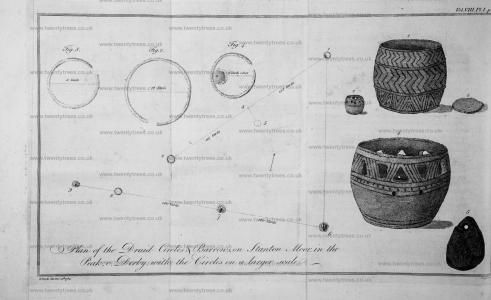
Having thus dispatched, Sir, what I had to say concerning your urns, and the very rare and curious circumstance of inclosure attending them, it may be proper, for a conclusion, to add a word on the diagram which accompanied them, and represents a plan of the ground where they were found; and the rather, as reference has above been made to those Druidical monuments expressed in the diagram. The positions, Sir, of the circles and barrows are, in my opinion, as singular and remarkable as the urns themselves.
The first observable is, that the circles, N° 1 and 2, Pl. I. stand in a right line, being connected as it were by the single stone N° 3 [l], standing in the line, and from which the circles are equidistant, viz. each two hundred and twenty-five paced yards. The barrow, in which the urns were found is within the circle N° 1, and marked with the letter a. In fig. 4, this circle is given on a larger scale; it is nine yards, one foot diameter, but N° 2, at the end of the line, and represented also on a larger scale, is not less than fixteen yards across. We may note further, that the connecting stone, as I call it, is but thirty-four paced yards west of the temple, as you term it, or the Nine Ladies N° 5, so that the circles N° 1 and 2, are also at equal distances from the temple.
Note l. This stone is called by the country people, the king, and there is a drawing of it in Archaeologia, vol. VI. p. 112. Plate XV. 7
Note m. See again, Archaeologia, VI. p. 112. Ib.
The next thing to be remarked is, that the barrows, N° 6 and 7, and the circle N° 8, appear again to range also in a line; and that N° 6 is two hundred and sixty paced yards distant from N° 7, and this last the same from the circle N° 8, which is here also exhibited on a larger scale, fig. 8. and is eleven yards in diameter. Lastly the barrow, N° 9, stands in a line with N° 6, 7, 8, that is, at the termination of the line, and is distant one hundred paced yards from the last mentioned N° 8.
Surely, Sir, there is something very mysterious in these arrangements. One can never suppose these Druidical monuments could be thus fortuitously placed; that would be too wonderful a coincidence; but upon what plan, design, or system, the Druids proceeded in forming this group of British antiquities, I cannot pretend to explain; let others, more sagacious, divine, taking this along with them at the same time, that N° 1 and 6, are pretty near N. and S. of each other.
I am. Sir, your mod obedient,
Sam. Pegge.
P. S. I have omitted to note, and I beg pardon for the omission, that in a draught of your smaller urn, as big as the original, which you shewed me, I remarked two small perforations in the side, under the ornamental border at the top; and I think vou said there were two similar ones on the other side of the urn, and nearly opposite. This particular is to me as astonishing and as unaccountable as any one of the foregoing circumstances.
Since this, Major Rooke being desirous of examining the small barrows, opened one that was within the circle marked (8) in the plan, in which he found an urn of coarse thin clay, full of burnt bones, and upon them lay a very singular Druidical remain, in appearance of mountain pitch, very hard and light, and of the size of the drawing. Considering the figure, which is that of a heart, and the perforation at the top evidently made by a tool, we cannot but esteem it a British amulet.
N° I. pl. I. is an urn of coarse clay taken out of a small barrow on Stanton Moor marked a in the plan: circumference three feet, three inches; height ten inches. Within this urn was a small one N° 2 covered with a piece of clay, N° 3. In the same barrow were two more urns similar to the above.
N° 4. The size of the s urn taken out of N° 1. This is not only the type of the small urn in its true dimensions, but the drawing expressed the colour of it also.