


The True Chronicles of Jean le Bel Volume 1 Chapters 1-60 1307-1342
The True Chronicles of Jean le Bel offer one of the most vivid and immediate accounts of 14th-century Europe, written by a knight who lived through the events he describes, and experienced some of them first hand. Covering the early decades of the Hundred Years’ War, this remarkable chronicle follows the campaigns of Edward III of England, the politics of France and the Low Countries, and the shifting alliances that shaped medieval warfare. Unlike later historians, Jean le Bel writes with a strong sense of eyewitness authenticity, drawing on personal experience and the testimony of fellow soldiers. His narrative captures not only battles and sieges, but also the realities of military life, diplomacy, and the ideals of chivalry that governed noble society. A key source for Jean Froissart, Le Bel’s chronicle stands on its own as a compelling and insightful work, at once historical record and literary achievement. This translation builds on the 1905 edition published in French by Jules Viard, adding extensive translations from other sources Rymer's Fœdera, the Chronicles of Adam Murimuth, William Nangis, Walter of Guisborough, a Bourgeois of Valenciennes, Geoffrey le Baker of Swinbroke and Richard Lescot to enrich the original text and Viard's notes.
Available at Amazon in eBook and Paperback format.
Chester Archaeological and History Society 1856 Page 48 is in Chester Archaeological and History Society 1856.
Denbigh Castle by William Ayrton.

The Goblin Tower [Map]. Denbigh Castle.
One of the most amusing, if not always the most instructive, provinces of the Archaeologist, has ever been the etymology of names,—both of things, people, and places; and perhaps in no country is there such a field for tracing real or fancied derivations as in Wales, where almost every hill, valley, river or ruin, possesses a title referable to either a British, Saxon, or sometimes a Roman origin.
Denbigh is certainly no exception to this rule; but from the mass of conflicting opinions as to the origin 6f its name, we may select that of Archdeacon Newcome, who in his History of Denbigh says, "The first syllable of the name is without doubt Dinas, a city; and perhaps the last is a proper name." Walters' Dictionary makes it Dinas buck, i.e the desirable city.
While searching the Welsh language for the etymology of the word, it has been remarked by our Historic Secretary, Mr. Wynne Ffoulkes, that the name of Denbigh is nowhere to be found as the title of the place before the Conquest. Previous to that time the inhabitants of the neighbourhood are mentioned in every authentic record as " the men of Rhos Rhyfoniog;" so that Denbigh is, in all probability, a name of English origin. Henry Lacy, first Lord of Denbigh, was Earl of Lincoln, and possessed, among others, a manor in Yorkshire called Deneby, which name, he (Mr. Ffoulkes) thinks may probably have been bestowed by the Earl on his new possession in Wales.
It appears doubtful whether any Castle (in the present sense of the term) preceded the ruin now under notice. That the site was, long before this time, an important fortified post we have abuudant evidence, but that it possessed anything we should recognize as a complete garrisoned town and Castle is not so clear.
Continues ...

1606. Plan of Denbigh Castle and Town Walls [Map] from Speed's Theatre of Great Britain.

Plan of Denbigh Castle from a Survey by James Harrison.

Goblin Tower [Map] at Denbigh Castle.
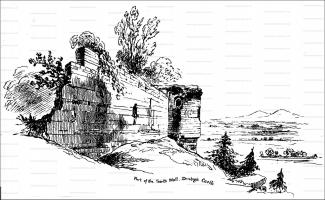
Part of the South Wall of Denbigh Castle [looking toward the Treasure House Tower [Map]]
This is a translation of the 'Memoires of Jacques du Clercq', published in 1823 in two volumes, edited by Frederic, Baron de Reissenberg. In his introduction Reissenberg writes: 'Jacques du Clercq tells us that he was born in 1424, and that he was a licentiate in law and a counsellor to Philip the Good, Duke of Burgundy, in the castellany of Douai, Lille, and Orchies. It appears that he established his residence at Arras. In 1446, he married the daughter of Baldwin de la Lacherie, a gentleman who lived in Lille. We read in the fifth book of his Memoirs that his father, also named Jacques du Clercq, had married a lady of the Le Camelin family, from Compiègne. His ancestors, always attached to the counts of Flanders, had constantly served them, whether in their councils or in their armies.' The Memoires cover a period of nineteen years beginning in in 1448, ending in in 1467. It appears that the author had intended to extend the Memoirs beyond that date; no doubt illness or death prevented him from carrying out this plan. As Reissenberg writes the 'merit of this work lies in the simplicity of its narrative, in its tone of good faith, and in a certain air of frankness which naturally wins the reader’s confidence.' Du Clercq ranges from events of national and international importance, including events of the Wars of the Roses in England, to simple, everyday local events such as marriages, robberies, murders, trials and deaths, including that of his own father in Book 5; one of his last entries.
Available at Amazon in eBook and Paperback format.

Burgess Gate [Map] at Denbigh Castle.