

Chronicle of a Bourgeois of Valenciennes
Récits d’un bourgeois de Valenciennes aka The Chronicle of a Bourgeois of Valenciennes is a vivid 14th-century vernacular chronicle written by an anonymous urban chronicler from Valenciennes in the County of Hainaut. It survives in a manuscript that describes local and regional history from about 1253 to 1366, blending chronology, narrative episodes, and eyewitness-style accounts of political, military, and social events in medieval France, Flanders, and the Low Countries. The work begins with a chronological framework of events affecting Valenciennes and its region under rulers such as King Philip VI of France and the shifting allegiances of local nobility. It includes accounts of conflicts, sieges, diplomatic manoeuvres, and the impact of broader struggles like the Hundred Years’ War on urban life in Hainaut. Written from the perspective of a burgher (bourgeois) rather than a monastery or royal court, the chronicle offers a rare lay viewpoint on high politics and warfare, reflecting how merchants, townspeople, and civic institutions experienced the turbulence of the 13th and 14th centuries. Its narrative style combines straightforward reporting of events with moral and civic observations, making it a valuable source for readers interested in medieval urban society, regional politics, and the lived experience of war and governance in pre-modern Europe.
Available at Amazon in eBook and Paperback format.
Effigy of Sir Roger de Bois and Lady is in Monumental Effigies of Great Britain.
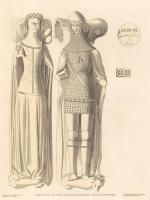
THESE are said to be the effigies of Roger de Bois and Margaret his wife. Bloomheld thus describes the tomb in his time: "On the East of the Church" (at Ingham in Norfolk), "just by the rood-loft, a tomb raised, on which is the effigies of a knight in complete armour, under his head the head and body of a Saracen, at his feet a hound." This inscription, he further says, was about the monument:
Monsieur Roger de Boys gist icy [Monsiuer Roger is here in the ground]
Et Dame Margarete sa feme auxi [And Dame Margaret his wife also]
Vous qui passez par icy [You who pass here ]
Priez Dieu de leur aimes eit mercy. [Pray for their souls]
Elle mourut l'an n'tre Seigneur mille trecent quinsieme et il mourut l'an de dit notre Seigneur 1300. [She died in the year of our Lord, one thousand and thirty-fifth, and he died in the year of our Lord, 1300.]
The Knight and his Lady wear long mantles, on the right shoulder of each of which is a circular badge, bearing what is called the Tau cross of St. Anthonya, and the letters ANTbON, in the uncial character. Details. 1. Badge on the shoulders. 2. Compartments of the girdle, one embossed with [Symbol here like a curved M].
Note a. Pope Boniface VIII. is said to have instituted an order of St. Anthony in 129S, and it is more certainly known that in 1382 Count Albert of Bavaria founded one in Hainault, on occasion of some remarkable cures of the disease called St. Anthony's lire, performed at a chapel dedicated to the Saint. Gentlemen of the first rank and merit were knights of this Order; the ensigns of which are said to have been a crutch, a hermit's cord, and a little bell. (Moreri, Diet. Historique, article St. Antoine.) The Tau cross has very much, it will be observed, the form of a crutch. The surcoat of the knight is exceedingly curious. The little circles with which it is covered must not be mistaken for ordinary mails; the mailing of the camail shows the difference; and indeed the skirt of the hauberk appears underneath this outward defence, which is perhaps of stamped leather or of quilted work thickly set with studs. Mr. Stothard considered this monument to be one of those Erected some time subsequent to the death of the persons whom it represented. In strict chronological order of costume it may be placed sixty or seventy years later.