The History of William Marshal was commissioned by his son shortly after William’s death in 1219 to celebrate the Marshal’s remarkable life; it is an authentic, contemporary voice. The manuscript was discovered in 1861 by French historian Paul Meyer. Meyer published the manuscript in its original Anglo-French in 1891 in two books. This book is a line by line translation of the first of Meyer’s books; lines 1-10152. Book 1 of the History begins in 1139 and ends in 1194. It describes the events of the Anarchy, the role of William’s father John, John’s marriages, William’s childhood, his role as a hostage at the siege of Newbury, his injury and imprisonment in Poitou where he met Eleanor of Aquitaine and his life as a knight errant. It continues with the accusation against him of an improper relationship with Margaret, wife of Henry the Young King, his exile, and return, the death of Henry the Young King, the rebellion of Richard, the future King Richard I, war with France, the death of King Henry II, and the capture of King Richard, and the rebellion of John, the future King John. It ends with the release of King Richard and the death of John Marshal.
Available at Amazon in eBook and Paperback format.
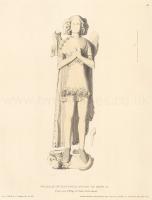
Effigy of William of Hatfield is in Monumental Effigies of Great Britain.
WAS the second son of Edward III by his Queen Philippa, and was born at Hatfield [Map], in Yorkshire, in 1335. He was christened after his maternal grandfather, William Earl of Hainault, died in his childhood, and was buried in the cathedral at York [Map]. The effigy is nearly four feet six inches in height, and may therefore be supposed that of a child about eleven years of age. This is a good example of the domestic attire of a noble youth of the day. On his head is a circlet surmounted by pearls. A rich juste-au-corps (probably embroidered cloth of golda) covers his figure. A mantle, the edge of which is indented into the form of a running pattern of ornamental foliage, falls over his breast and shoulders, and depends behind to the ancles. His shoes are divided into fretwork compartments, filled up with quatrefoils. His head is supported by angels, and his feet rest on a couchant lion. He wears a rich jewelled girdle round his hips; a characteristic mark of the monuments of this, and of many of the following century. It is not easy to imagine how a cincture thus placed sustained itself.
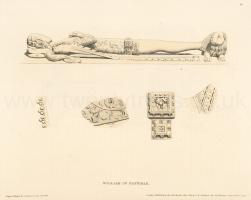
Details. Plate II. Profile. 1. Portion of the circlet and pearls. 9. Ornament on the juste-au-corps, or body coat. 3. Ornament on the shoes.
Note a. Thus Chaucer, describing the attire of a gallant youth:
"Embrouded was he, as it were a mede.
All full of freshe Bom es white and rede.
--- Short was his goune" ----
William of Hatfield: On 16th February 1337 he was born to King Edward III of England and Philippa of Hainaut Queen Consort England at Hatfield [Map]. He died shortly afterwards around 3rd March 1337. He was buried at York Minster [Map] where there is a monument to him in the north aisle. Coefficient of inbreeding 3.00%.