


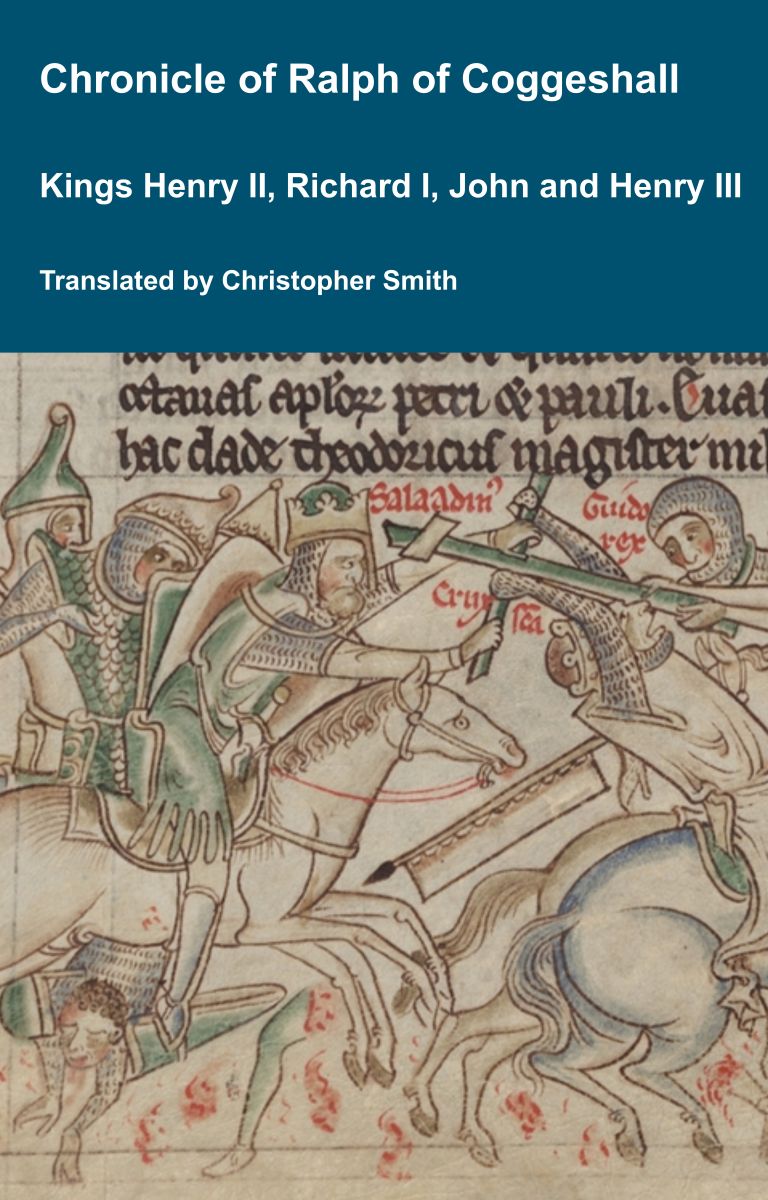
Chronicle of Abbot Ralph of Coggeshall
The Chronicle of Abbot Ralph of Coggeshall (Chronicon Anglicanum) is an indispensable medieval history that brings to life centuries of English and European affairs through the eyes of a learned Cistercian monk. Ralph of Coggeshall, abbot of the Abbey of Coggeshall in Essex in the early 13th century, continued and expanded his community’s chronicle, documenting events from the Norman Conquest of 1066 into the tumultuous reign of King Henry III. Blending eyewitness testimony, careful compilation, and the monastic commitment to record-keeping, this chronicle offers a rare narrative of political intrigue, royal power struggles, and social upheaval in England and beyond. Ralph’s work captures the reigns of pivotal figures such as Richard I and King John, providing invaluable insights into their characters, decisions, and the forces that shaped medieval rule. More than a simple annal, Chronicon Anglicanum conveys the texture of medieval life and governance, making it a rich source for scholars and readers fascinated by English history, monastic authorship, and the shaping of the medieval world.
Available at Amazon in eBook and Paperback format.
Itinerarium Peregrinorum et Gesta Regis Ricardi is in Early Medieval Books.
Chapter 6.14. King Richard, although already about to embark on the ships in order to return home, and although the French refused assistance, was nevertheless recalled by the people of Joppa through messengers; he hastened to Jaffa by galleys, having sent his soldiers overland.
Meanwhile, King Richard was busily engaged in preparing to leave Acre for his own country, and his ships were all but ready: he had also obtained consent and a blessing from the Templars and Hospitallers, and had sent forward seven of his galleys, with troops to dislodge the enemy from Baruth, by which he would pass; and the expedition had succeeded, for the enemy fled in alarm. The king was in big tent, talking with his officers about embarking for their homes on the morrow, when, lo! the messengers from Joppa entered, and tearing their garments, related to the king how the enemy had taken Joppa, all but the citadel, in which the remnant were besieged, and unless he should render them speedy assistance, they would all be involved in one common fate, according to the conditions which had been entered into with Saladin. The king hearing of the danger to which the besieged were exposed, and pitying their condition, interrupted the messengers: 'As God lives,' said he, 'I will be with them, and give them all the assistance in my power!' The words were hardly out of his mouth, before a proclamation was made that the army should be got ready. But the French would not vouchsafe even to honour the king with an answer, exclaiming proudly that they should never again march under his command; and in this they were not disappointed, for they never again marched under anybody's command, for in a short time they all miserably perished. Meanwhile, however, the soldiers of all nations, whose hearts God had touched, and the sufferings of their fellowcreatures excited to compassion, hastened to set out with the king; namely, the Templars, the Hospitallers., and several other valiant knights, all of whom marched by land to Cæsarea; but the noble king trusting for his safety to his own valour, embarked on board his fleet of galleys, which were equipped with every thing that could be necessary. With him were the earl of Leicester, Andrew de Chaveguy, Roger de Satheya, Jordan de Humez, Ralph de Mauleon, Achus de Fay, and the knights of Pratelles, companions of the king together with many others of illustrious names, besides Genoese and Pisans. Those who went by land to Cæsarea, halted there some time for fear of an ambuscade, which they heard had been laid by Saladin for all such as should pass that, way; and there was no better way for them to go by, on account of the son of Arcisus, who guarded the maritime district between Cæsarea and Arsur: and besides this, a contrary wind arose, which detained the kings ships three days at Cayphas, where they had put in. The king, vexed at this delay, exclaimed aloud, 'O Lord God, why dost thou detain us here? consider, I pray thee, the urgency of the case, and the devoutness of our wishes.' No sooner had he prayed thus, than God caused a favourable wind to spring up, which wafted his fleet before it into the harbour of Joppa, in the midst of the night of Friday immediately preceding the Saturday on which they had agreed to surrender, and all of them would have been given over to destruction. Alas, for the perfidy of that wicked race! Early on the morning of that day, which was the day of St. Peter ad vincula, the besieged were importuned by the Turks to fulfil the conditions of the truce. They accordingly began at the ninth hour to pay in part the bezants which they had promised; when the wicked Turks, behaving worse than brute beasts, and with no feeling of humanity about them, cut off the heads of those who paid them the money; and thus seven of them had already perished, and their heads were thrown into a ditch. But those in the town who were still alive, discovering the treachery, were struck with terror, and began to send forth cries of 262Itinerary lamentation and distress. Seeing certain death before them, they bent their knees, and confessed their sins to one another, thinking no longer of their lives which were doomed, but of their souls; whilst to delay their fate for some few moments longer, — for who is there that does not fear death? — they fled up the fortress as far they were able, and there awaited the stroke of martyrdom, shedding tears, and supplicating the mercy of the Almighty, who at length was appeased, and deigned to listen to their petition: their deliverer was already come, his fleet was riding in the harbour, and his soldiers were eager to land for their rescue!
 Become a Member via our Buy Me a Coffee page to read more.
Chapter 6.15: Of the fierce conflict by which the king recovered the castle of Joppa, and liberated the besieged.
The Turks, discovering the arrival of the king's fleet, sallied down to the seaside with sword and shield, and sent forth showers of arrows: the shore was so thronged with their multitude that there was hardly a foot of ground to spare. Neither did they confine themselves to acting on the defensive, for they shot their arrows at the crews of the ships, and the cavalry spurred their horses into the sea to prevent the king's men from landing. The king, gathering his ships together, consulted with his officers what was the best step to take. 'Shall we,' said he, 'push on against this rabble multitude who occupy the shore, or shall we value our lives more than the lives of those poor fellows who are exposed to destruction for want of our assistance?' Some of them replied that further attempts were useless, for it was by no means certain that any one remained alive to be saved, and how could they land in the face of so large a multitude? The king looked around thoughtfully, and at that moment saw a priest plunge into the water and swim towards the royal galley. When he was received on board, he addressed the king with palpitating heart and spirits almost failing him. 'Most noble king, the remnant of our people, waiting for your arrival, are exposed like sheep to be slain, unless the divine grace shall bring you to their rescue.' 'Are any of them still alive, then?' asked the king, 'and if so, where are they?' 'There are still some of them alive,' said the priest,' and hemmed in and at the last extremity in front of yonder tower.' 'Please God, then,' replied the king, 'by whose guidance we have come, we will die with our brave brothers in arms, and a curse light on him who hesitates.' The word was forthwith given, the galleys were pushed to land: the king dashed forward into the waves with his thighs unprotected by armour, and up to his middle in the water; he soon gained firm footing on the dry strand: behind him followed Geoffrey du Bois and Peter de Pratelles, and in the rear came all the others rushing through the waves. The Turks stood to defend the shore, which was covered with their numerous troops. The king, with an arbalest which he held in his hand, drove them back right and left; his companions pressed upon the recoiling enemy, whose courage quailed when they saw it was the king, and they no longer dared to meet him The king brandished his fierce sword, which allowed them no time to resist, but they yield before his fiery blows, and are driven in confusion with blood and havoc by the king's men until the shore was entirely cleared of them. They then brought together beams, poles, and wood, from the old ships and galleys to make a barricade; and the king placed there some knights, servants, and arbalesters, to keep guard and to dislodge the Turks, who, seeing that they could no longer oppose our troops, dispersed themselves on the shore with cries and howlings in one general flight. The king then, by a winding chair, which he had remarked in the house of the Templars, was the first to enter the town, where he found more than 3,000 of the Turks turning over every thing in the houses, and carrying away the spoil. The brave king had no sooner entered the town, than he caused his banners to be hoisted on an eminence, that they might be seen by the Christians in the tower, who taking courage at the sight, rushed forth in arms from the tower to meet the king, and at the report thereof the Turks were thrown into confusion. The king, meanwhile, with brandished sword, still pursued and slaughtered the enemy, who were thus enclosed between the two bodies of the Christians, and filled the streets with their slain. Why need I say more? All were slain, except such as took to flight in time; and thus those who had before been victorious were now defeated and received condign punishment, whilst the king still continued the pursuit, shewing no mercy to the enemies of Christ's Cross, whom God had given into his hands; for there never was a man on earth who so abominated cowardice as he.
Become a Member via our Buy Me a Coffee page to read more.
Chapter 3.12. King Richard, though infirm, attacked the city with his men. With a ballista operated by his own hand he killed many, and by means of sappers and stone-throwers he brought down a certain tower.
King Richard had not yet fully recovered from his illness. Nevertheless, being anxious about the tasks to be done, he devoted himself earnestly to the capture of the city. He therefore ordered that the city be attacked by his men, in the hope that divine grace might grant success according to their desire. He had a screen constructed, strengthened with many bindings and firmly put together, a structure commonly called a cercleia, carefully assembled, which was to be pushed into the ditch outside the city wall. Beneath it were his most skilled crossbowmen; and he had himself carried there on a silk mattress, so that by his presence he might burden (i.e. intimidate) the Saracens and encourage his own men to fight. From there he used his ballista, in which he was highly skilled, and he killed many with the bolts and darts he launched. His sappers likewise worked a subterranean passage beneath that tower against which his stone-throwers were directing their shots. When they set fire to the timber that had been driven into the widening fissure of the foundations, and with repeated blows of the stone-throwers, the tower suddenly fell with a great crash.
Rex Ricardus , licet valetudinarius , cum suis urbem impugnat , balista propria manu plures occidit , fossoribus et petrariis turrim quandam dejicit.
Rex Ricardus nondum plene de infirmitate convaluerat. Verum tamen gerendorum sollicitus, magnopere vacnbat urbi capiendæ. Procurabat igitur civitatem a suis oppugnari, si forte gratia divina pro voto proficeret. Fecit itaque fieri craticulam, multiplicatis nexibus consolidatam, vulgo dictam cercleiam, studiosissimo compactam apparatu, quam in fossatum extra murum civitatis statuit producendam. Subtus erant sui balistarii peritissimi ; seque illuc fecit deportari in culcitra serica, ut Saracenos sua oneraret præsentia, et suos animaret ad pugnandum. Inde sua utebatur balista, cujus erat peritus, et plures jaculis peremit emissis et pilis. Sui quoque fossores meatu subterraneo turris illius, ad quam petrariæ suæ jaculabantur, fundamenta quæritabant, in quorum dehiscentem diruptionem cum lignorum materiem intrusam igne succenderent, crebris etiam petrariarum ictibus, subito corruit fragore.
Become a Member via our Buy Me a Coffee page to read more.