

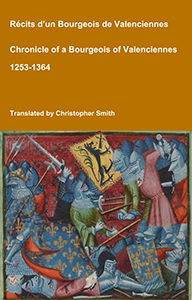
Chronicle of a Bourgeois of Valenciennes
Récits d’un bourgeois de Valenciennes aka The Chronicle of a Bourgeois of Valenciennes is a vivid 14th-century vernacular chronicle written by an anonymous urban chronicler from Valenciennes in the County of Hainaut. It survives in a manuscript that describes local and regional history from about 1253 to 1366, blending chronology, narrative episodes, and eyewitness-style accounts of political, military, and social events in medieval France, Flanders, and the Low Countries. The work begins with a chronological framework of events affecting Valenciennes and its region under rulers such as King Philip VI of France and the shifting allegiances of local nobility. It includes accounts of conflicts, sieges, diplomatic manoeuvres, and the impact of broader struggles like the Hundred Years’ War on urban life in Hainaut. Written from the perspective of a burgher (bourgeois) rather than a monastery or royal court, the chronicle offers a rare lay viewpoint on high politics and warfare, reflecting how merchants, townspeople, and civic institutions experienced the turbulence of the 13th and 14th centuries. Its narrative style combines straightforward reporting of events with moral and civic observations, making it a valuable source for readers interested in medieval urban society, regional politics, and the lived experience of war and governance in pre-modern Europe.
Available at Amazon in eBook and Paperback format.
Saint Paul's Letters is in New Testament.
NIV. I pray that the eyes of your heart may be enlightened in order that you may know the hope to which he has called you, the riches of his glorious inheritance in his holy people,.
NIV. and his incomparably great power for us who believe. That power is the same as the mighty strength.
John Evelyn's Diary. 17th October 1686. Dr. Patrick, Dean of Peterborough [aged 60], preached at Covent Garden Church on Ephes. v. 18, 19, showing the custom of the primitive saints in serving God with hymns, and their frequent use of them upon all occasions: touching the profane way of mirth and intemperance of this ungodly age. Afterward I visited my Lord Chief Justice of Ireland [aged 53], with whom I had long and private discourse concerning the miserable condition that kingdom was like to be in, if Tyrconnel's [aged 56] counsel should prevail at Court.
NIV. 26 "In your anger do not sin" Do not let the sun go down while you are still angry, 27 and do not give the devil a foothold.

John Evelyn's Diary. 2nd April 1649. To London, and inventoried my movables that had hitherto been dispersed for fear of plundering: wrote into France, touching my sudden resolutions of coming over to them. On the 8th, again heard an excellent discourse from Archbishop Usher [aged 68], on Ephes. 4, v. 26-27.
KJV. For ye are bought with a price: therefore glorify God in your body, and in your spirit, which are God's.
BEB. For a payment has been made for you: let God be honoured in your body.
WEB. For you were bought with a price. Therefore glorify God in your body and in your spirit, which are God's.
NIV. We are therefore Christ's ambassadors, as though God were making his appeal through us. We implore you on Christ's behalf: Be reconciled to God.
Abbot John Whethamstede’s Chronicle of the Abbey of St Albans
Abbot John Whethamstede's Register aka Chronicle of his second term at the Abbey of St Albans, 1451-1461, is a remarkable text that describes his first-hand experience of the beginning of the Wars of the Roses including the First and Second Battles of St Albans, 1455 and 1461, respectively, their cause, and their consequences, not least on the Abbey itself. His text also includes Loveday, Blore Heath, Northampton, the Act of Accord, Wakefield, and Towton, and ends with the Coronation of King Edward IV. In addition to the events of the Wars of the Roses, Abbot John, or his scribes who wrote the Chronicle, include details in the life of the Abbey such as charters, letters, land exchanges, visits by legates, and disputes, which provide a rich insight into the day-to-day life of the Abbey, and the challenges faced by its Abbot.
Available at Amazon in eBook and Paperback format.
KJB. Now then we are ambassadors for Christ, as though God did beseech you by us: we pray you in Christ's stead, be ye reconciled to God.
Samuel Pepys' Diary. 9th August 1663. Lord's Day. Up, and leaving my brother John [aged 22] to go somewhere else, I to church, and heard Mr. Mills (who is lately returned out of the country, and it seems was fetched in by many of the parishioners, with great state,) preach upon the authority of the ministers, upon these words, "We are therefore embassadors of Christ". Wherein, among other high expressions, he said, that such a learned man used to say, that if a minister of the word and an angell should meet him together, he would salute the minister first; which methought was a little too high.
Henry Machyn's Diary. 7th April 1559. The vij day of Aprell was browth unto [saint Thomas] of Acurs in Chepe from lytyll sant Barthellmuw [in] Lothbere masteres ...., and ther was a gret compene of pepull, ij and ij together, and nodur prest nor clarke, the nuw prychers in ther gowne lyke ley[-men,] nodur syngyng nor sayhyng tyll they cam [to the grave,] and a-for she was pute into the grayff a [collect] in Englys, and then put in-to the grayff, and after [took some] heythe [earth] and caste yt on the corse, and red a thynge ... for the sam, and contenent cast the heth in-to the [grave], and contenent red the pystyll of sant Poll to the Stesselonyans the (blank) chapter, and after thay song pater-noster in Englys, boyth prychers and odur, and [women,] of a nuw fassyon, and after on of them whent in-to the pulpytt and mad a sermon.
NIV. In the name of the Lord Jesus Christ, we command you, brothers and sisters, to keep away from every believer who is idle and disruptive and does not live according to the teaching you received from us.
John Evelyn's Diary. 22nd February 1678. Dr. Pierce preached at Whitehall [Map], on 2 Thessalonians iii. 6, against our late schismatics, in a rational discourse, but a little over-sharp, and not at all proper for the auditory there.
and to make it your ambition to lead a quiet life: You should mind your own business and work with your hands, just as we told you,.
NIV. 14 having canceled the charge of our legal indebtedness, which stood against us and condemned us; he has taken it away, nailing it to the cross. 15 And having disarmed the powers and authorities, he made a public spectacle of them, triumphing over them by the cross.

John Evelyn's Diary. 23rd February 1673. The Bishop of Chichester [aged 59] preached before the King [aged 42] on Coloss. II 14, 15, admirably well, as he can do nothing but what is well.
NIV. Set your minds on things above, not on earthly things.

John Evelyn's Diary. 28th January 1655. A stranger preached from Colossians iii. 2, inciting our affections to the obtaining heavenly things. I understood afterward that this man had been both chaplain and lieutenant to Admiral Penn [aged 33], using both swords; whether ordained or not I cannot say; into such times were we fallen!
William of Worcester's Chronicle of England
William of Worcester, born around 1415, and died around 1482 was secretary to John Fastolf, the renowned soldier of the Hundred Years War, during which time he collected documents, letters, and wrote a record of events. Following their return to England in 1440 William was witness to major events. Twice in his chronicle he uses the first person: 1. when writing about the murder of Thomas, 7th Baron Scales, in 1460, he writes '… and I saw him lying naked in the cemetery near the porch of the church of St. Mary Overie in Southwark …' and 2. describing King Edward IV's entry into London in 1461 he writes '… proclaimed that all the people themselves were to recognize and acknowledge Edward as king. I was present and heard this, and immediately went down with them into the city'. William’s Chronicle is rich in detail. It is the source of much information about the Wars of the Roses, including the term 'Diabolical Marriage' to describe the marriage of Queen Elizabeth Woodville’s brother John’s marriage to Katherine, Dowager Duchess of Norfolk, he aged twenty, she sixty-five or more, and the story about a paper crown being placed in mockery on the severed head of Richard, 3rd Duke of York.
Available at Amazon in eBook and Paperback format.
NIV. and have put on the new self, which is being renewed in knowledge in the image of its Creator.
John Evelyn's Diary. 15th November 1674. The anniversary of my baptism: I first heard that famous and excellent preacher, Dr. Burnet [aged 31], author of the "History of the Reformation" on Colossians iii. 10, with such flow of eloquence and fullness of matter, as showed him to be a person o£ extraordinary parts.


For to me, to live is Christ and to die is gain.
If I am to go on living in the body, this will mean fruitful labor for me. Yet what shall I choose? I do not know!
KJB. Let this mind be in you, which was also in Christ Jesus:
ESV. Have this mind among yourselves, which is yours in Christ Jesus,.
John Evelyn's Diary. 18th March 1683. I went to hear Dr. Horneck [aged 42] preach at the Savoy Church [Map], on Phil. II 5. He was a German born, a most pathetic preacher, a person of a saint-like life, and hath written an excellent treatise on Consideration.
NIV. Finally, brothers and sisters, whatever is true, whatever is noble, whatever is right, whatever is pure, whatever is lovely, whatever is admirable--if anything is excellent or praiseworthy--think about such things.
John Evelyn's Diary. 29th July 1677. Mr. Bohun, my Son's [aged 22] late tutor, preached at Abinger, on Phil., iv. 8, very elegantly and practically.
KJB. Thou therefore endure hardness, as a good soldier of Jesus Christ.
John Evelyn's Diary. 17th March 1686. I went to my house in the country, refusing to be present at what was to passe at the Privy Seale the next day. In the morning Dr. Tenison [aged 49] preached an incomparable discourse at Whitehall [Map], on 2 Timothy 3, 4.
KJB. No man that warreth entangleth himself with the affairs of this life; that he may please him who hath chosen him to be a soldier.
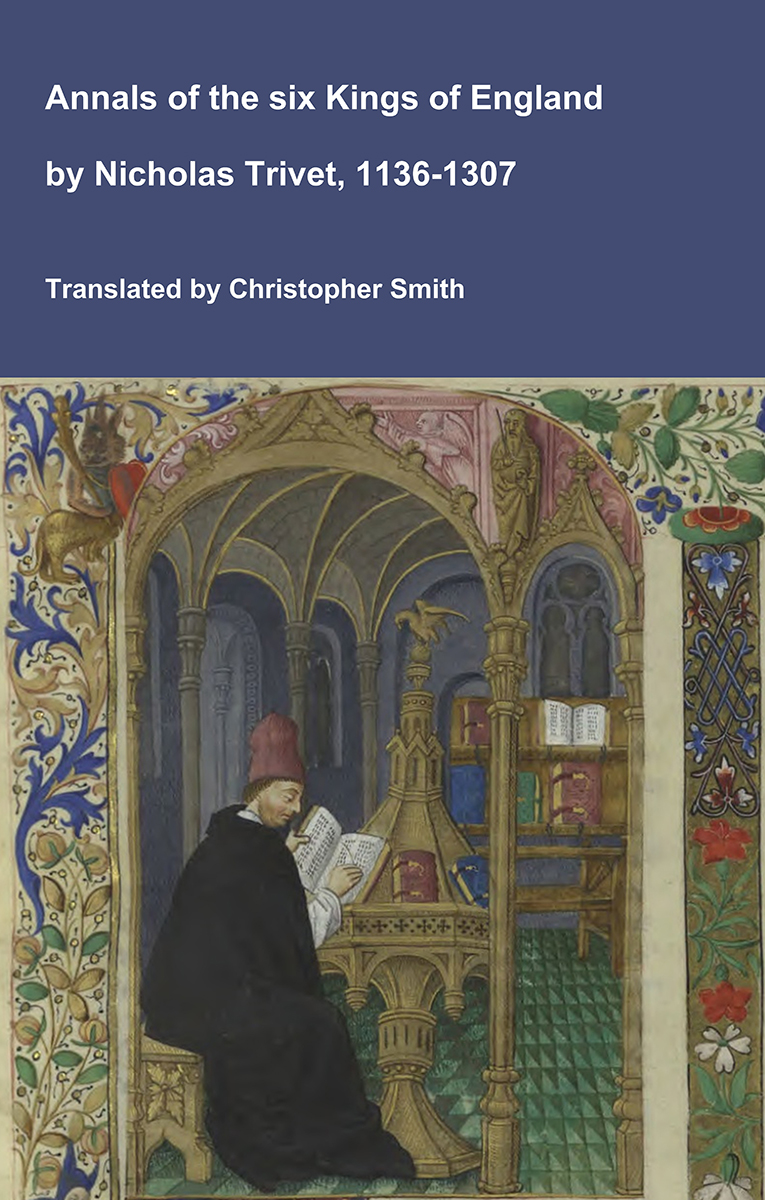
Annals of the six Kings of England by Nicholas Trivet
Translation of the Annals of the Six Kings of England by that traces the rise and rule of the Angevin aka Plantagenet dynasty from the mid-12th to early 14th century. Written by the Dominican scholar Nicholas Trivet, the work offers a vivid account of English history from the reign of King Stephen through to the death of King Edward I, blending political narrative with moral reflection. Covering the reigns of six monarchs—from Stephen to Edward I—the chronicle explores royal authority, rebellion, war, and the shifting balance between crown, church, and nobility. Trivet provides detailed insight into defining moments such as baronial conflicts, Anglo-French rivalry, and the consolidation of royal power under Edward I, whose reign he describes with particular immediacy. The Annals combines careful year-by-year reporting with thoughtful interpretation, presenting history not merely as a sequence of events but as a moral and political lesson. Ideal for readers interested in medieval history, kingship, and the origins of the English state, this chronicle remains a valuable and accessible window into the turbulent world of the Plantagenet kings.
Available at Amazon in eBook and Paperback format.
John Evelyn's Diary. 17th March 1686. I went to my house in the country, refusing to be present at what was to passe at the Privy Seale the next day. In the morning Dr. Tenison [aged 49] preached an incomparable discourse at Whitehall [Map], on 2 Timothy 3, 4.
NIV. Beyond all question, the mystery from which true godliness springs is great: He appeared in the flesh, was vindicated by the Spirit, was seen by angels, was preached among the nations, was believed on in the world, was taken up in glory.

John Evelyn's Diary. 1st January 1687. Mr. Wake [aged 29] preached at St. Martin's on 1 Tim. iii. 16, concerning the mystery of godliness. He wrote excellently, in answer to the Bishop of Meaux.
And the servant of the Lord must not strive; but be gentle unto all men, apt to teach, patient,.
NIV. But godliness with contentment is great gain.
John Evelyn's Diary. 15th September 1672. Dr. Duport, Greek Professor of Cambridge, preached before the King [aged 42], on 1 Timothy vi. 6. No great preacher, but a very worthy and learned man.
NIV. Having a form of godliness, but denying the power thereof: from such turn away.
NIV. All Scripture is God-breathed and is useful for teaching, rebuking, correcting and training in righteousness,.
NIV. Nothing in all creation is hidden from God's sight. Everything is uncovered and laid bare before the eyes of him to whom we must give account.
John Evelyn's Diary. 9th March 1690. Preached at Whitehall Dr. Burnet [aged 46], late Bishop of Sarum, on Heb. iv. 13, anatomically describing the texture of the eye; and that, as it received such innumerable sorts of spies through so very small a passage to the brain, and that without the least confusion or trouble, and accordingly judged and reflected on them; so God who made this sensory, did with the greatest ease and at once see all that was done through the vast universe, even to the very thought as well as action. This similitude he continued with much perspicuity and aptness; and applied it accordingly, for the admonishing us how uprightly we ought to live and behave ourselves before such an all-seeing Deity; and how we were to conceive of other his attributes, which we could have no idea of than by comparing them by what we were able to conceive of the nature and power of things, which were the objects of our senses; and therefore it was that in Scripture we attribute those actions and affections of God by the same of man, not as adequately or in any proportion like them, but as the only expedient to make some resemblance of his divine perfections; as when the Scripture says, "God will remember the sins of the penitent no more:" not as if God could forget anything, but as intimating he would pass by such penitents and receive them to mercy.
NIV. Therefore, since we have a great high priest who has ascended into heaven, Jesus the Son of God, let us hold firmly to the faith we profess.
John Evelyn's Diary. 16th March 1673. Dr. Pearson [aged 60], Bishop of Chester, preached on Hebrews ix. 14; a most incomparable sermon from one of the most learned divines of our nation. I dined at my Lord Arlington's [aged 55] with the Duke [aged 23] and Duchess of Monmouth [aged 22]; she is one of the wisest and craftiest of her sex, and has much wit. Here was also the learned Isaac Vossius [aged 55].


Chronicle of Walter of Guisborough
A canon regular of the Augustinian Guisborough Priory, Yorkshire, formerly known as The Chronicle of Walter of Hemingburgh, describes the period from 1066 to 1346. Before 1274 the Chronicle is based on other works. Thereafter, the Chronicle is original, and a remarkable source for the events of the time. This book provides a translation of the Chronicle from that date. The Latin source for our translation is the 1849 work edited by Hans Claude Hamilton. Hamilton, in his preface, says: 'In the present work we behold perhaps one of the finest samples of our early chronicles, both as regards the value of the events recorded, and the correctness with which they are detailed; Nor will the pleasing style of composition be lightly passed over by those capable of seeing reflected from it the tokens of a vigorous and cultivated mind, and a favourable specimen of the learning and taste of the age in which it was framed.'
Available at Amazon in eBook and Paperback format.
NIV. For I will forgive their wickedness and will remember their sins no more."
KJB. For I will forgive their wickedness and will remember their sins no more."
KJB. Looking diligently lest any man fail of the grace of God; lest any root of bitterness springing up trouble you, and thereby many be defiled;.
ESV. See to it that no one fails to obtain the grace of God; that no "root of bitterness" springs up and causes trouble, and by it many become defiled;.
John Evelyn's Diary. 7th March 1684. Dr. Meggot, Deane of Winchester, preached an incomparable sermon, (the King [aged 53] being now gone to Newmarket,) on 12 Heb. 15. shewing and pathetically pressing the care we ought to have least we come short of the grace of God. Afterwards I went to visite Dr. Tenison [aged 47] at Kensington, whither he was retired to refresh after he had ben sick of the smallpox.
NIV. Speak and act as those who are going to be judged by the law that gives freedom,.
ESV. So speak and so act as those who are to be judged under the law of liberty.
KJV. So speak ye, and so do, as they that shall be judged by the law of liberty.
John Evelyn's Diary. 26th October 1684. Dr. Goodman [aged 59] preach'd before the King [aged 54] on 2 James 12 concerning the law of liberty: an excellent discourse and in good method. He is author of "The Prodigal Son", a treatise worth reading, and another of the old Religion.
NIV. But the wisdom that comes from heaven is first of all pure; then peace-loving, considerate, submissive, full of mercy and good fruit, impartial and sincere.
Abbot John Whethamstede’s Chronicle of the Abbey of St Albans
Abbot John Whethamstede's Register aka Chronicle of his second term at the Abbey of St Albans, 1451-1461, is a remarkable text that describes his first-hand experience of the beginning of the Wars of the Roses including the First and Second Battles of St Albans, 1455 and 1461, respectively, their cause, and their consequences, not least on the Abbey itself. His text also includes Loveday, Blore Heath, Northampton, the Act of Accord, Wakefield, and Towton, and ends with the Coronation of King Edward IV. In addition to the events of the Wars of the Roses, Abbot John, or his scribes who wrote the Chronicle, include details in the life of the Abbey such as charters, letters, land exchanges, visits by legates, and disputes, which provide a rich insight into the day-to-day life of the Abbey, and the challenges faced by its Abbot.
Available at Amazon in eBook and Paperback format.
John Evelyn's Diary. 25th January 1680. Dr. Cave [aged 42], author of "Primitive Christianity", etc., a pious and learned man, preached at Whitehall [Map] to the household, on James iii. 17, concerning the duty of grace and charity.