

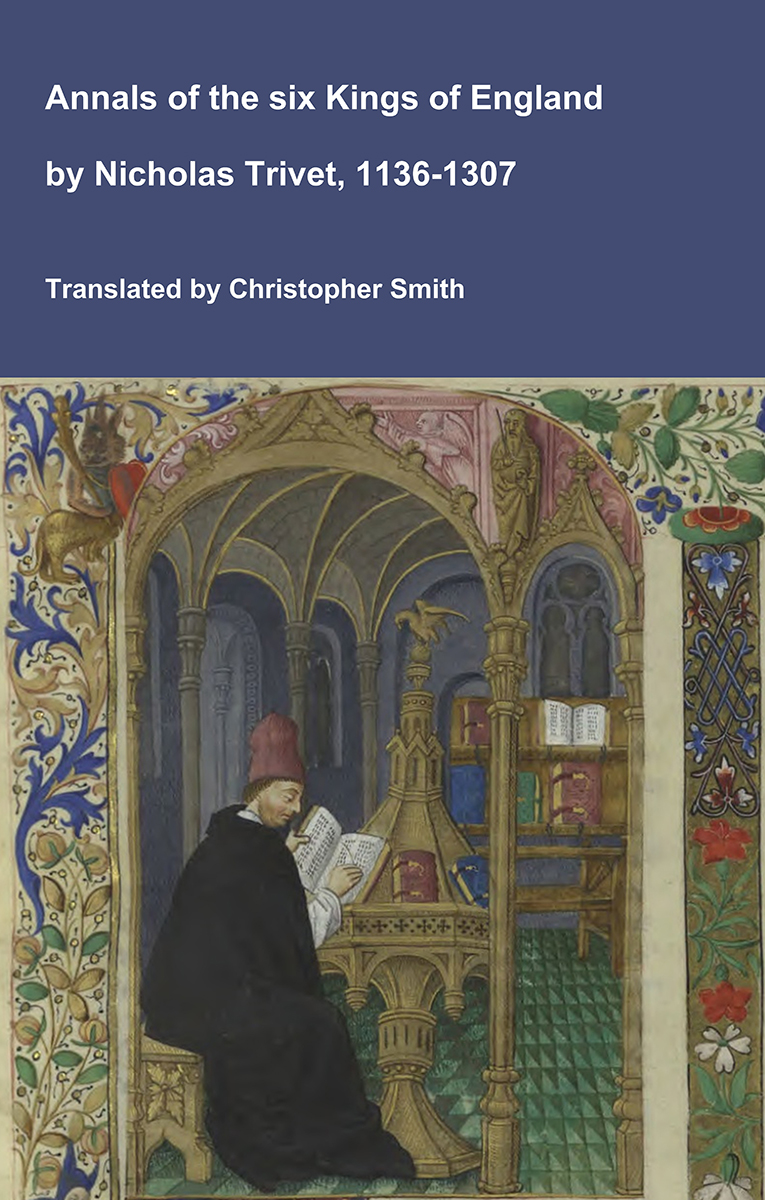
Annals of the six Kings of England by Nicholas Trivet
Translation of the Annals of the Six Kings of England by that traces the rise and rule of the Angevin aka Plantagenet dynasty from the mid-12th to early 14th century. Written by the Dominican scholar Nicholas Trivet, the work offers a vivid account of English history from the reign of King Stephen through to the death of King Edward I, blending political narrative with moral reflection. Covering the reigns of six monarchs—from Stephen to Edward I—the chronicle explores royal authority, rebellion, war, and the shifting balance between crown, church, and nobility. Trivet provides detailed insight into defining moments such as baronial conflicts, Anglo-French rivalry, and the consolidation of royal power under Edward I, whose reign he describes with particular immediacy. The Annals combines careful year-by-year reporting with thoughtful interpretation, presenting history not merely as a sequence of events but as a moral and political lesson. Ideal for readers interested in medieval history, kingship, and the origins of the English state, this chronicle remains a valuable and accessible window into the turbulent world of the Plantagenet kings.
Available at Amazon in eBook and Paperback format.
The Asiatic Journal and Monthly Miscellany is in Newspapers.
[After 24th March 1845] With reference to the exaggerated and unjust statements respecting this unfortunate regiment, a letter has appeared in a London newspaper (The Times March 24th 1845) from Sir William Napier vindicating his brother from the imputation cast upon him of being "the murderer" of the soldiers and showing that due precautions had been taken by him to secure... the 78th Regiment which was ordered up the river from Karachi to Sukkur... Although the 78th arrived at Sukkur in excellent health... the disease burst out suddenly with unusual violence and enraged till the end of the year "the sickness" he adds "has astounded the medical men who call it an extraordinary epidemic for which they cannot account, this then furnishes further evidence of the fatal as well as the deceitful character of the Sindh climate especially to Europeans. . We understand that the officers, NCOs and privates of HM 78th Highlanders have subscribed upwards of 1000 rupees or 100 pounds for the purpose of erecting a monument in one of the public churches of Edinburgh to the memory of their comrades who died in Sindh... This cenotaph will be raised to commemorate the victims of the noisome pestilence, the unhappy beings whose deaths at Sukkur put the last sad seal to the iniquity of the Sindh invasion." (p 561)