

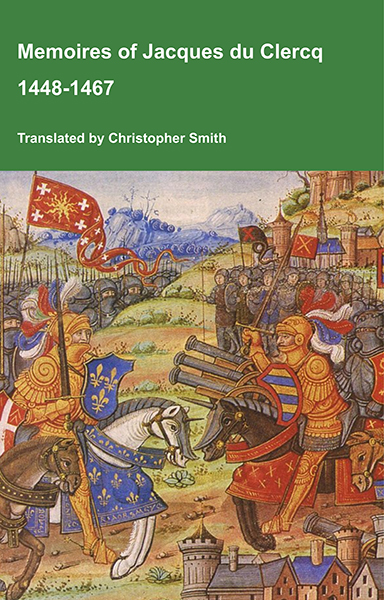
This is a translation of the 'Memoires of Jacques du Clercq', published in 1823 in two volumes, edited by Frederic, Baron de Reissenberg. In his introduction Reissenberg writes: 'Jacques du Clercq tells us that he was born in 1424, and that he was a licentiate in law and a counsellor to Philip the Good, Duke of Burgundy, in the castellany of Douai, Lille, and Orchies. It appears that he established his residence at Arras. In 1446, he married the daughter of Baldwin de la Lacherie, a gentleman who lived in Lille. We read in the fifth book of his Memoirs that his father, also named Jacques du Clercq, had married a lady of the Le Camelin family, from Compiègne. His ancestors, always attached to the counts of Flanders, had constantly served them, whether in their councils or in their armies.' The Memoires cover a period of nineteen years beginning in in 1448, ending in in 1467. It appears that the author had intended to extend the Memoirs beyond that date; no doubt illness or death prevented him from carrying out this plan. As Reissenberg writes the 'merit of this work lies in the simplicity of its narrative, in its tone of good faith, and in a certain air of frankness which naturally wins the reader’s confidence.' Du Clercq ranges from events of national and international importance, including events of the Wars of the Roses in England, to simple, everyday local events such as marriages, robberies, murders, trials and deaths, including that of his own father in Book 5; one of his last entries.
Available at Amazon in eBook and Paperback format.
William of Newburgh is in Late Medieval Books.
[22nd August 1138] The inhabitants, despairing of assistance from the king or the provinces beyond the Humber, and animated by the admonitions of archbishop Thurstan, of pious memory, determined to fight for their lives, their wives and their children. They unanimously assembled against a host formidable for its cruelty, and made a stand not far from the river Tees; and though they were very inferior indeed in point of numbers, yet they were greatly superior to their enemies by confidence in the goodness and justice of their cause. The Scots, setting fire to their camp early in the morning, passed the river, and, contemning the paucity of their opponents, rushed boldly to the conflict. The battle was not of long continuance, where little or nothing was done by the sword; for the light-armed troops, galled by arrows from a distance, soon turned their backs, and left the victory and the field to our countrymen. It is related that many thousands of the Scots were slain in the battle, or in the flight, and king David, accompanied by few soldiers, but with much disgrace, fled to his own country. This battle was, by the assistance of God, successfully fought against the Scots, in the month of August, in the fourth year of the reign of king Stephen.
In the morning, when a large multitude of people had assembled together to storm the castle, they found the wretched Jews who had survived standing on the battlements, announcing, in melancholy voice, the massacre of their people, which had taken place in the night; and to give ocular proof of this great sacrifice, they threw the dead bodies over the wall, and cried out to this effect: "Behold the bodies of those unfortunate people, who, in their mad fury, inflicted death upon themselves; and, when dying, set fire to the interior of the castle in order to burn us alive, because we refused to commit the like act, and chose rather to throw ourselves upon the mercy of the Christians. God, however, has preserved us from the fury of our brethren, and from the destruction of the flames, in order that we shall embrace your religion -- for in our trouble we have gained understanding, and acknowledge the truth of Christ; we, therefore, pray your charity, for we are prepared to do that which you usually require, to be cleansed by holy baptism -- to put away our ancient ceremonies, and to be united to the church of Christ. Receive us, therefore, as brethren instead of enemies; and let us live with you in the faith and peace of Christ." While they thus spoke, with tears in their eyes, many of our people looked with deep horror and astonishment upon the mildness of those who were dead, and pitied the survivors; but the chiefs of the confederacy, among whom was one Richard, truly surnamed Malbeste, a most daring fellow, were unmoved by pity for these miserable wretches. They deceitfully addressed kind words to them, and promised the favor they hoped, under the testimony of their faith, in order that they might not fear to come forth; but, as soon as they came out, those cruel swordsmen seized them as enemies, and slaughtered them in the midst of their continual cries for the baptism of Christ.
With regard to these persons, who were thus butchered with savage ferocity, I will affirm, without hesitation, that if, in their entreaty for holy Baptism, there was no fiction, they were baptized with their own blood, and were by no means defrauded of its efficacy; but whether they sought the holy font feignedly or unfeignedly, the cruelty of those murderers is to be execrated. Their first crime, doubtless, was that of shedding human blood like water, without lawful authority; their second, that of acting barbarously, rather through the blackness of malice than the zeal for justice; their third, was that of refusing the grace of Christ to those who sought it; the fourth, that of deceiving those miserable people by telling lies to induce them to come forth to be victims.
When the massacre was complete, the confederates proceeded immediately to the cathedral church and, by violent representations, compelled the terrified wardens to deliver up the acknowledgments of the debts by which the Christians were bound, and which had been deposited there by the Jews, who were the farmers of the royal revenues, having obtained possession of those evidences of detestable avarice, they solemnly committed them to the flames in the midst of the church, and thus freed themselves and many others from their bonds. After these things were done, those among the confederates who had accepted the emblem of the Lord, commenced their intended journey before any inquiry could be instituted; but the rest remained in the county under the apprehension of an inquiry. These events at York occurred at the time of the Passion of our Lord, that is to say, o the day before Palm Sunday [17th March].
Moreover, once she had been released from the law of her husband, and had the power to marry whom she wished, she left two daughters with their father, who were afterwards married, by their father’s provision, to the two sons of the most illustrious Count Theobald, namely Henry and Theobald. At last, she obtained the marriage she had desired. Finally, the Duke of Normandy and she met at the appointed place [on 18th May 1152] and entered into a marriage agreement. This was done with less solemnity because of the persons involved, but with more cautious foresight, lest the solemn preparation of the wedding should give rise to some obstacle. Soon afterwards, the duchy of Aquitaine, which extends from the borders of Anjou and Brittany as far as the Pyrenees, the mountains dividing Gaul and Spain, gradually withdrew itself from the dominion of the Franks and, by reason of the marriage, passed into the power of the Duke of Normandy. The French, indeed, were wasting away with envy, but were unable to hinder the advancement of the same duke.
Porro illa soluta a lege viri, et habens potestatem cui vellet nubendi, duabus apud patrem filiabus relictis, quæ postea duobus illustrissimi comitis Teobaldi filiis Henrico scilicet et Teobaldo, paterna provisione nupserunt, desideratis tandem potita est nuptiis. Denique convenientes dux Normanniæ et illa loco condicto, pactum conjugale inierunt,Finally, the Duke of Normandy and she met at the appointed place and entered into a marriage agreement. This was done with less solemnity because of the persons involved, but with more cautious foresight, lest the solemn preparation of the wedding should give rise to some obstacle. Soon afterwards, the duchy of Aquitaine, which extends from the borders of Anjou and Brittany as far as the Pyrenees, the mountains dividing Gaul and Spain, gradually withdrew itself from the dominion of the Franks and, by reason of the marriage, passed into the power of the Duke of Normandy. The French, indeed, were wasting away with envy, but were unable to hinder the advancement of the same duke. minus quidem sollemniter ratione personarum, sed cautiori providentia, ne quid scilicet impedimenti pareret sollemnis præparatio nuptiarum. Mox ducatus Aquitaniæ, qui a finibus Andegavensium et Britonum ad Pyrenæos usque montes, Galliam Hispaniamque dirimentes, extenditur, Francorum se ditioni paulatim subducens ratione conjugis in ducis Normannici potestatem transivit; Francis quidem invidia tabescentibus, sed impedire non valentibus ejusdem ducis provectum.
Chapter 9: How the Jews of Lincoln and York were treated
The people of Lincoln, hearing what had been done to the Jews, seizing the opportunity and animated by example, thought they might venture upon something; and having assembled together, they broke out in a sudden commotion against the Jews who lived there with them. But they, having heard of the fear or destruction of their people in diverse places, were rendered very cautious; and after a few of them had been exposed to danger, they retired quickly with their money into the royal fortress. Thus this slight commotion was soon quieted.
The people of York, however, neither by the fear of a most courageous prince, nor the vigor of the laws, nor reason, nor humanity, were prevented from satiating their personal fury in the general destruction of their perfidious fellow-citizens, and sweeping away the whole race in their city. Inasmuch as this is most worthy of remembrance, it ought to be transmitted to posterity by a full narration.
Of the Jews of York (as I have mentioned above) the principal were Benedict and Joceus, men who were rich, and who lent on usury far and wide. Besides, with profuse expense they had built houses of the largest extent in the midst of the city, which might be compared to royal palaces; and there they lived in abundance and luxury almost regal, like two princes of their own people, and tyrants to the Christians, exercising cruel tyranny towards those whom they had oppressed by usury. When they were in London, at the solemnity of the royal coronation, Benedict (as it has been mentioned) had, by the judgment of God, a most unhappy lot assigned him for his end, and appeared to be in this accursed; but Joceus, having been with difficulty rescued from danger for a time, returned to York. Now, although the king, after the tumult at London, had passed a law for the peace of the Jews, and acted in good faith towards them throughout England, according to the ancient custom; yet, when the king was afterwards resident in the parts beyond sea, many people in the county of York took an oath together against the Jews, being unable to endure their opulence while they themselves were in want; and, without any scruple of Christian conscientiousness, thirsted for their perfidious blood, through the desire of plunder. Those who urged them on to venture upon these measures were certain persons of higher rank, who owed large sums to those impious usurers. Some of these, who had pledged their own estates to them for money, which they had received, were oppressed with great poverty; and others who were under obligations, on account or their own bonds, were oppressed by the tax-gatherers to satisfy the usurers who had dealings with the king. Some also of those who had accepted the sign of the Lord, and were now in readiness to set out for Jerusalem, could more easily be impelled to aid the expenses of a journey undertaken for the Lord, out of the plunder of His enemies; because they had very little reason to fear that any question would arise on this account after they had commenced their journey.
Late at night no small portion of the city was blazing in a conflagration that was kindled by chance, or rather (as it is believed) by confederates; so that while the citizens were occupied with their own houses, because of the peril of fire, they could offer no impediment to the plunderers. An armed band of the confederates, with iron tools made ready for this purpose, and with great violence, broke into the house of the said Benedict, who had died miserably at London (as it is mentioned above); in this house his wife and sons, and many others, were living; and after they had slain all that were in it, they set fire to the roof also; and while the fire was sullenly gaining strength, they swept away all the wealth, and left the house in flames; and thus, favored by darkness and well-laden, the plunderers retired to their secret retreat. The Jews, struck with consternation at this event and especially Joceus, who was more eminent than the rest, earnestly entreated the governor of the royal castle, and secured his assistance. They carried thither vast loads of their money, as if they bad been royal treasurers ; and, moreover, they had a very vigilant guard for their own security.
After some days, those nocturnal plunderers returned with greater confidence and ferocity; and, being joined by many others, they fiercely attacked the house of Joceus; which, from the magnitude and strength of its construction, might be said to be equal to a castle of no small size. At length they took it; and after plundering it, they set it on fire, while all those persons whose misfortune it was to be in the house were destroyed either by the sword or by fire. Joceus, however, cautiously foreseeing this misfortune, had a short Lime before removed into the castle with his wife and sons. In like manner the rest of the Jews acted, very few remaining abroad to be victims. After the plunderers had decamped with the booty acquired by so daring a deed, a promiscuous mob rushed in when it was morning, and carried off different kinds of things, and household furniture of every sort -- the remains left by the plunderers and the fire. After this, those who had previously regarded the Jews with hatred, uniting with the confederates, and entertaining no respect for the vigor of the law, openly and with unbridled license begin to rage against them; and, not being content with their substance, they gave to all they could find outside the castle the option either of holy baptism, or of death. At length, some who were baptized united themselves with the Christians; but they only feigned conversion in order to escape death; but others were slain without mercy, who refused to receive the sacrament of life, even though feignedly.
While these events were occurring, the multitude which had fled into the castle seemed to be in safety. The governor of the castle, however, happening to go out upon some kind of business, when he wished to enter the castle again, he was not permitted by the multitude inside and on the watch, as they were uncertain whom they could trust, lest, perchance, his faith towards them might happen to waver; and if he were corrupted, he might, after having received them for protection, expose them to their enemies. However, he instantly went to the governor of the county, who happened to be there on the king's business, with a large company of knights of the shire, and complained that he was defrauded by the Jews of the custody of the castle, which had been committed to him. The governor was indignant and enraged against the Jews; while those, in particular, who had been the authors of the confederacy, continued to inflame his anger. They alleged that the timorous precaution of those miserable wretches was nothing else than a proud occupation of the royal castle, which of itself was greatly to the injury of the lord the king. Since many people were determined to attack those faithless men in every possible way, and to rescue the royal castle from them, the governor gave orders that the people should be assembled, and that the castle should be attacked. The irrevocable word went forth; the zeal of the Christian people was roused, and immense bands of armed men, not only from the pity, but also from the county, gathered around the castle.
Then the governor began to regret the order which he had issued, and endeavored, in vain, to recall his command, and wished, but too late, to forbid the assault. But he had no power, either by the weight of reason or of authority, to restrain their minds, which were now inflamed, nor to prevent them from pursuing their design. The nobility of the city, and the more respectable citizens, apprehending danger from this commotion, cautiously declined to join such a riot; but the whole class of workmen, and all the young men in the city, with a very great mob of country people, and not a few military men, assisted with such alacrity, and urged forward the work of blood, as if each one sought his own private advantage, and something great for himself. Many of the clergy, too, were present; and among them a certain hermit, who appeared more fervent than the rest. Equal zeal inflamed all; thinking that they performed a great service to God, if they swept away a race rebellious against Christ, while, in their blinded understandings, they perverted that passage of David, that is to say, of the Lord, which is uttered in the person of the Savior, "God shall let me see my desire upon my enemies. Slay them not, lest my people forget" [Psalm 59:11]. In fact, the perfidious Jew that crucified the Lord Jesus Christ is suffered to live amongst Christians, from the same regard to Christian utility, that causes the form of the cross of the Lord to be painted in the church of Christ; that is to say, to perpetuate the highly beneficial remembrance of the passion of the Lord amongst all the faithful; and while in the Jew we execrate that impious action, in that sacred form we venerate the Divine majesty with due devotion. Thus the Jews ought to live among Christians for our own utility; but for their own iniquity they ought to live in servitude. The Jews who were living in England under king Henry II, by a preposterous proceeding, had been made happy and famous above the Christians; and out of their great prosperity, lifting themselves up imprudently against Christ, they had inflicted many sufferings upon the Christians; on which account, in the days of the new king, they underwent by the just judgment of Christ this peril of their lives -- those lives which they possessed by his clemency; and yet, in the admirable order of His justice, those men can by no means be excused, who, by an unexpected commotion, inflicted slaughter upon them.