

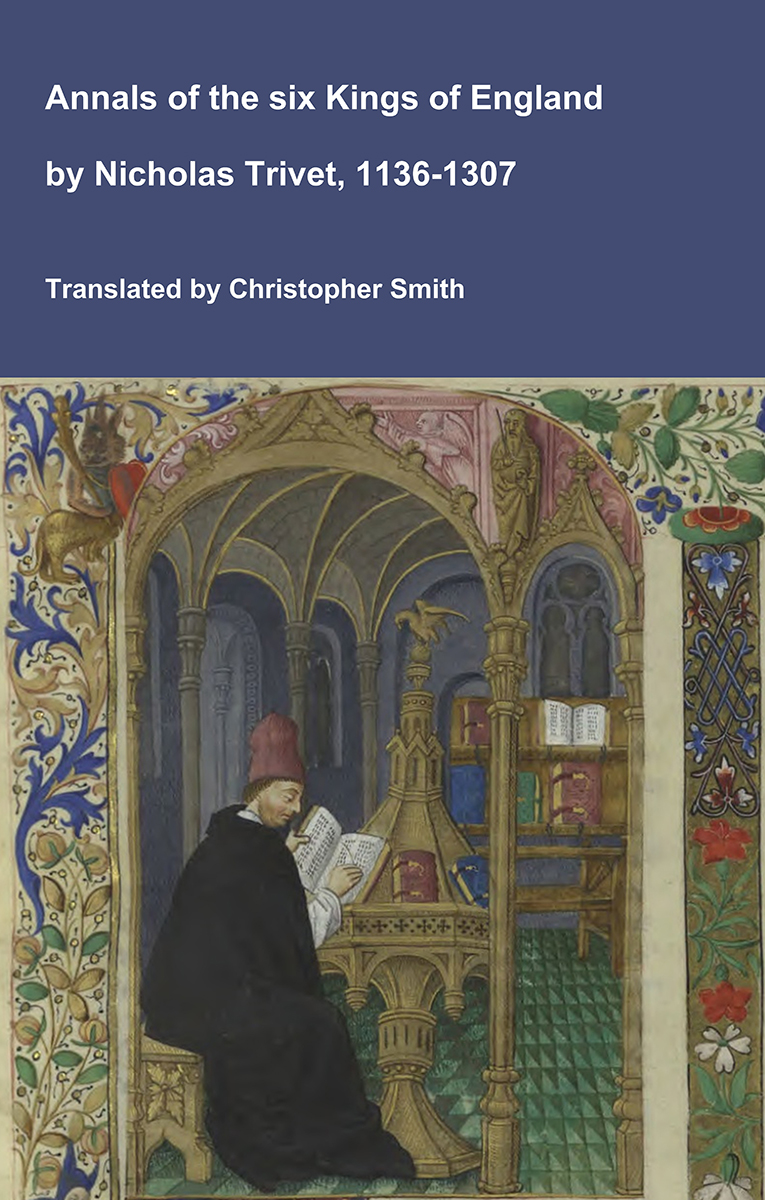
Annals of the six Kings of England by Nicholas Trivet
Translation of the Annals of the Six Kings of England by that traces the rise and rule of the Angevin aka Plantagenet dynasty from the mid-12th to early 14th century. Written by the Dominican scholar Nicholas Trivet, the work offers a vivid account of English history from the reign of King Stephen through to the death of King Edward I, blending political narrative with moral reflection. Covering the reigns of six monarchs—from Stephen to Edward I—the chronicle explores royal authority, rebellion, war, and the shifting balance between crown, church, and nobility. Trivet provides detailed insight into defining moments such as baronial conflicts, Anglo-French rivalry, and the consolidation of royal power under Edward I, whose reign he describes with particular immediacy. The Annals combines careful year-by-year reporting with thoughtful interpretation, presenting history not merely as a sequence of events but as a moral and political lesson. Ideal for readers interested in medieval history, kingship, and the origins of the English state, this chronicle remains a valuable and accessible window into the turbulent world of the Plantagenet kings.
Available at Amazon in eBook and Paperback format.
Paternal Family Tree: Cave
In or before 1493 [his father] Richard Cave of Stanford in Northamptonshire and Elizabeth Mervin [aged 23] were married.
In 1495 [his father] Richard Cave of Stanford in Northamptonshire and [his step-mother] Margaret Saxby [aged 23] were married.
Around 1502 Ambrose Cave was born to [his father] Richard Cave of Stanford in Northamptonshire.
In 1538 [his father] Richard Cave of Stanford in Northamptonshire died.
On 25th April 1559 [his daughter] Margaret Cave was born to Ambrose Cave [aged 57]. She married 16th July 1566 Henry Knollys and had issue.
On 16th July 1566 [his son-in-law] Henry Knollys [aged 24] and [his daughter] Margaret Cave [aged 7] were married.
On 2nd April 1568 Ambrose Cave [aged 66] died. Monument at St Nicholas' Church, Stanford-on-Avon [Map].


Vesta Monumenta. 1733. Plate 1.39 depicts Tutbury Castle. Engraving by George Vertue [aged 49] after a drawing originally produced for a survey of the properties of the Duchy of Lancaster conducted by the Chancellor of the Duchy, Ambrose Cave, in 1561.

Vesta Monumenta. 1733. Plate 1.40 depicts Melbourne Castle [Map]. Engraving by George [aged 49] Vertue after a drawing originally produced for a survey of the properties of the Duchy of Lancaster conducted by the Chancellor of the Duchy, Ambrose Cave, in 1561.
Chronicle of Walter of Guisborough
A canon regular of the Augustinian Guisborough Priory, Yorkshire, formerly known as The Chronicle of Walter of Hemingburgh, describes the period from 1066 to 1346. Before 1274 the Chronicle is based on other works. Thereafter, the Chronicle is original, and a remarkable source for the events of the time. This book provides a translation of the Chronicle from that date. The Latin source for our translation is the 1849 work edited by Hans Claude Hamilton. Hamilton, in his preface, says: 'In the present work we behold perhaps one of the finest samples of our early chronicles, both as regards the value of the events recorded, and the correctness with which they are detailed; Nor will the pleasing style of composition be lightly passed over by those capable of seeing reflected from it the tokens of a vigorous and cultivated mind, and a favourable specimen of the learning and taste of the age in which it was framed.'
Available at Amazon in eBook and Paperback format.

Vesta Monumenta. 1734. Plate 1.42. Pontefract Castle [Map]. Engraving by George [aged 50] Vertue after a drawing originally produced for a survey of the properties of the Duchy of Lancaster conducted by the Chancellor of the Duchy, Ambrose Cave, in 1561.

Vesta Monumenta. 1734. Plate 1.44. Knaresborough Castle [Map]. Engraving by George [aged 50] Vertue after a drawing originally produced for a survey of the properties of the Duchy of Lancaster conducted by the Chancellor of the Duchy, Ambrose Cave, in 1561.

Vesta Monumenta. 1734. Plate 1.41. Lancaster Castle [Map] and Priory Church [Map]. Engraving by George [aged 50] Vertue after a drawing originally produced for a survey of the properties of the Duchy of Lancaster conducted by the Chancellor of the Duchy, Ambrose Cave, in 1561.

Vesta Monumenta. 1737. Plate 1.46. Tickhill Castle [Map]. Engraving by George [aged 53] Vertue after a drawing originally produced for a survey of the properties of the Duchy of Lancaster conducted by the Chancellor of the Duchy, Ambrose Cave, in 1561.

Vesta Monumenta. 1753. Plate 2.13. Clitheroe Castle [Map]. Engraving by George Vertue [aged 69] after a drawing originally produced for a survey of the properties of the Duchy of Lancaster conducted by the Chancellor of the Duchy, Ambrose Cave, in 1561.

Vesta Monumenta. 1753. Plate 2.11. Sandal Castle [Map]. Engraving by George Vertue [aged 69] after a drawing originally produced for a survey of the properties of the Duchy of Lancaster conducted by the Chancellor of the Duchy, Ambrose Cave, in 1561.