

The History of William Marshal was commissioned by his son shortly after William’s death in 1219 to celebrate the Marshal’s remarkable life; it is an authentic, contemporary voice. The manuscript was discovered in 1861 by French historian Paul Meyer. Meyer published the manuscript in its original Anglo-French in 1891 in two books. This book is a line by line translation of the first of Meyer’s books; lines 1-10152. Book 1 of the History begins in 1139 and ends in 1194. It describes the events of the Anarchy, the role of William’s father John, John’s marriages, William’s childhood, his role as a hostage at the siege of Newbury, his injury and imprisonment in Poitou where he met Eleanor of Aquitaine and his life as a knight errant. It continues with the accusation against him of an improper relationship with Margaret, wife of Henry the Young King, his exile, and return, the death of Henry the Young King, the rebellion of Richard, the future King Richard I, war with France, the death of King Henry II, and the capture of King Richard, and the rebellion of John, the future King John. It ends with the release of King Richard and the death of John Marshal.
Available at Amazon in eBook and Paperback format.
Paternal Family Tree: Fountaine
In or before 1633 [his father] Brigg Fountaine of Salle in Norfolk and [his mother] Joanne Henley were married.
Around 1633 Andrew Fountaine was born to Brigg Fountaine of Salle in Norfolk and Joanne Henley.
In or before 1659 Andrew Fountaine [aged 25] and Theophila Stubbe [aged 37] were married.
In 1659 [his wife] Theophila Stubbe [aged 38] died.
In 1661 [his father] Brigg Fountaine of Salle in Norfolk died.
Around 1664 Andrew Fountaine [aged 31] became acquainted with John Coke [aged 28] who he apparently saved from drowning. The pair subsequently travelled to the Continent together. Thereafter Andrew Fountaine became steward to John Coke and is reported to have extracted large sums of money from the estate.
On or after 29th April 1672 Andrew Fountaine [aged 39] and Sarah Chicheley were married.

In 1676 [his daughter] Elizabeth Fountaine was born to Andrew Fountaine [aged 43] and [his wife] Sarah Chicheley. She married in or before 1706 Colonel Edward Clent of Knightwick in Worcestershire and had issue.
In 1676 [his son] Andrew Fountaine was born to Andrew Fountaine [aged 43] and [his wife] Sarah Chicheley at Salle, Norfolk.

Abbot John Whethamstede’s Chronicle of the Abbey of St Albans
Abbot John Whethamstede's Register aka Chronicle of his second term at the Abbey of St Albans, 1451-1461, is a remarkable text that describes his first-hand experience of the beginning of the Wars of the Roses including the First and Second Battles of St Albans, 1455 and 1461, respectively, their cause, and their consequences, not least on the Abbey itself. His text also includes Loveday, Blore Heath, Northampton, the Act of Accord, Wakefield, and Towton, and ends with the Coronation of King Edward IV. In addition to the events of the Wars of the Roses, Abbot John, or his scribes who wrote the Chronicle, include details in the life of the Abbey such as charters, letters, land exchanges, visits by legates, and disputes, which provide a rich insight into the day-to-day life of the Abbey, and the challenges faced by its Abbot.
Available at Amazon in eBook and Paperback format.
In March 1679 Andrew Fountaine [aged 46] was elected MP Newton. His wife's brother-in-law Richard Legh [aged 44] controlled the Newton constituency and paid for his election expenses.
In October 1679 Andrew Fountaine [aged 46] was elected MP Newton.
In 1681 Andrew Fountaine [aged 48] was elected MP Newton.
In 1694 Andrew Fountaine [aged 61] reached a final settlement with the Coke family over the leases given to him by John Coke; all leases and income to be surrendered by Andrew Fountaine in exchange for £10,000. A year later Andrew Fountaine purchased Narford Hall.

In 1701 Andrew Fountaine [aged 68], as a consequence of financial difficulties, compelled him to sell his Hertfordshire estates including his newly built house at Bell Bar to John Somers 1st Baron Somers [aged 49].
In 1702 Andrew Fountaine [aged 69] commissioned the building of Narford Hall. He laid the first stone on 29th June 1702.
In 1703 the daughters of William Barkham 3rd Baronet, Dorothy Barkham, Frances Barkham and Jane Barkham conveyed the manor of South Acre, Norfolk to Andrew Fountaine [aged 70].
In or before 1706 [his son-in-law] Colonel Edward Clent of Knightwick in Worcestershire [aged 28] and [his daughter] Elizabeth Fountaine [aged 29] were married. She brought Narford Hall to the marriage.
On 7th February 1707 Andrew Fountaine [aged 74] died. His son [aged 31] inherited Narford Hall. Buried at Church of St Mary, Narford [Map].
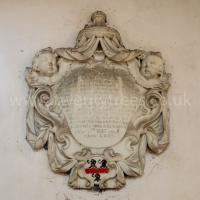
After 7th February 1707 Monument to Andrew Fountaine [deceased] at Church of St Mary, Narford [Map].
Great x 1 Grandfather: Arthur Fountayne of Salle
GrandFather: John Fountayne of Salle
GrandFather: Andrew Henley of Taunton in Somerset
Mother: Joanne Henley