

William of Worcester's Chronicle of England
William of Worcester, born around 1415, and died around 1482 was secretary to John Fastolf, the renowned soldier of the Hundred Years War, during which time he collected documents, letters, and wrote a record of events. Following their return to England in 1440 William was witness to major events. Twice in his chronicle he uses the first person: 1. when writing about the murder of Thomas, 7th Baron Scales, in 1460, he writes '… and I saw him lying naked in the cemetery near the porch of the church of St. Mary Overie in Southwark …' and 2. describing King Edward IV's entry into London in 1461 he writes '… proclaimed that all the people themselves were to recognize and acknowledge Edward as king. I was present and heard this, and immediately went down with them into the city'. William’s Chronicle is rich in detail. It is the source of much information about the Wars of the Roses, including the term 'Diabolical Marriage' to describe the marriage of Queen Elizabeth Woodville’s brother John’s marriage to Katherine, Dowager Duchess of Norfolk, he aged twenty, she sixty-five or more, and the story about a paper crown being placed in mockery on the severed head of Richard, 3rd Duke of York.
Available at Amazon in eBook and Paperback format.
On 26th January 1657 Archbishop William Wake was born in Blandford Forum, Dorset [Map].
John Evelyn's Diary. 1st January 1687. Mr. Wake [aged 29] preached at St. Martin's on 1 Tim. iii. 16, concerning the mystery of godliness. He wrote excellently, in answer to the Bishop of Meaux.
John Evelyn's Diary. 20th March 1687. The Bishop of Bath and Wells [aged 49] (Dr. Ken) preached at St. Martin's [Map] to a crowd of people not to be expressed, nor the wonderful eloquence of this admirable preacher; the text was Matt. xxvi. 36 to verse 40, describing the bitterness of our Blessed Savior's agony, the ardor of his love, the infinite obligations we have to imitate his patience and resignation; the means by watching against temptations, and over ourselves with fervent prayer to attain it, and the exceeding reward in the end. Upon all which he made most pathetical discourses. The Communion followed, at which I was participant. I afterward dined at Dr. Tenison's [aged 50] with the Bishop and that young, most learned, pious, and excellent preacher, Mr. Wake [aged 30]. In the afternoon, I went to hear Mr. Wake at the newly built church of St. Anne, on Mark viii. 34, upon the subject of taking up the cross, and strenuously behaving ourselves in time of persecution, as this now threatened to be.
In 1688 Archbishop William Wake [aged 30] and Ethelreda Hovell [aged 18] were married.
In 1693 Archbishop William Wake [aged 35] was appointed Rector of St James' Church, Piccadilly.
In 1703 Archbishop William Wake [aged 45] was appointed Dean of Exeter.
In 1705 Archbishop William Wake [aged 47] was consecrated Bishop of Lincoln.
In 1716 Archbishop William Wake [aged 58] was translated to Archbishop of Canterbury.
On 20th July 1729 William Stukeley [aged 41] was ordained as a Deacon by Archbishop William Wake [aged 72].
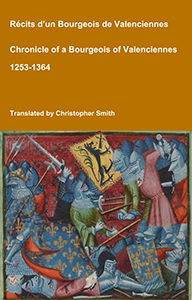
Chronicle of a Bourgeois of Valenciennes
Récits d’un bourgeois de Valenciennes aka The Chronicle of a Bourgeois of Valenciennes is a vivid 14th-century vernacular chronicle written by an anonymous urban chronicler from Valenciennes in the County of Hainaut. It survives in a manuscript that describes local and regional history from about 1253 to 1366, blending chronology, narrative episodes, and eyewitness-style accounts of political, military, and social events in medieval France, Flanders, and the Low Countries. The work begins with a chronological framework of events affecting Valenciennes and its region under rulers such as King Philip VI of France and the shifting allegiances of local nobility. It includes accounts of conflicts, sieges, diplomatic manoeuvres, and the impact of broader struggles like the Hundred Years’ War on urban life in Hainaut. Written from the perspective of a burgher (bourgeois) rather than a monastery or royal court, the chronicle offers a rare lay viewpoint on high politics and warfare, reflecting how merchants, townspeople, and civic institutions experienced the turbulence of the 13th and 14th centuries. Its narrative style combines straightforward reporting of events with moral and civic observations, making it a valuable source for readers interested in medieval urban society, regional politics, and the lived experience of war and governance in pre-modern Europe.
Available at Amazon in eBook and Paperback format.
In 1731 [his wife] Ethelreda Hovell [aged 61] died.

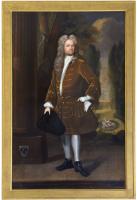
Before 1737 Thomas Gibson [aged 56]. Portrait of Archbishop William Wake [aged 79].
On 24th January 1737 Archbishop William Wake [aged 79] died at Lambeth Palace [Map].
[his daughter] Dorothy Wake was born to Archbishop William Wake and Ethelreda Hovell. She married James Pennyman, son of James Pennyman 3rd Baronet and Mary Wharton.