

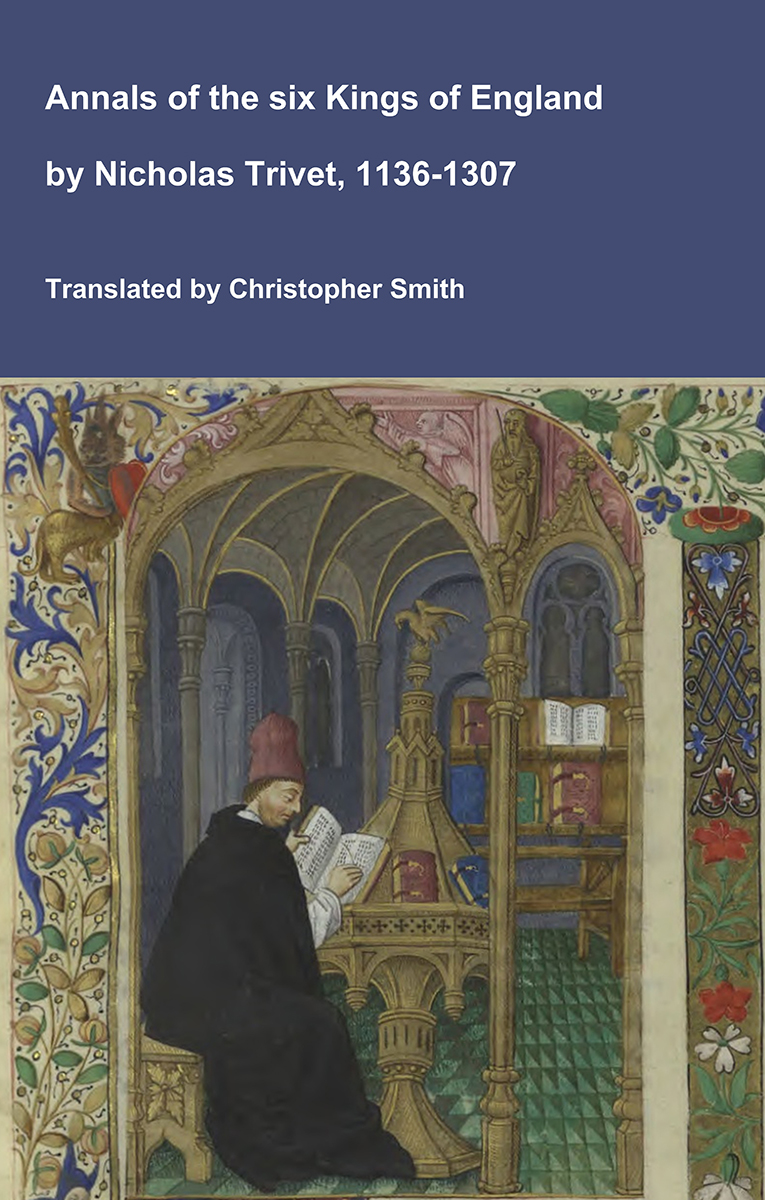
Annals of the six Kings of England by Nicholas Trivet
Translation of the Annals of the Six Kings of England by that traces the rise and rule of the Angevin aka Plantagenet dynasty from the mid-12th to early 14th century. Written by the Dominican scholar Nicholas Trivet, the work offers a vivid account of English history from the reign of King Stephen through to the death of King Edward I, blending political narrative with moral reflection. Covering the reigns of six monarchs—from Stephen to Edward I—the chronicle explores royal authority, rebellion, war, and the shifting balance between crown, church, and nobility. Trivet provides detailed insight into defining moments such as baronial conflicts, Anglo-French rivalry, and the consolidation of royal power under Edward I, whose reign he describes with particular immediacy. The Annals combines careful year-by-year reporting with thoughtful interpretation, presenting history not merely as a sequence of events but as a moral and political lesson. Ideal for readers interested in medieval history, kingship, and the origins of the English state, this chronicle remains a valuable and accessible window into the turbulent world of the Plantagenet kings.
Available at Amazon in eBook and Paperback format.
Around 1514 Bishop John Ponet was born.
Diary of Edward VI. 30th June 1550. Jhon Poynet made bishop of Rochester, and receivid his othe.2
Note 2. The letters patent nominating John Ponet (age 36) to the see of Rochester, dated the 6th June, are printed by Rymer, xv. 237; followed by the letters of Signiflcavit addressed to the archbishop of Canterbury, dated the 27th of the same month; and at p. 240 are letters patent dated the 4th July, authorising the bishop to hold in commendam until the feast of the Annunciation in 1555, the vicarage of Ashford in the diocese of Canterbury, the rectory of Towen in the diocese of Bangor, the rectory of St. Michael [Map] near Crooked-lane in the city of London, and a prebend of the church of Canterbury. "June xxvij. 1550, upon consideracion that mr. Poynett nowe elected busshope of Rochester hath no house to dwell in, and his lyving small, it was agreed he shulde enjoye his benefice in commendam; but from henseforth it is decreed that no busshope shall keepe other benefice than his busshopprick only." (Council Book.) Ponet was translated to Winchester on the 23d March, 1550-1. On the domestic scandal connected with Ponet's marriage, see Machyn's Diary, pp. 8, 320, and the Chronicle of the Grey Friars of London, p. 70.
On 8th March 1551 Bishop John Ponet (age 37) was elected Bishop of Winchester.
Chronicle of Greyfriars. 27th June 1551. And the xxvij. day of the same monyth the byshoppe of Wynchester (age 37) that was than (John Ponetc ) was devorsyd from hys wyffe in Powlles, the whyche was a bucheres wyff of Nottynggam, and gave hare husbande a sartyne mony a yere dureynge hys lyffe as it was jugydde by the lawe.
Note c. The name is left blank in the manuscript. This passage is remarkable as a fuller statement of the same matter of which a brief notice occurs in Machyn's Diary, p. 8, and which was only assigned by strong presumption to bishop Ponet. See the note, ibid, p. 320.
Henry Machyn's Diary. 27th July 1551. The xxvij day of July was the nuw bisshope of W (age 37) ... was devorsyd from the bucher wyff with shame enog[h.]
Note. The xxvij of July was the new bishop of W—divorced from the butcher wife with shame enough. Though the name is burnt, this appears to belong to John Ponet, bishop of Winchester, who had been translated to that see on the 23d March preceding. He had published "A Defence of the Marriage of Priests" in 1549, which is noticed in Strype, Memorials, Book ii. chap. 18. And it seems that he married again very shortly after this divorce, the following entry occurring in the register of Croydon: "1551, Oct. 25. Reverendus pater Johannes episcopus Wynton' duxit Mariam Haymond generosam in ista ecclesia coram multitudine parochianorum, presente reverendissimo patre Thoma Cantuar' archiepiscopo cum multis." (Collectanea Topogr. et Geneal. iv. 91.)
In August 1556 Bishop John Ponet (age 42) died.