

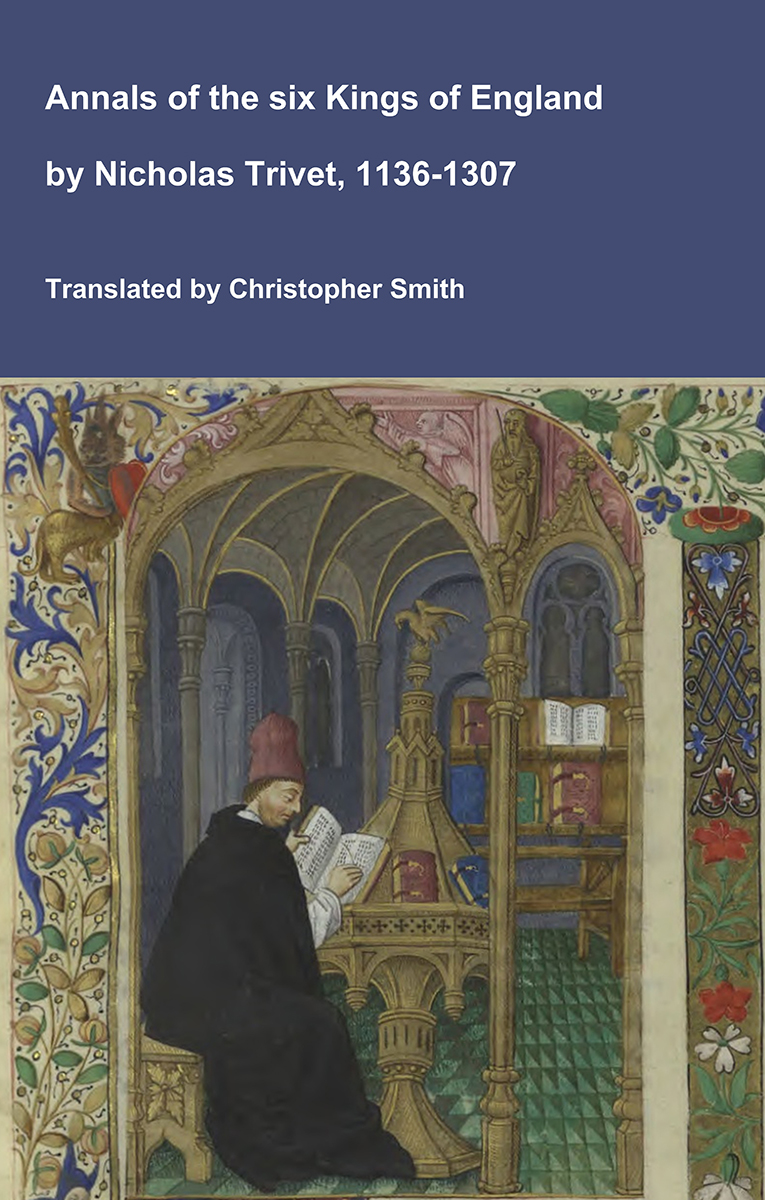
Annals of the six Kings of England by Nicholas Trivet
Translation of the Annals of the Six Kings of England by that traces the rise and rule of the Angevin aka Plantagenet dynasty from the mid-12th to early 14th century. Written by the Dominican scholar Nicholas Trivet, the work offers a vivid account of English history from the reign of King Stephen through to the death of King Edward I, blending political narrative with moral reflection. Covering the reigns of six monarchs—from Stephen to Edward I—the chronicle explores royal authority, rebellion, war, and the shifting balance between crown, church, and nobility. Trivet provides detailed insight into defining moments such as baronial conflicts, Anglo-French rivalry, and the consolidation of royal power under Edward I, whose reign he describes with particular immediacy. The Annals combines careful year-by-year reporting with thoughtful interpretation, presenting history not merely as a sequence of events but as a moral and political lesson. Ideal for readers interested in medieval history, kingship, and the origins of the English state, this chronicle remains a valuable and accessible window into the turbulent world of the Plantagenet kings.
Available at Amazon in eBook and Paperback format.
On 9th September 1271 Bishop Walter Scammel was elected Dean of Salisbury.
Annals of Dunstable. In the same year died the bishop of Salisbury1, who had been blind for seven years; and the dean2 of that church succeeded him.
Eodem anno obiit episcopus Sarisburiensis, qui per septennium cæcus fuit; et successit ei decanus dictæ ecclesiæ.
Note 1. Bishop Robert Wickhampton, died on the 24th April 1284.
Note 2. Bishop Walter Scammel, died between 20th and 25th September 1286.
On 26th June 1284 Bishop Walter Scammel was elected Bishop of Salisbury.
Annals of Dunstable. In the same year Brother John (age 54), archbishop of Canterbury, visited the diocese of Lincoln for the first time. And on the feast of Saint Luke [18th October 1284] he turned aside to Dunstable for the purpose of visitation. And since he found everything there in good order, because the bishop of Lincoln had quite recently visited that house, he nevertheless stayed there one night. And he received from that monastery for his procuration four marks; and he departed. Also, to a certain canon of Dunstable who had incurred irregularity, the said archbishop gave the cross, and by the authority granted to those signed with the cross absolved the said canon from that irregularity, provided that on the first expedition he should make redemption of it, so far as he might be able to obtain the money from his own chamber or also from his friends, without loss to the monastery. On the following Sunday [22nd October 1284] the said archbishop consecrated Walter Scammel as bishop of Salisbury, namely in one of the manors1 of that bishop near Reading. Also, the inspection of our privileges concerning the appropriation of churches the same archbishop then postponed."
Eodem anno, frater Johannes, Cantuariensis archiepiscopus, primo visitavit Lincolniensem diocesim. Et die Sancti Lucæ apud Dunstaple causa visitationis divertit. Cumque ibi omnia prospere reperisset, eo quod Lincolniensis episcopus quasi recenter domum illam visitasset, una tamen nocte ibidem pernoctavit. Et recepit ab illo monasterio pro procuratione sua quatuor marcas; et discessit. Item, cuidam canonico de Dunstaple, qui irregularitatem contraxerat, dictus archiepiscopus dedit crucem, et auctoritate cruce signatis indulta, dictum canonicum ab ipsa irregularitate absolvit. Ita quod in prima expeditione faceret inde redemptionem, quatenus assequi posset pecuniam a sua propria camera, seu etiam ab amicis, sine monasterii læsione. Dominica proxima sequenti dictus archiepiscopus Walterum Scamal in episcopum Sarisburiensem Salisbury, consecravit; videlicet, in quodam manerio ipsius episcopi juxta Redingges. Item, inspectionem privilegioleges as to rum nostrorum super appropriatione ecclesiarum, idem archiepiscopus ad tunc posuit in respectum.
Note 1. The manor of Sunning, aka Sunninghill, in Berkshire.
On 22nd October 1284 Bishop Walter Scammel was consecrated Bishop of Salisbury by Archbishop John Peckham (age 54). See Annals of Dunstable.
On 4th January 1285 Bishop Walter Scammel was enthroned Bishop of Salisbury.
Between 20th and 25th September 1286 Bishop Walter Scammel died.