

Annals of the six Kings of England by Nicholas Trivet
Translation of the Annals of the Six Kings of England by that traces the rise and rule of the Angevin aka Plantagenet dynasty from the mid-12th to early 14th century. Written by the Dominican scholar Nicholas Trivet, the work offers a vivid account of English history from the reign of King Stephen through to the death of King Edward I, blending political narrative with moral reflection. Covering the reigns of six monarchs—from Stephen to Edward I—the chronicle explores royal authority, rebellion, war, and the shifting balance between crown, church, and nobility. Trivet provides detailed insight into defining moments such as baronial conflicts, Anglo-French rivalry, and the consolidation of royal power under Edward I, whose reign he describes with particular immediacy. The Annals combines careful year-by-year reporting with thoughtful interpretation, presenting history not merely as a sequence of events but as a moral and political lesson. Ideal for readers interested in medieval history, kingship, and the origins of the English state, this chronicle remains a valuable and accessible window into the turbulent world of the Plantagenet kings.
Available at Amazon in eBook and Paperback format.
In 1448 Christopher Urswick was born.
On 29th October 1485 King Henry VII of England and Ireland [aged 28] processed from Tower of London [Map] to Westminster Abbey [Map]. Ahead of him marched the heralds and serjeants-at-arms, the Esquire of the Body, the King's Secretary Richard Fox [aged 37], almoner Christopher Urswick [aged 37], the mayor of London and the Garter King of Arms. Also ahead of him were Thomas Stanley 1st Earl of Derby [aged 50], John de la Pole Earl Lincoln 1st [aged 23], John de Vere 13th Earl of Oxford [aged 43] and William Berkeley 1st Marquess Berkeley [aged 59]. Following behind were the only two Dukes: Jasper Tudor 1st Duke Bedford [aged 53], created the day before, and John de la Pole 2nd Duke of Suffolk [aged 43].


In 1488 Christopher Urswick [aged 40] was appointed Dean of York.
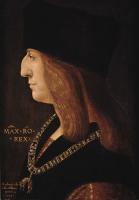
Chronicle of Edward Hall [1496-1548]. After that, all this army was arrayed and even ready to set forward whereof were chieftains and leaders, Jasper Duke of Bedford [aged 61], and John, Earl of Oxford [aged 50] beside other the King [aged 35] sent Christopher Urswick [aged 44] almoner, and syr John Wriothesley knight to Maximilia [aged 33], to certify him that the King was all in a readiness, and would shortly arrive in the continent land, as soon as he were advertised that Maximilian and his men, were ready and prepared to join with him. The Ambassadors sailed into Flanders, and after their message done, they sent two letters in all hast to King Henry, the which not only sore unquieted and vexed him, but also caused him to take more thought, care and study on him then he did before: for they declared that no prince could be more unprovided or more destitute of men and armure, no more lacking all things, appertaining to war than was Maximilian, and that he lay lurking in a corner, sore sick of the flux of the purse, so that he had neither men, horses, munitions, armour nor money, nevertheless his mind and will was good, if his power and ability had been correspondent and therefore there was no trust to be put in his aide or puissance. Their letters both appalled and made sorrowful the King of England, which like a prudent prince did well consider and ponder, that it were both jeopardous and costly, for him alone to enterprise so great a war. And on the other part, if he should desist and leave of his pretended purpose, all me might call him coward and recreant prince. Beside this, he thought that his own nation would not take his tarrying at home in good nor favourable part, considering that syth they had given so large money for the preparation of all things necessary and convenient for the same, they might conceive in their heads and imagine, that under colour and pretence of a dissimulated war he had exacted of the notable sums of money, and now the treasure was once paid, then the war was done, and his coffers well enriched, and the commons impoverished. So that at this time he doubted and cast perils on every side and part, and beside this he was not a little sorry that Maximilia author of this war did absent himself and defraud him of his society and assistance. And while he studied and mused what counsel he should best take in such a doubtful and sudden case, he like a grave prince, remembering the saying of the wise man, work by counsel and thou shall not repent the, assembled together all his lords and other of his private counsel, by whose minds it was concluded and determined, that he should manfully and courageously persevere and precede in this broached and begun enterprise, recording well with themselves, and affirming plainly that all chivalry and martial prowess, the more difficult and heard that it is to attain to, the more renowned is the glory, and the fame more immortal of the vanquisher and obtainer. Therefore by this counsel of his friends and senate, he made Proclamation that every man should set forward into France, and yet not opening how Judasly Maximilian had deceived him, least that they knowing the whole fact, should not be so courageous to go toward that battle and precede forward on their journey. And therefore, to provide and force all perils and dangers that might accidentally ensue, he so strengthened, multiplied and augmented his army in such number before he took ship, that he with his own power might discourage and overcome the whole puissance of his adversaries.
In 1494 Christopher Urswick [aged 46] was appointed Archdeacon Richmond.
In 1500 Christopher Urswick [aged 52] was appointed Archdeacon of Norwich.
In 1504 Christopher Urswick [aged 56] was appointed Archdeacon of Oxford.
Before 1509 Christopher Urswick [aged 60] was appointed priest and confessor to Margaret Beaufort Countess Richmond [aged 65].


On 24th March 1522 Christopher Urswick [aged 74] died in Hackney. He was buried in St Augustine's Church, Hackney.
Historia Regis Henrici Septimi by Bernado Andrea. The victory having been happily won by the Earl of Richmond through the divine ordering of God Almighty and Most High, and the tyrant having been slain according to his deserts, the shrill cry of trumpets and the blare of horns strikes the stars. Moreover, all those of the ecclesiastical order who had come with that most fortunate Earl of Richmond lift their voices from the depths of their hearts to heaven with most devout prayers. Among them was that reverend and most faithful man, then Keeper of the Secrets, now Keeper of the Privy Seal and Bishop of Winchester1, my lord and most honoured patron, set at the head of the companies of the heavenly soldiery, together with his brother of happy memory, Michael Deacon2 and Bishop of St Asaph, sometime the king’s confessor, and also Lord Christopher Urswick3, Dean of Windsor, then the king’s almoner. But the most Christian prince, not as many mortals are wont to be in prosperity, showed himself most humble; and, commanding silence of all with his hand, thus he began to speak:
Parta Dei Optimi Maximique divina dispositione a Richemundiæ comite feliciter victoria, tyrannoque pro meritis trucidato, stridor lituum clangorque tubarum astra ferit. Ecclesiastici præterea ordinis omnes qui cum illo faustissimo Richemundiæ comite advenerant voces imo pectore ad cœlum usque cum pientissimis eunt precibus. Inter quos ille reverendus fidissimusque, tunc Secretorum, nunc vero Privati Sigilli Custos et Wyntoniensis præsul, dominus ac Mæcenas meus observandissimus, coelestis militiæ copiis, unacum felicis recordationis fratre Michaele Dyaconi Assavensi episcopo Francicastro, regio quondam confessore, item domino Christoforo Wrsouyt, decano Wyndezoræ, regio tunc eleemosinario, prælatus erat. Princeps autem Christianissimus, non ut plerique mortalium solent, in prosperis humillimus extitit, manuque cunctis silentium imperante sic exorsus est:
Note 1. Peter Courtenay, died 1492. He was elected Bishop of Exeter in 1478. Following the death of King Edward IV he and his brother Walter fled to Henry Tudor in Brittany. He was translated to Winchester in 1487.
Note 2. Michael Deacon, died 1500, was appointed Bishop of St Asaph in 1495.
Note 3. Christopher Urswick, 1448-1522, Dean of York, Archdeacon of Richmond, Norwich and Oxford, and confessor of King Henry VII's mother Margaret Beaufort.
The Deeds of the Dukes of Normandy
The Gesta Normannorum Ducum [The Deeds of the Dukes of Normandy] is a landmark medieval chronicle tracing the rise and fall of the Norman dynasty from its early roots through the pivotal events surrounding the Norman Conquest of England. Originally penned in Latin by the monk William of Jumièges shortly before 1060 and later expanded at the behest of William the Conqueror, the work chronicles the deeds, politics, battles, and leadership of the Norman dukes, especially William’s own claim to the English throne. The narrative combines earlier historical sources with firsthand information and oral testimony to present an authoritative account of Normandy’s transformation from a Viking settlement into one of medieval Europe’s most powerful realms. William’s history emphasizes the legitimacy, military prowess, and governance of the Norman line, framing their expansion, including the conquest of England, as both divinely sanctioned and noble in purpose. Later chroniclers such as Orderic Vitalis and Robert of Torigni continued the history, extending the coverage into the 12th century, providing broader context on ducal rule and its impact. Today this classic work remains a foundational source for understanding Norman identity, medieval statesmanship, and the historical forces that reshaped England and Western Europe between 800AD and 1100AD.
Available at Amazon in eBook and Paperback format.
Chronicle of Edward Hall [1496-1548]. When King Henry was returned into England, he first of all things elected into the Society of Sainct George, vulgarly called the Order of the Garter, Alphose duke of Calabria son, according to his desire which Alphonse was son and heir to Ferdinand King of Naples,and after King of the same realm, until he was overcome by King Charles. And after, the King sent Christopher Urswick, Ambassador with the garter, collar, mantel, and other habiliments appertaining to the companions of the said noble order. Which Ambassador arriving at Napels [Map], delivered to the duke the whole habile, with all the ceremonies and due circumstances thereunto belonging which duke very reverently received it, and with more reverence requested himself with the same in a solemn presence, thinking that by this apparel and investiture, he was made a friend and companion in order with the King of England, whose friendship obtained, he feared nothing the assaults or invasions of his enemies. And this was the cause that he desired so much to be companion of that noble order, firmly believing that the King of England sovereign of that order, should be aider and maintainer of him against the French King, whom he knew would passe the mountains and make war on him. But this custom of assistance in orders was, either never begun, or before clearly abolished: For in our time there have bene many noble men of Italy, companions as well of the Golden Fleece in Burgundy, as of the order of Saint Michael in France, that have bene banished and profligate from their natural country, and yet have not been aided by the sovereign nor companions of the same order. For surely the statutes and ordinances of all the said orders do not oblige and bind them to that case, but in certain points. After this the duke dismissed the Ambassador, rewarding him most princely.