

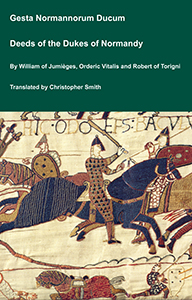
The Deeds of the Dukes of Normandy
The Gesta Normannorum Ducum [The Deeds of the Dukes of Normandy] is a landmark medieval chronicle tracing the rise and fall of the Norman dynasty from its early roots through the pivotal events surrounding the Norman Conquest of England. Originally penned in Latin by the monk William of Jumièges shortly before 1060 and later expanded at the behest of William the Conqueror, the work chronicles the deeds, politics, battles, and leadership of the Norman dukes, especially William’s own claim to the English throne. The narrative combines earlier historical sources with firsthand information and oral testimony to present an authoritative account of Normandy’s transformation from a Viking settlement into one of medieval Europe’s most powerful realms. William’s history emphasizes the legitimacy, military prowess, and governance of the Norman line, framing their expansion, including the conquest of England, as both divinely sanctioned and noble in purpose. Later chroniclers such as Orderic Vitalis and Robert of Torigni continued the history, extending the coverage into the 12th century, providing broader context on ducal rule and its impact. Today this classic work remains a foundational source for understanding Norman identity, medieval statesmanship, and the historical forces that reshaped England and Western Europe between 800AD and 1100AD.
Available at Amazon in eBook and Paperback format.
In 1627 Christopher Wase was born in Hackney.
In 1649 Christopher Wase (age 22) published a translation of Sophocles's 'Electra,' dedicated to Princess Elizabeth (age 13), with an appendix designed to show his devotion to the Stuart house.
John Evelyn's Diary. 1st February 1652. I brought with me from Paris Mr. Christopher Wase (age 25), sometime before made to resign his Fellowship in King's College, Cambridge, because he would not take the Covenant. He had been a soldier in Flanders, and came miserable to Paris. From his excellent learning, and some relation he had to Sir R. Browne (age 47), I bore his charges into England, and clad and provided for him, till he should find some better condition; and he was worthy of it. There came with us also Captain Griffith, Mr. Tyrell, brother to Sir Timothy Tyrell, of Shotover (near Oxford).
John Evelyn's Diary. 30th May 1652. I went to obtain of my Lord Devonshire (age 34) that my nephew, George, might be brought up with my young Lord, his son, to whom I was recommending Mr. Wase (age 25). I also inspected the manner of camleting silk and grograms at one Monsieur La Dorées in Moor-fields, and thence to Colonel Morley (age 36), one of their Council of State, as then called, who had been my schoolfellow, to request a pass for my wife's (age 17) safe landing, and the goods she was to bring with her out of France; which he courteously granted, and did me many other kindnesses, that was a great matter in those days.


John Evelyn's Diary. 16th March 1669. To London, to place Mr. Christopher Wase (age 42) about my Lord Arlington (age 51).


John Evelyn's Diary. 2nd April 1669. I now placed Mr. Wase (age 42) with Mr. Williamson, Secretary to the Secretary of State, and Clerk of the Papers.
On 29th August 1690 Christopher Wase (age 63) died.