

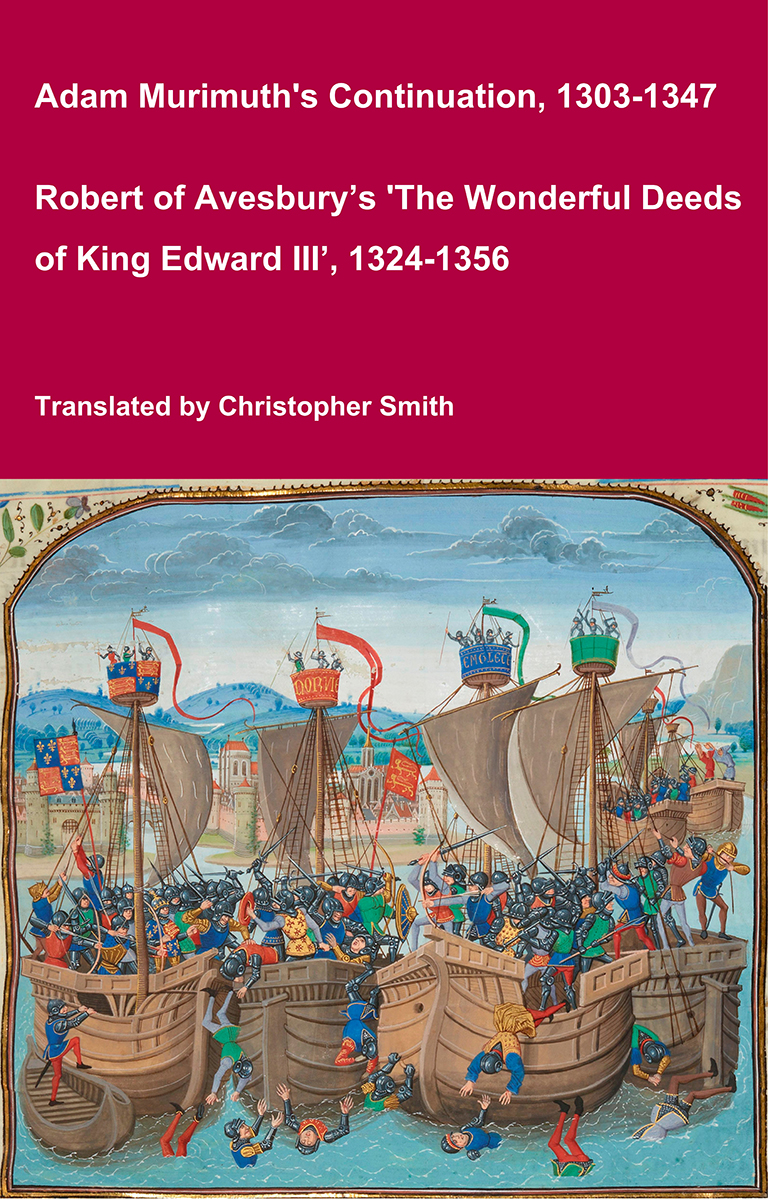
Adam Murimuth's Continuation and Robert of Avesbury’s 'The Wonderful Deeds of King Edward III'
This volume brings together two of the most important contemporary chronicles for the reign of Edward III and the opening phases of the Hundred Years’ War. Written in Latin by English clerical observers, these texts provide a vivid and authoritative window into the political, diplomatic, and military history of fourteenth-century England and its continental ambitions. Adam Murimuth Continuatio's Chronicarum continues an earlier chronicle into the mid-fourteenth century, offering concise but valuable notices on royal policy, foreign relations, and ecclesiastical affairs. Its annalistic structure makes it especially useful for establishing chronology and tracing the development of events year by year. Complementing it, Robert of Avesbury’s De gestis mirabilibus regis Edwardi tertii is a rich documentary chronicle preserving letters, treaties, and official records alongside narrative passages. It is an indispensable source for understanding Edward III’s claim to the French crown, the conduct of war, and the mechanisms of medieval diplomacy. Together, these works offer scholars, students, and enthusiasts a reliable and unembellished account of a transformative period in English and European history. Essential for anyone interested in medieval chronicles, the Hundred Years’ War, or the reign of Edward III.
Available at Amazon in eBook and Paperback format.
Paternal Family Tree: Strode
On 28th December 1627 Colonel John Strode was born to George Strode of Squerryes Court Westerham Kent [aged 42].
In 1663 Colonel John Strode [aged 35] was appointed Lieutenant Dover Castle.
In 1663 [his father] George Strode of Squerryes Court Westerham Kent [aged 78] died.
John Evelyn's Diary. 6th January 1665. To Dover, Kent [Map], where Colonel Stroode [aged 37], Lieutenant of the Castle, having received the letter I brought him from the Duke of Albemarle [aged 56], made me lodge in it, and I was splendidly treated, assisting me from place to place. Here I settled my first Deputy. The Mayor and officers of the Customs were very civil to me.


John Evelyn's Diary. 29th May 1665. I went with my little boy to my district in Kent, to make up accounts with my officers. Visited the Governor of at Dover Castle [aged 37], where were some of my prisoners.
On 27th October 1665 Colonel John Strode [aged 37] was elected MP Sandwich.
Samuel Pepys' Diary. 4th June 1666. Up, and with Sir J. Minnes [aged 67] and Sir W. Pen [aged 45] to White Hall in the latter's coach, where, when we come, we find the Duke [aged 32] at St. James's, whither he is lately gone to lodge. So walking through the Parke we saw hundreds of people listening at the Gravel-pits, [Kensington] and to and again in the Parke to hear the guns, and I saw a letter, dated last night, from Strowd [aged 38], Governor of Dover Castle, which says that the Prince [aged 46] come thither the night before with his fleete, but that for the guns which we writ that we heard, it is only a mistake for thunder1 and so far as to yesterday it is a miraculous thing that we all Friday, and Saturday and yesterday, did hear every where most plainly the guns go off, and yet at Deale [Map] and Dover, Kent [Map] to last night they did not hear one word of a fight, nor think they heard one gun. This, added to what I have set down before the other day about the Katharine, makes room for a great dispute in philosophy, how we should hear it and they not, the same wind that brought it to us being the same that should bring it to them: but so it is. Major Halsey, however (he was sent down on purpose to hear newes), did bring newes this morning that he did see the Prince and his fleete at nine of the clock yesterday morning, four or five leagues to sea behind the Goodwin [Map], so that by the hearing of the guns this morning we conclude he is come to the fleete.
Note 1. Evelyn [aged 45] was in his garden when he heard the guns, and be at once set off to Rochester, Kent [Map] and the coast, but he found that nothing had been heard at Deal (see his "Diary", June 1st, 1666).


On 26th November 1668 Colonel John Strode [aged 40] and Rebecca Crispe were married.

In or before 1679. John Hayls [aged 78]. Portrait of Colonel John Strode [aged 51].
In 1685 Colonel John Strode [aged 57] was elected MP Sandwich.
Chronicle of a Bourgeois of Valenciennes
Récits d’un bourgeois de Valenciennes aka The Chronicle of a Bourgeois of Valenciennes is a vivid 14th-century vernacular chronicle written by an anonymous urban chronicler from Valenciennes in the County of Hainaut. It survives in a manuscript that describes local and regional history from about 1253 to 1366, blending chronology, narrative episodes, and eyewitness-style accounts of political, military, and social events in medieval France, Flanders, and the Low Countries. The work begins with a chronological framework of events affecting Valenciennes and its region under rulers such as King Philip VI of France and the shifting allegiances of local nobility. It includes accounts of conflicts, sieges, diplomatic manoeuvres, and the impact of broader struggles like the Hundred Years’ War on urban life in Hainaut. Written from the perspective of a burgher (bourgeois) rather than a monastery or royal court, the chronicle offers a rare lay viewpoint on high politics and warfare, reflecting how merchants, townspeople, and civic institutions experienced the turbulence of the 13th and 14th centuries. Its narrative style combines straightforward reporting of events with moral and civic observations, making it a valuable source for readers interested in medieval urban society, regional politics, and the lived experience of war and governance in pre-modern Europe.
Available at Amazon in eBook and Paperback format.
Before 30th March 1686 Colonel John Strode [aged 58] died. He was buried in Westminster Abbey [Map] on 30th March 1686.
Kings Wessex: Great x 20 Grand Son of King Edmund "Ironside" I of England
Kings Gwynedd: Great x 16 Grand Son of Owain "Great" King Gwynedd
Kings Seisyllwg: Great x 22 Grand Son of Hywel "Dda aka Good" King Seisyllwg King Deheubarth
Kings Powys: Great x 17 Grand Son of Maredudd ap Bleddyn King Powys
Kings England: Great x 15 Grand Son of King Henry "Curtmantle" II of England
Kings Scotland: Great x 19 Grand Son of King Duncan I of Scotland
Kings Franks: Great x 27 Grand Son of Charles "Charlemagne aka Great" King of the Franks King Lombardy Holy Roman Emperor
Kings France: Great x 21 Grand Son of Hugh I King of the Franks
Kings Duke Aquitaine: Great x 25 Grand Son of Ranulf I Duke Aquitaine
Great x 4 Grandfather: John Strode  9 x Great Grand Son of King Henry "Curtmantle" II of England
Great x 3 Grandfather: Walter Strode 10 x Great Grand Son of King Henry "Curtmantle" II of England
Great x 2 Grandfather: Thomas Strode 11 x Great Grand Son of King Henry "Curtmantle" II of England
Great x 1 Grandfather: Edward Strode 12 x Great Grand Son of King Henry "Curtmantle" II of England
GrandFather: William Strode 13 x Great Grand Son of King Henry "Curtmantle" II of England
Father: George Strode of Squerryes Court Westerham Kent 14 x Great Grand Son of King Henry "Curtmantle" II of England
Colonel John Strode 15 x Great Grand Son of King Henry "Curtmantle" II of England