

Chronicle of Walter of Guisborough
A canon regular of the Augustinian Guisborough Priory, Yorkshire, formerly known as The Chronicle of Walter of Hemingburgh, describes the period from 1066 to 1346. Before 1274 the Chronicle is based on other works. Thereafter, the Chronicle is original, and a remarkable source for the events of the time. This book provides a translation of the Chronicle from that date. The Latin source for our translation is the 1849 work edited by Hans Claude Hamilton. Hamilton, in his preface, says: 'In the present work we behold perhaps one of the finest samples of our early chronicles, both as regards the value of the events recorded, and the correctness with which they are detailed; Nor will the pleasing style of composition be lightly passed over by those capable of seeing reflected from it the tokens of a vigorous and cultivated mind, and a favourable specimen of the learning and taste of the age in which it was framed.'
Available at Amazon in eBook and Paperback format.
Wiltshire Archaeological Magazine 1857 V4 Pages 307-363. Outside this temple [West Kennet Long Barrow [Map] or ], and at a little more than a foot below the surface, Dr. Toope, then living at Marlborough, found in 1678 the ground full of human skulls and bones. The feet lay towards the temple. In a letter to Aubrey, from which an extract is given below, the Doctor describes his discovery, as well as the professional use which he made of it, for the benefit of his fortunate patients at Marlborough.1 Mr. Aubrey says, sharp and form'd flints were found among them.2
Note 1. "In Wilts, between Kinnett and Overton, on the lands of one Captayne Walter Grubb, I approach'd workmen digging not far off the roade; I inquir'd their digging, who answer'd, 'making new boundaries to enclose for French grasse or 5 foile.' Said the men, 'we throw up many bones here, but know not of what creatures.' I quickly perceiy'd they were humane, and came the next day and dugg for them, and stored myselfe with many bushells, of which I made a noble medicine that relieved many of my distressed neighbours: the bones large, and almost rotten, but the teeth extreme and wonderfully white, hard and sound. (No tobacco taken in those daies.) About eighty yards from it is a large spherical foundation, (he means circular) [The Sanctuary [Map]?] whose diameter is forty yards, by which you know the circuit. Within this large temple there is another orbe, whose sphere is 15 yards in diameter; round about this temple a most exact plaine and superficies; under this superficies layd the bones soe close one by another, that scul toucheth scul, - I exposed 2 or 3, and never took up a bone of them to observe and see in what manner they lay. I perceived their fect lay toward the temple, and but little more than a foot under the superficies. At the feet of the first order, I saw lay the heads of the next, as above, their feet intending the temple; I really believe the whole plaine, on that even ground, is full of dead bodies," (Dr. R. Toope to Mr, Aubrey, from Bristoll, 1 Dec., 1685.)
Note by Mr. Aubrey relating to the above letter. "This was discovered in 1678, and Dr. Toope was lately at the Golgotha again to supply a defect of medicine he had from hence."
Note 2. Stukeley's Abury, p, 33.
Colt Hoare 1812. By the following description of this avenue, inserted by the learned Camden in his Britannia, it appears that he had seen Mr. Aubrey's manuscripts, and amongst them the letter before cited from Dr. Toope. He says, "From this place viz. Aubury to West Kennet, is a walk that has been enclosed on each side with large stones; one side, at present, wants a great many, but the other is almost, if not wholly, entire; above which place, on the brow of the hill, is another monument, encompassed with a circular trench, and a double circle of stones, four or five foot high, though most of them are now fallen down: the diameter of the outer circle is forty yards, and of the inner, fifteen. Between West Kennet and this place, is a walk much like that from Aubury thither, at least a quarter of a mile in length." He then recites the circumstance of the discovery of human bones. In the above quotation Mr. Camden has also continued the same statement with Aubrey, in mentioning a trench round the circular temple on Overton hill, and which Dr. Stukeley denies having existed.
Colt Hoare 1812. "As to the stones that composed this avenue, they were of all shapes, sizes and height that happened, altogether rude. Some we measured six feet thick, sixteen in circumference. If of a flattish make, the broadest dimension was set in the line of the avenue, and the most sightly side of the stone inward. The founders were sensible that all the effect desired in the case, was their bulk and regular station. When the avenue comes to the enclosures of West Kennet, it passes through three of them, crosses a little field lane, and the common road from Marlborough to Bath, just after the road makes a right angle descending from Overton hill. In this angle, the Roman road from Marlborough to Bath just after the road makes a right angle descending from Overton Hill. In this angle, the Romand road from Marlbrough coming down the hill, enters the common road. Passing the Roman road, it traverses an angle of a pasture, and falls into the upper part of the same road again, and marches through five more pastures, all. dong the quick, set hedge side, so that the quick is planted in the very middle of it. Many of the stones are seen lying in their proper places, both in the pastures, and in the road. These stones are all thrown down or reclining, and very large. We measured one by the style twelve feet long, six and a half broad, and three and an half thick. At the bottom of these pastures on the right, runs the virgin stream of Kennet, just parted from its fountain by Silbury hill.1 One stone is still standing by a little green lane going down to the river. Now our avenue marches direcdy up the hill across some ploughed fields, still by the hedge of the Marlborough road, where yet stands mother stone belonging to it. Then we are brought to the very summit of the celebrated Overton hill, properly the Hakpen, or head of the Snake. The temple that stood here was intended for the head of the snake in the huge picture, and at a distance, when seen in perspective, it very aptly does. consisted of concentric ovals, not much different from circles, their longest diameter being east and west. By the best intelligence I could obtain from the ruins of it, the outer circle eighty and ninety cubits (one hundred and thirty eight feet four inches, and one hundred and fifty-five feet seven inches and a half) in diameter, the medium being eighty five cubits, or one hundred and forty-six It consisted of forty stones, whereof eighteen remained, but only three standing. The inner was twenty-six, and thirty cubits (forty-four feet eleven inches and a half, and fifty-one feet ten inches and a half) diameter, equal to the interval between circle and circle: the stones were eighteen in number, somewhat higger than those of the outer circle, Every body here remember both circles entire, and standing, except two or three fallen."2
Note 1. This copious spring must only be considered as a considered stream to the river Kennet, which rises much higher up the country, above the village of Monkton. II.
Note 2. Mr. Aubrey and Dr. Stukeley do not at all agree as to the numbers of stones, of which these two circles were composed; the former writer states the outward circle to consist of twenty-two stones, and the inward of fifteen, making total of thirty-seven. Dr. Toope states the diameter of the large sphere to be forty yards, and the smaller one to be fifteen. H.
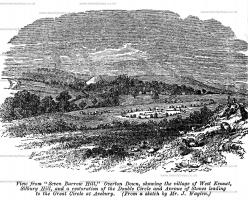
Wiltshire Archaeological Magazine 1859 V6 Pages 317-336. The downs and fields around Avebury abound with barrows; this locus consecratus, like the later one of Stonehenge, being surrounded by its primitive British necropolis. One of the most remarkable groups is on Kennet or Overton Hill or Down [Map], near the site of the "sanctuary [Map]" and commencement of the Kennet avenue which led to the great circle at Avebury, and a little beyond the seventy-ninth milestone from London. There are about ten barrows in all, seven of which are or have been of conspicuous size, and must be those called the Seven Barrows (seofon beorgas) in an Anglo-Saxon charter of the tenth century referring to Kennet. (Cod. Dip. No. 571). The hill itself went by the name of "Seven Barrowes Hill" as late as the seventeenth century, as appears from a passage in the curious work, "A Fool's Bolt soon shot at Stonage."1 Of this group, seven were opened by Sir R. C. Hoare about 1815. The most southerly of the ten is a low mound, not examined by Sir Richard, or numbered on his plan.2 It is situated in a ploughed land called "Mill-field," where was the double circle of the "sanctuary," which field was enclosed in 1685, as we learn from the curious letter of Dr. Toope of Marlborough. Here, close to the sacred circles, a large number of skeletons were found, with "the feet intending the temple." The Doctor obtained from this spot "many bushels" of bones, of which he says, "he made a noble medicine that relieved many of his distressed neighbours!" Cranium hominis has now lost its reputation, even in epilepsy; and if, at the present day, a skull be removed from an ancient barrow, it is for preservation in the cabinet of the anatomist; where it is treasured for the purposes of science. The low mound in this field is perhaps the base of the barrow, which Dr. Stukeley says was levelled for ploughing, in 1720, in which was found an unburnt skeleton "within a bed of great stones forming a kind of arch," and with it "several beads of amber, long and round, as big as one's thumb end, and several enamelled beads of glass, some white and some green."3
Note 1. Collected and published by Hearne, with Langtoft's Chronicle, in 1725, and usually attributed to a Mr. John Gibbons. I am, however, indebted to the Rev. Canon Jackson for the information, that a note preserved among the Aubrey MSS., at the Bodleian, shows it to have been written by a Mr. Jay of Nettlecombe, Somersetshire, who died about the year 1675.
Note 2. Ancient Wilts, vol. ii. p. 70, pl. x. A view of this group of barrows, with a distinct representation of the triplet in the centre, is given by Stukeley. Abury, pi. xxix. p.
Note 3. Abury, p. 44.
Archaeologia Volume 38 1883 Section XXVII. Dr. Stukeley's description was written about 1725, in which year, probably, his sketch of the barrow, which he absurdly designates that of an Arch-Druid, was made.b Stukeley gives it the name of South Long Barrow, from its situation in respect to Silbury Hill, and the circles of Avebury. He says: "It stands east and west, pointing to the dragon's head on Overton-hill. A very operose congeries of huge stones upon the east end, and upon part of its back or ridge, piled one upon another, with no little labour - doubtless in order to form a sufficient chamber for the remains of the person there buried — not easily to be disturbed. The whole tumulus is an excessively large mound of earth, 180 cubits long (i.e. 320 feet ), ridged up like a house. And we must needs conclude the people that made these durable mausolea had a very strong hope of the resurrection of their bodies, as well as souls, who thus provided against their being disturbed." Stukeley's large view, taken from the south, shows no peribolus of stones on that side; but in two distant views six or eight standing stones appear at the east end. The rest of these stones, figured by Aubrey sixty years previously, had probably been removed by that great depredator of the Avebury circles and avenues, "Farmer Green," who, about the year 1710, as we learn from Stukeley, removed similar stones from a neighbouring barrow, "to make mere-stones withal" — the boundaries probably of his own sheep-walks. Among the unpublished papers of Stukeley's, referred to in a previous note, is a further notice of this tumulus, as to which he says, "Dr. Took, as they call him,a1 has miserably defaced South Long Barrow by digging half the length of it. It was most neatly smoothed up to a sharp ridge, to throw off the rain, and some of the stones are very large."
Note b. Abury, p. 46. Tab. xxxi. compare Tab. xxx. for the date; and Tab. xxi. and xxi. or distant views of the barrow. In a collection of unpublished sketches and papers of Stukeley's, which fell into the hands of Gough and are now in the Bodleian, are two or three plans and drawings of South Long Barrow, showing the position of the stones on the surface at the east end, much as they still remain.
Note a1. Meaning no doubt the Doctor Toope, whose letter to Aubrey is preserved in his "Monumenta Britannica."