

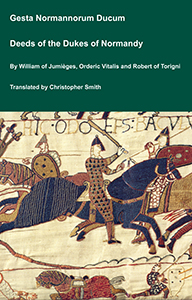
The Deeds of the Dukes of Normandy
The Gesta Normannorum Ducum [The Deeds of the Dukes of Normandy] is a landmark medieval chronicle tracing the rise and fall of the Norman dynasty from its early roots through the pivotal events surrounding the Norman Conquest of England. Originally penned in Latin by the monk William of Jumièges shortly before 1060 and later expanded at the behest of William the Conqueror, the work chronicles the deeds, politics, battles, and leadership of the Norman dukes, especially William’s own claim to the English throne. The narrative combines earlier historical sources with firsthand information and oral testimony to present an authoritative account of Normandy’s transformation from a Viking settlement into one of medieval Europe’s most powerful realms. William’s history emphasizes the legitimacy, military prowess, and governance of the Norman line, framing their expansion, including the conquest of England, as both divinely sanctioned and noble in purpose. Later chroniclers such as Orderic Vitalis and Robert of Torigni continued the history, extending the coverage into the 12th century, providing broader context on ducal rule and its impact. Today this classic work remains a foundational source for understanding Norman identity, medieval statesmanship, and the historical forces that reshaped England and Western Europe between 800AD and 1100AD.
Available at Amazon in eBook and Paperback format.
Paternal Family Tree: Stanley
Edward Smith-Stanley 14th Earl of Derby was appointed Privy Council.

On 30th June 1798 [his father] Edward Smith-Stanley 13th Earl of Derby [aged 23] and [his mother] Charlotte Margaret Hornby Countess Derby were married. He the son of [his grandfather] Edward Smith-Stanley 12th Earl of Derby [aged 45] and [his grandmother] Elizabeth Hamilton Countess Derby.
On 29th March 1799 Edward Smith-Stanley 14th Earl of Derby was born to [his father] Edward Smith-Stanley 13th Earl of Derby [aged 23] and [his mother] Charlotte Margaret Hornby Countess Derby.
Around 1812 Edward Smith-Stanley 14th Earl of Derby [aged 12] educated at Eton College [Map].
Around 1815 Edward Smith-Stanley 14th Earl of Derby [aged 15] educated at Christ Church College, Oxford University.
On 31st May 1825 Edward Smith-Stanley 14th Earl of Derby [aged 26] and Emma Caroline Bootle-Wilbraham Countess Derby [aged 20] were married. She by marriage Countess Derby. He the son of Edward Smith-Stanley 13th Earl of Derby [aged 50] and Charlotte Margaret Hornby Countess Derby.
After 31st May 1825 [his daughter] Emma Charlotte Smith-Stanley was born to Edward Smith-Stanley 14th Earl of Derby [aged 26] and [his wife] Emma Caroline Bootle-Wilbraham Countess Derby [aged 20]. She married 11th October 1860 Wellington Patrick Manvers Chetwynd-Talbot, son of Charles Chetwynd-Talbot 2nd Earl Talbot and Frances Thomasina Lambart Countess Talbot.

On 21st July 1826 [his son] Edward Henry Stanley 15th Earl of Derby was born to Edward Smith-Stanley 14th Earl of Derby [aged 27] and [his wife] Emma Caroline Bootle-Wilbraham Countess Derby [aged 21]. He married 1870 Mary Catherine Sackville-West Marchioness Salisbury, daughter of George Sackville-West 5th Earl De La Warr and Elizabeth Sackville Countess De La Warr.
On 21st October 1834 [his grandfather] Edward Smith-Stanley 12th Earl of Derby [aged 81] died. His son [his father] Edward [aged 59] succeeded 13th Earl Derby, 7th Baronet Stanley of Bickerstaffe. [his mother] Charlotte Margaret Hornby Countess Derby by marriage Countess Derby.
On 15th January 1841 [his son] Frederick Arthur Stanley 16th Earl of Derby was born to Edward Smith-Stanley 14th Earl of Derby [aged 41] and [his wife] Emma Caroline Bootle-Wilbraham Countess Derby [aged 36]. He married 31st May 1864 Constance Villiers Countess Derby, daughter of George William Villiers 4th Earl Clarendon and Katherine Grimston Countess Clarendon, and had issue.

1844. Frederick Richard Say [aged 39]. Portrait of Edward Smith-Stanley 14th Earl of Derby [aged 44].
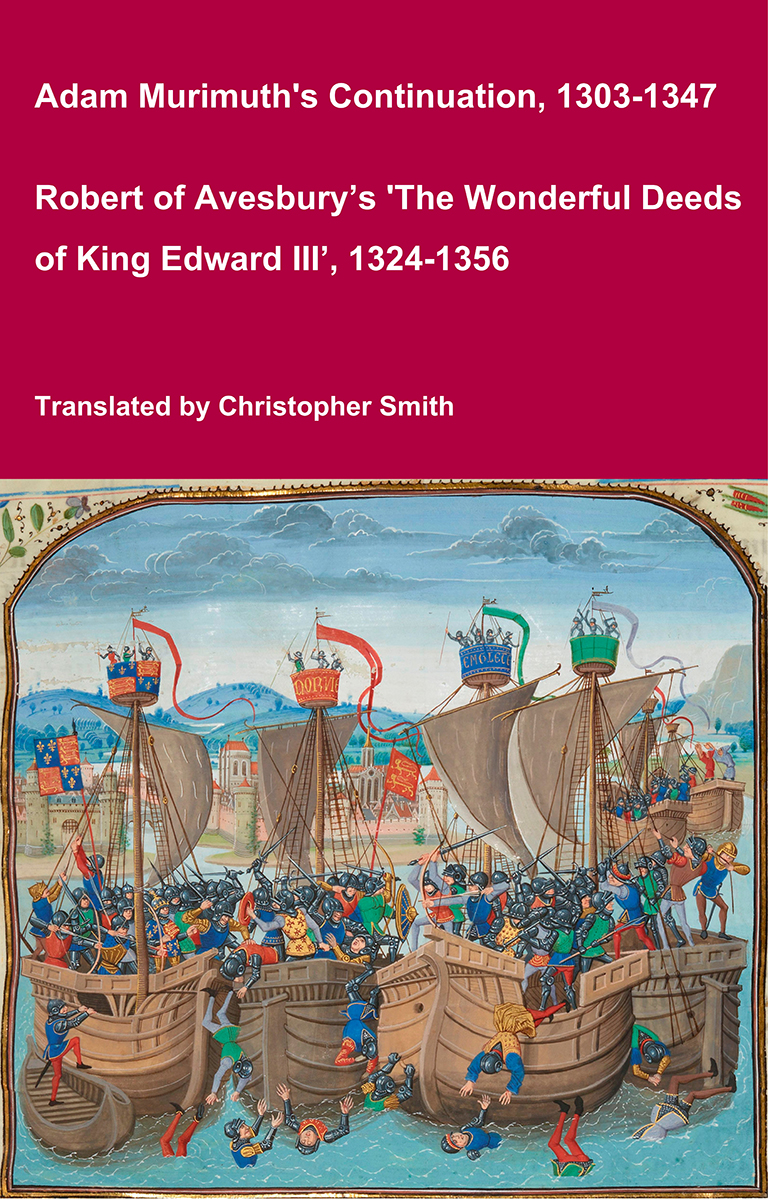
Adam Murimuth's Continuation and Robert of Avesbury’s 'The Wonderful Deeds of King Edward III'
This volume brings together two of the most important contemporary chronicles for the reign of Edward III and the opening phases of the Hundred Years’ War. Written in Latin by English clerical observers, these texts provide a vivid and authoritative window into the political, diplomatic, and military history of fourteenth-century England and its continental ambitions. Adam Murimuth Continuatio's Chronicarum continues an earlier chronicle into the mid-fourteenth century, offering concise but valuable notices on royal policy, foreign relations, and ecclesiastical affairs. Its annalistic structure makes it especially useful for establishing chronology and tracing the development of events year by year. Complementing it, Robert of Avesbury’s De gestis mirabilibus regis Edwardi tertii is a rich documentary chronicle preserving letters, treaties, and official records alongside narrative passages. It is an indispensable source for understanding Edward III’s claim to the French crown, the conduct of war, and the mechanisms of medieval diplomacy. Together, these works offer scholars, students, and enthusiasts a reliable and unembellished account of a transformative period in English and European history. Essential for anyone interested in medieval chronicles, the Hundred Years’ War, or the reign of Edward III.
Available at Amazon in eBook and Paperback format.
On 30th June 1851 [his father] Edward Smith-Stanley 13th Earl of Derby [aged 76] died. His son Edward [aged 52] succeeded 14th Earl Derby, 8th Baronet Stanley of Bickerstaffe.
On 23rd February 1852 Edward Smith-Stanley 14th Earl of Derby [aged 52] was appointed Prime Minister.
On 20th February 1858 Edward Smith-Stanley 14th Earl of Derby [aged 58] was appointed Prime Minister.
In 1859 Queen Victoria of the United Kingdom [aged 39] appointed two Knights of the Garter:
725th Dudley Ryder 2nd Earl of Harrowby [aged 60].
726th Edward Smith-Stanley 14th Earl of Derby [aged 59].


On 11th October 1860 [his son-in-law] Wellington Patrick Manvers Chetwynd-Talbot [aged 43] and Emma Charlotte Smith-Stanley [aged 35] were married. She the daughter of Edward Smith-Stanley 14th Earl of Derby [aged 61] and Emma Caroline Bootle-Wilbraham Countess Derby [aged 55]. He the son of Charles Chetwynd-Talbot 2nd Earl Talbot and Frances Thomasina Lambart Countess Talbot.
The Times. 24th December 1861. Yesterday, with little of the pomp and pageantry of a State ceremonial, but with every outward mark of respect, and with all the solemnity which befitted his high station and his public virties, the mortal remains of the husband [deceased] of our Queen [aged 42] were interred in the last resting-place of England's Sovereigns-the Chapel Royal of St. George's, Windsor [Map]. By the express desire of his Royal Highness the funeral was of the plainest and most private character; but in the Chapel, to do honour to his obsequies, were assembled all the chiefest men of the State, and throughout England, by every sign of sorrow and imourning, the nation manifested its sense of the loss wlhich it has sustaiined. Windsor itself wore an aspect of the most profound gloom. Every shop was closed and every blind drawn down. The streets were silent and almost deserted, and all wvho appeared abroad were dressed in the deepest mourning. The great bell of Windsor Castle [Map] clanged out: its doleful sound at intervals from an early hour, and minute bells were tolled also at St. John's Church. At the parish church of Cleover and at St. John's there were services in the morning and: aternoon, and the day was observed throughout the Royal borough in the strictest manner. The weather was in character with the occasion, a chill, damp air, with a dull leaden sky above, increased the gloom which hung over all. There were but few visitors in the town, for the procession did not pass beyond the immediate precincts of the Chapel and Castle, and none were admitted except those connected with the Castle andi their friends. At 11 o'clock a strong force of the A division took possession of the avenues leading to the Chapel Royal, and from that time only the guests specially invited and those who were to take part in the ceremonial were allowed to pass. Shortly afterwards a of honour of the Grenadier Guards, of which regiment his Royal Highness was Colonel, with the colonrs of the regiment shrouded in crape, marched in and took up its position before the principal entrance to the Chapel Royal. Another guard of honour from the same regiment was also on duty in the Quadrangle at the entrance to the State apartments. They were speedily followed by a squadron of the 2nd Life Guards dismounted, and by two companies of the Fusileer Guards, who were drawn uip in single file along each side of the road by which the procession was to pass, from the Norman gateway to the Chapel door. The officers wore the deepest military mourning-scarves, sword-knots, and rosettes of crape. In the Rome Park was stationed a troop of Horse Artillery, which commenced firing minute guns at the end of the Long Walk, advancing slowly until it reached the Castle gates just at the close of the ceremony. The Ministers, the officers of the Queen's Household, and other distinguished personages who had been honoured with an invitation to attend the ceremonial, reached Windsor a special train from Paddington. They were met by carriages provided for them at the station, and began to arrive at the Chapel Royal soon after 11 o'clock. The Earl of Derby [aged 62], the Archbishop of Canterbury [aged 81], Earl Russell [aged 69], and the Duke of Buccleuch were among the first to make their appearance, and as they alighted at the door of the Chapel they were received by the proper officials and conducted to the seats appointed for them in the Choir. In the Great Quadrangle were drawn up the hearse and the mourning coaches, and, all the preparations having been completed within the Castle, the procession began to be formed shortly before 12 o'clock. It had been originally intended that it should leave the Castle by the St. George's gate, and, proceeding down Castle-hill, approach the Chapel through Henry VII.'s gateway, but at a late hour this arrangement was changed, and the shorter route by the Norman gatewvay was chosen.
The crowd which had gradually collected at the foot of Castle-hill, owing to this change, saw nothing of the procession but the empty carriages as they returned to the Castle after setting down at the Chapel. The few spectators who were fortunate enough to gain admission to the Lower Ward stood in a narrow fringe along the edge of the flags in front of the houses of the Poor Knights, and their presence was the only exception to the strict privacy of the ceremonial. The Prince of Wales [aged 20] and the other Royal mourners assembled in the Oak Room, but did not form part of the procession. They were conveyed to the Chapel in private carriages before the coffin was placed in the hearse, passing through St. George's gatewayinto the Lower Ward. In the first carriage were the Prince of Wales, Prince Arthur [aged 11], and the Duke of Saxe Coburg [aged 8]. The Crown Prince of Prussia [aged 30], the Duke of Brabant [aged 26], and the Count of Flanders [aged 24] followed in the next; and in the others were the Duke de Nemours [aged 47], Prince Louis of Hesse [aged 24], Prince Edward of Saxe-Weimar [aged 38], and the Maharajah Dhuleep Singh, with the gentlemen of their respective suites. Scarcely had they alighted at the door of Wolsey's Chapel, from which they were conducted through the Chapter Room to the door of the Chapel Royal to be in readiness to meet the coffin, when the first minute gun fired in tlhe distance, and the rattle of the troops reversing arms announced that the procession had started, and exactly at 12 o'clock the first mourning coach moved from under the Norman gateway. First came nine mourning coaches, each drawn by four horses, conveying the Physicians, Equerries, and other members of the household of the late Prince. In the last were the Lord Steward [aged 63] (Earl St. Germans), the Lord Chamberlain [aged 56] (Viscount Sidney), and the Master of the Horse [aged 57] (the Marquis of Ailesbury). The carriages and trappings were of the plainest description; the horses had black velvet housings and feathers, but on the carriages there, were no feathers or ornaments of any kind. The mourning coaches were followed by one of the Queen's carriages, drawn by six horses, and attended by servants in State liveries, in which was the Groom of the Stole [aged 26], Earl Spencer, carrying the crown, and a Lord of the Bedchamber, Lord George Lennox, carrying the baton, sword, and hat of his late Royal Highness. Next escorted by a troop of the 2nd Life Guards, came the hearse, drawn by six black horses, which, like the carriages, was quite plain and unornamented. On the housings of the horses and on the sides of the hearse were emblazoned the scutcheons of Her Majesty and of the Prince, each surmounted by a, crown, the Prince's arms being in black and Her Majesty's in white. The procession was closed by four State carriages.
 Become a Member via our Buy Me a Coffee page to read more.
On 31st May 1864 Frederick Arthur Stanley 16th Earl of Derby [aged 23] and Constance Villiers Countess Derby [aged 24] were married. She the daughter of George William Villiers 4th Earl Clarendon [aged 64] and Katherine Grimston Countess Clarendon [aged 54]. He the son of Edward Smith-Stanley 14th Earl of Derby [aged 65] and Emma Caroline Bootle-Wilbraham Countess Derby [aged 59].
On 28th June 1866 Edward Smith-Stanley 14th Earl of Derby [aged 67] was appointed Prime Minister.
In 1869 Edward Smith-Stanley 14th Earl of Derby [aged 69] was appointed Knight Grand Cross of the Order of St Michael.
On 23rd October 1869 Edward Smith-Stanley 14th Earl of Derby [aged 70] died. His son Edward [aged 43] succeeded 15th Earl Derby, 9th Baronet Stanley of Bickerstaffe.
On 26th April 1876 [his former wife] Emma Caroline Bootle-Wilbraham Countess Derby [aged 71] died.
Kings Wessex: Great x 23 Grand Son of King Edmund "Ironside" I of England
Kings Gwynedd: Great x 20 Grand Son of Owain "Great" King Gwynedd
Kings Seisyllwg: Great x 26 Grand Son of Hywel "Dda aka Good" King Seisyllwg King Deheubarth
Kings Powys: Great x 21 Grand Son of Maredudd ap Bleddyn King Powys
Kings Godwinson: Great x 24 Grand Son of King Harold II of England
Kings England: Great x 14 Grand Son of King Edward III of England
Kings Scotland: Great x 22 Grand Son of King Duncan I of Scotland
Kings Franks: Great x 30 Grand Son of Charles "Charlemagne aka Great" King of the Franks King Lombardy Holy Roman Emperor
Kings France: Great x 18 Grand Son of Philip V King France I King Navarre
Kings Duke Aquitaine: Great x 28 Grand Son of Ranulf I Duke Aquitaine
Great x 4 Grandfather: Edward Stanley 3rd Baronet  8 x Great Grand Son of King Edward III of England
Great x 3 Grandfather: Thomas Horton Stanley 4th Baronet 9 x Great Grand Son of King Edward III of England
Great x 4 Grandmother: Elizabeth Bosville
Great x 2 Grandfather: Edward Stanley 11th Earl of Derby 10 x Great Grand Son of King Edward III of England
Great x 3 Grandmother: Elizabeth Patten
Great x 1 Grandfather: James Stanley "Lord Strange" 11 x Great Grand Son of King Edward III of England
GrandFather: Edward Smith-Stanley 12th Earl of Derby 12 x Great Grand Son of King Edward III of England
Great x 2 Grandfather: Hugh Smith of Weald Hall Essex
Great x 1 Grandmother: Lucy Smith
Father: Edward Smith-Stanley 13th Earl of Derby 13 x Great Grand Son of King Edward III of England
Great x 4 Grandfather: William Hamilton 1st Duke Hamilton  8 x Great Grand Son of King Edward III of England
Great x 3 Grandfather: James Hamilton Duke Hamilton, 1st Duke Brandon 9 x Great Grand Son of King Edward III of England
Great x 4 Grandmother: Anne Hamilton 3rd Duchess Hamilton 9 x Great Grand Daughter of King Edward III of England
Great x 2 Grandfather: James Hamilton 5th Duke Hamilton 2nd Duke Brandon 10 x Great Grand Son of King Edward III of England
Great x 4 Grandfather: Digby Gerard 5th Baron Gerard 9 x Great Grand Son of King Edward III of England
Great x 3 Grandmother: Elizabeth Gerard Duchess Brandon 10 x Great Grand Daughter of King Edward III of England
Great x 4 Grandmother: Elizabeth Gerard Baroness Gerard 11 x Great Grand Daughter of King Edward III of England
Great x 1 Grandfather: James Hamilton 6th Duke Hamilton 3rd Duke Brandon 11 x Great Grand Son of King Edward III of England
Great x 4 Grandfather: John Cochrane 2nd Earl Dundonald 10 x Great Grand Son of King Edward III of England
Great x 3 Grandfather: John Cochrane 4th Earl Dundonald 11 x Great Grand Son of King Edward III of England
Great x 2 Grandmother: Anne Cochrane Duchess Hamilton Duchess Brandon 12 x Great Grand Daughter of King Edward III of England
GrandMother: Elizabeth Hamilton Countess Derby 12 x Great Grand Daughter of King Edward III of England
Great x 2 Grandfather: John Barnaby Gunning
Great x 1 Grandmother: Elizabeth Gunning Duchess Hamilton and Argyll
Great x 3 Grandfather: Theobald Bourke
Great x 2 Grandmother: Bridget Bourke
Edward Smith-Stanley 14th Earl of Derby 14 x Great Grand Son of King Edward III of England
GrandFather: Geoffrey Hornby 
Mother: Charlotte Margaret Hornby Countess Derby