

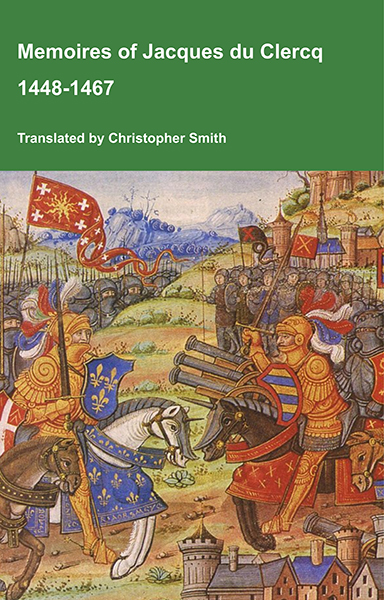
This is a translation of the 'Memoires of Jacques du Clercq', published in 1823 in two volumes, edited by Frederic, Baron de Reissenberg. In his introduction Reissenberg writes: 'Jacques du Clercq tells us that he was born in 1424, and that he was a licentiate in law and a counsellor to Philip the Good, Duke of Burgundy, in the castellany of Douai, Lille, and Orchies. It appears that he established his residence at Arras. In 1446, he married the daughter of Baldwin de la Lacherie, a gentleman who lived in Lille. We read in the fifth book of his Memoirs that his father, also named Jacques du Clercq, had married a lady of the Le Camelin family, from Compiègne. His ancestors, always attached to the counts of Flanders, had constantly served them, whether in their councils or in their armies.' The Memoires cover a period of nineteen years beginning in in 1448, ending in in 1467. It appears that the author had intended to extend the Memoirs beyond that date; no doubt illness or death prevented him from carrying out this plan. As Reissenberg writes the 'merit of this work lies in the simplicity of its narrative, in its tone of good faith, and in a certain air of frankness which naturally wins the reader’s confidence.' Du Clercq ranges from events of national and international importance, including events of the Wars of the Roses in England, to simple, everyday local events such as marriages, robberies, murders, trials and deaths, including that of his own father in Book 5; one of his last entries.
Available at Amazon in eBook and Paperback format.
Maternal Family Tree: Anne Denman 1581-1661

Before 25th April 1617 [her father] Thomas Aylesbury 1st Baronet [aged 41] and [her mother] Anne Denman [aged 36] were married.
Before 25th April 1617 Frances Aylesbury Countess Clarendon was born to [her father] Thomas Aylesbury 1st Baronet [aged 41] and [her mother] Anne Denman [aged 36]. She was baptisd before 25th April 1617.
In 1629 [her future husband] Edward Hyde 1st Earl Clarendon [aged 19] and Anne Ayloffe were married. She died six months later.


In 1634 Edward Hyde 1st Earl Clarendon [aged 24] and Frances Aylesbury Countess Clarendon [aged 16] were married.
On 12th March 1637 [her daughter] Anne Hyde Duchess of York was born to [her husband] Edward Hyde 1st Earl Clarendon [aged 28] and Frances Aylesbury Countess Clarendon [aged 19]. She married 3rd September 1660 King James II of England Scotland and Ireland, son of King Charles I of England, Scotland and Ireland and Henrietta Maria Bourbon Queen Consort England, and had issue.


In March 1642 [her son] Lawrence Hyde 1st Earl Rochester was born to [her husband] Edward Hyde 1st Earl Clarendon [aged 33] and Frances Aylesbury Countess Clarendon [aged 24]. He married 1665 Henrietta Boyle Countess Rochester, daughter of Richard Boyle 2nd Earl Cork 1st Earl Burlington and Elizabeth Clifford Countess Burlington, and had issue.


In 1657 [her father] Thomas Aylesbury 1st Baronet [aged 81] died. Baronet Aylesbury of London extinct.

In 1660 Henry Hyde 2nd Earl Clarendon and Theodosia Capell were married. She died a year later. He the son of Edward Hyde 1st Earl Clarendon [aged 50] and Frances Aylesbury Countess Clarendon [aged 42].
On 3rd September 1660 [her son-in-law] James, Duke of York [aged 26] and Anne Hyde [aged 23] were married in secret. She by marriage Duchess York. She gave birth to their son Charles Stewart seven weeks later. She the daughter of Edward Hyde 1st Earl Clarendon [aged 51] and Frances Aylesbury Countess Clarendon [aged 43]. He the son of King Charles I of England, Scotland and Ireland and Henrietta Maria Bourbon Queen Consort England [aged 50].


On 20th April 1661 King Charles II of England Scotland and Ireland [aged 30] created a number of new Baronets and Peers:
William Morice 1st Baronet [aged 33] was created 1st Baronet Morice of Werrington in Devon. Gertrude Bampfylde Lady Morice by marriage Lady Morice of Werrington in Devon.
John Crew 1st Baron Crew [aged 63] was created 1st Baron Crew of Stene in Northamptonshire. Jemima Waldegrave Baroness Crew [aged 59] by marriage Baroness Crew of Stene in Northamptonshire.
[her husband] Edward Hyde 1st Earl Clarendon [aged 52] was created 1st Earl Clarendon at Westminster Abbey [Map] on the occasion of the Coronation Charles II. Frances Aylesbury Countess Clarendon [aged 43] by marriage Countess Clarendon.
Oliver Fitzwilliam 1st Earl Tyrconnel [aged 51] was created 1st Earl Tyrconnel. Eleanore Holles Countess Tyrconnel by marriage Countess Tyrconnel.
In November 1661 [her mother] Anne Denman [aged 80] died.
John Evelyn's Diary. 15th August 1662. Came my [her husband] Lord Chancellor (the Earl of Clarendon) [aged 53] and his lady [aged 45], his purse and mace borne before him, to visit me. They were likewise collationed with us, and were very merry. They had all been our old acquaintance in exile, and indeed this great person had ever been my friend. His son, Lord Cornbury, was here, too.
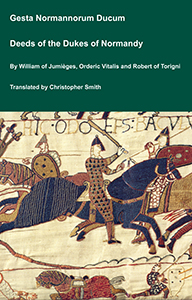
The Deeds of the Dukes of Normandy
The Gesta Normannorum Ducum [The Deeds of the Dukes of Normandy] is a landmark medieval chronicle tracing the rise and fall of the Norman dynasty from its early roots through the pivotal events surrounding the Norman Conquest of England. Originally penned in Latin by the monk William of Jumièges shortly before 1060 and later expanded at the behest of William the Conqueror, the work chronicles the deeds, politics, battles, and leadership of the Norman dukes, especially William’s own claim to the English throne. The narrative combines earlier historical sources with firsthand information and oral testimony to present an authoritative account of Normandy’s transformation from a Viking settlement into one of medieval Europe’s most powerful realms. William’s history emphasizes the legitimacy, military prowess, and governance of the Norman line, framing their expansion, including the conquest of England, as both divinely sanctioned and noble in purpose. Later chroniclers such as Orderic Vitalis and Robert of Torigni continued the history, extending the coverage into the 12th century, providing broader context on ducal rule and its impact. Today this classic work remains a foundational source for understanding Norman identity, medieval statesmanship, and the historical forces that reshaped England and Western Europe between 800AD and 1100AD.
Available at Amazon in eBook and Paperback format.
John Evelyn's Diary. 15th October 1664. Dined at the [her husband] Lord Chancellor's [aged 55], where was the Duke of Ormond [aged 53], Earl of Cork, and Bishop of Winchester [aged 66]. After dinner, my Lord Chancellor and his lady [aged 47] carried me in their coach to see their palace (for he now lived at Worcester-House in the Strand), building at the upper end of St. James's street, and to project the garden. In the evening, I presented him with my book on Architecture, as before I had done to his Majesty [aged 34] and the Queen-Mother [aged 54]. His lordship caused me to stay with him in his bedchamber, discoursing of several matters very late, even till he was going into his bed.


In 1665 Lawrence Hyde 1st Earl Rochester [aged 22] and Henrietta Boyle Countess Rochester [aged 19] were married. She the daughter of Richard Boyle 2nd Earl Cork 1st Earl Burlington [aged 52] and Elizabeth Clifford Countess Burlington [aged 51]. He the son of Edward Hyde 1st Earl Clarendon [aged 55] and Frances Aylesbury Countess Clarendon [aged 47].
Samuel Pepys' Diary. 27th January 1667. Here we met with Mr. May [aged 45], and he and we to talk of several things, of building, and such like matters; and so walked to White Hall, and there I skewed my cozen Roger [aged 49] the [her daughter] Duchesse of York [aged 29] sitting in state, while her own mother [aged 49] stands by her; he had a desire, and I shewed him my Baroness Castlemayne [aged 26], whom he approves to be very handsome, and wonders that she cannot be as good within as she is fair without. Her little black boy came by him; and, a dog being in his way, the little boy called to the dog: "Pox of this dog!"-"Now", says he, blessing himself, "would I whip this child till the blood come, if it were my child!" and I believe he would. But he do by no means like the liberty of the Court, and did come with expectation of finding them playing at cards to-night, though Sunday; for such stories he is told, but how true I know not1.
Note 1. There is little reason to doubt that it was such as Evelyn describes it at a later time. "I can never forget the inexpressible luxury and prophaneness, gaming, and all dissoluteness, and, as it were, total forgetfulness of God (it being Sunday evening) which this day se'nnight I was witness of; the King [aged 36] sitting and toying with his concubines, Portsmouth [aged 17], Cleveland, Mazarin [aged 20], &c. A French boy singing love songs in that glorious gallery, whilst about twenty of the great courtiers and other dissolute persons were at basset round a large table, a bank of at least £2,000 in gold before them; upon which two gentlemen who were with me made reflexions with astonishment. Six days after was all in the dust". B.
On 8th August 1667 Frances Aylesbury Countess Clarendon [aged 50] died. She was buried in the Hyde Vault, Crypt, Westminster Abbey.
Samuel Pepys' Diary. 8th December 1667. At noon to dinner, where W. How with us, and after dinner, he being gone, I to my chamber again till almost night, and then took boat, the tide serving, and so to White Hall, where I saw the [her daughter] Duchesse of York [aged 30], in a fine dress of second mourning for her mother, being black, edged with ermine, go to make her first visit to the Queene [aged 58] since the [her son-in-law] Duke of York [aged 34] was sick; and by and by, she being returned, the Queene come and visited her. But it was pretty to observe that Sir W. Coventry [aged 39] and I, walking an hour and more together in the Matted Gallery, he observed, and so did I, how the Duchesse, as soon as she spied him, turned her head a one side. Here he and I walked thus long, which we have not done a great while before. Our discourse was upon everything: the unhappiness of having our matters examined by people that understand them not; that it was better for us in the Navy to have men that do understand the whole, and that are not passionate; that we that have taken the most pains are called upon to answer for all crimes, while those that, like Sir W. Batten and Sir J. Minnes [aged 68], did sit and do nothing, do lie still without any trouble; that, if it were to serve the King [aged 37] and kingdom again in a war, neither of us could do more, though upon this experience we might do better than we did; that the commanders, the gentlemen that could never be brought to order, but undid all, are now the men that find fault and abuse others; that it had been much better for the King to have given Sir J. Minnes and Sir W. Batten £1000 a-year to have sat still, than to have had them in his business this war: that the serving a Prince that minds not his business is most unhappy for them that serve him well, and an unhappiness so great that he declares he will never have more to do with a war, under him. That he hath papers which do flatly contradict the Duke of Albemarle's [aged 59] Narrative; and that he hath been with the Duke of Albemarle and shewed him them, to prevent his falling into another like fault: that the Duke of Albemarle seems to be able to answer them; but he thinks that the Duke of Albemarle and the Prince are contented to let their Narratives sleep, they being not only contradictory in some things (as he observed about the business of the Duke of Albemarle's being to follow the Prince upon dividing the fleete, in case the enemy come out), but neither of them to be maintained in others. That the business the other night of my Lord Anglesey [aged 53] at the Council was happily got over for my Lord, by his dexterous silencing it, and the rest, not urging it further; forasmuch as, had the Duke of Buckingham [aged 39] come in time enough, and had got it by the end, he, would have toused him in it; Sir W. Coventry telling me that my Lord Anglesey did, with such impudence, maintain the quarrel against the Commons and some of the Lords, in the business of my [her former husband] Lord Clarendon [aged 58], that he believes there are enough would be glad but of this occasion to be revenged of him. He tells me that he hears some of the Thomsons [aged 60] are like to be of the Commission for the Accounts, and Wildman [aged 46], which he much wonders at, as having been a false fellow to every body, and in prison most of the time since the King's coming in. But he do tell me that the House is in such a condition that nobody can tell what to make of them, and, he thinks, they were never in before; that every body leads, and nobody follows; and that he do now think that, since a great many are defeated in their expectation of being of the Commission, now they would put it into such hands as it shall get no credit from: for, if they do look to the bottom and see the King's case, they think they are then bound to give the King money; whereas, they would be excused from that, and therefore endeavour to make this business of the Accounts to signify little. I spoke with him about my Lord Sandwich's [aged 42] business, in which he is very friendly, and do say that the unhappy business of the prizes is it that hath brought all this trouble upon him, and the only thing that made any thing else mentioned, and it is true. So having discoursed with him, I spent some time with Sir Stephen Fox [aged 40] about the business of our adjusting the new method of the Excise between the Guards household and Tangier, the Lords Commissioners of the Treasury being now resolved to bring all their management into a course of payment by orders, and not by tallies, and I am glad of it, and so by water home late, and very dark, and when come home there I got my wife to read, and then come Captain Cocke [aged 50] to me; and there he tells me, to my great satisfaction, that Sir Robert Brookes [aged 30] did dine with him today; and that he told him, speaking of me, that he would make me the darling of the House of Commons, so much he is satisfied concerning me. And this Cocke did tell me that I might give him thanks for it; and I do think it may do me good, for he do happen to be held a considerable person, of a young man, both for sobriety and ability. Then to discourse of business of his own about some hemp of his that is come home to receive it into the King's stores, and then parted, and by and by my wife and I to supper, she not being well, her flux being great upon her, and so to bed.
On 9th December 1674 [her former husband] Edward Hyde 1st Earl Clarendon [aged 65] died at Rouen, France [Map]. His son Henry succeeded 2nd Earl Clarendon, 2nd Baron Hyde of Hindon in Wiltshire 1660. Flower Backhouse Countess Clarendon by marriage Countess Clarendon.
[her son] Edward Hyde was born to Edward Hyde 1st Earl Clarendon and Frances Aylesbury Countess Clarendon.
[her son] Henry Hyde 2nd Earl Clarendon was born to Edward Hyde 1st Earl Clarendon and Frances Aylesbury Countess Clarendon. He married (1) 1660 Theodosia Capell, daughter of Arthur Capell 1st Baron Capell Hadham and Elizabeth Morrison Baroness Capell Hadham, and had issue (2) 19th October 1670 Flower Backhouse Countess Clarendon.
[her daughter] Frances Hyde was born to Edward Hyde 1st Earl Clarendon and Frances Aylesbury Countess Clarendon. She married 9th July 1675 Thomas Keightley.
[her son] James Hyde was born to Edward Hyde 1st Earl Clarendon and Frances Aylesbury Countess Clarendon.
GrandFather: William Aylesbury 
Father: Thomas Aylesbury 1st Baronet
Frances Aylesbury Countess Clarendon
Mother: Anne Denman