

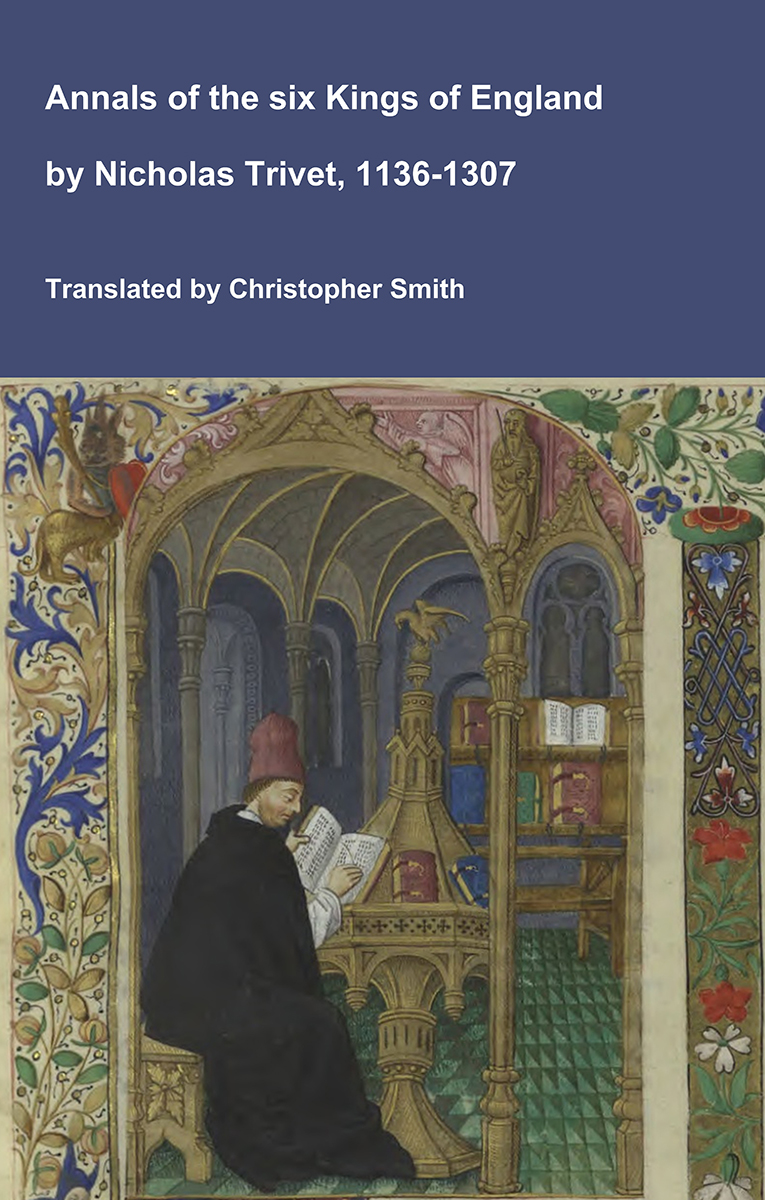
Annals of the six Kings of England by Nicholas Trivet
Translation of the Annals of the Six Kings of England by that traces the rise and rule of the Angevin aka Plantagenet dynasty from the mid-12th to early 14th century. Written by the Dominican scholar Nicholas Trivet, the work offers a vivid account of English history from the reign of King Stephen through to the death of King Edward I, blending political narrative with moral reflection. Covering the reigns of six monarchs—from Stephen to Edward I—the chronicle explores royal authority, rebellion, war, and the shifting balance between crown, church, and nobility. Trivet provides detailed insight into defining moments such as baronial conflicts, Anglo-French rivalry, and the consolidation of royal power under Edward I, whose reign he describes with particular immediacy. The Annals combines careful year-by-year reporting with thoughtful interpretation, presenting history not merely as a sequence of events but as a moral and political lesson. Ideal for readers interested in medieval history, kingship, and the origins of the English state, this chronicle remains a valuable and accessible window into the turbulent world of the Plantagenet kings.
Available at Amazon in eBook and Paperback format.
Frank Cadogan Cowper is in Painters.
On 28th December 1876 [his father] Frank Cowper (age 27) and [his mother] Edith Elise Cadogan (age 17) were married. They had ten children.
On 16th October 1877 Frank Cadogan Cowper was born to [his father] Frank Cowper (age 28) and [his mother] Edith Elise Cadogan (age 18) at Wicken, Northamptonshire.
In 1890 [his father] Frank Cowper (age 40) and [his mother] Edith Elise Cadogan (age 30) were divorced.

1901. Frank Cadogan Cowper (age 23). "An Aristocrat Answering the Summons to Execution".

1903. Frank Cadogan Cowper (age 25). "Fanny, Sketch of a girl in crinoline dress".

1905. Frank Cadogan Cowper (age 27). "St Agnes in Prison Receiving from Heaven the 'Shining White Garment".

1907. Frank Cadogan Cowper (age 29). "Vanity". The picture borrows motifs from Giulio Romano's portrait of Isabella d'Este at Hampton Court, a picture which had inspired the young Burne-Jones half a century earlier.
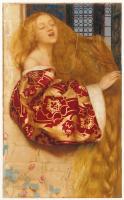
1908. Frank Cadogan Cowper (age 30). "Venetian Ladies Listening to "Rapunzel sings from the Tower."
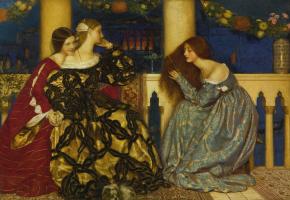
1909. Frank Cadogan Cowper (age 31). "Venetian Ladies Listening to "The Serenade" on the Grand Canal."
William of Worcester's Chronicle of England
William of Worcester, born around 1415, and died around 1482 was secretary to John Fastolf, the renowned soldier of the Hundred Years War, during which time he collected documents, letters, and wrote a record of events. Following their return to England in 1440 William was witness to major events. Twice in his chronicle he uses the first person: 1. when writing about the murder of Thomas, 7th Baron Scales, in 1460, he writes '… and I saw him lying naked in the cemetery near the porch of the church of St. Mary Overie in Southwark …' and 2. describing King Edward IV's entry into London in 1461 he writes '… proclaimed that all the people themselves were to recognize and acknowledge Edward as king. I was present and heard this, and immediately went down with them into the city'. William’s Chronicle is rich in detail. It is the source of much information about the Wars of the Roses, including the term 'Diabolical Marriage' to describe the marriage of Queen Elizabeth Woodville’s brother John’s marriage to Katherine, Dowager Duchess of Norfolk, he aged twenty, she sixty-five or more, and the story about a paper crown being placed in mockery on the severed head of Richard, 3rd Duke of York.
Available at Amazon in eBook and Paperback format.

1912. Frank Cadogan Cowper (age 34). "The Morning of the Nativity".

1913. Frank Cadogan Cowper (age 35). Portrait of William Walter Carlile 1st Baronet (age 50).
William Walter Carlile 1st Baronet: On 15th June 1862 he was born. In 1885 he and Blanche Anne Cadogan were married. On 3rd January 1950 he died. Baronet Carlile of Gayhurst in BucKinghamshire extinct.

1918. Frank Cadogan Cowper (age 40). "The Bluebird". Painted at 2 Edwardes Square Studios, a southerly outpost of the artists' colony in Holland Park that had sprung up in the later nineteenth-century under the leadership of the President of the Royal Academy, Sir Frederic Leighton.
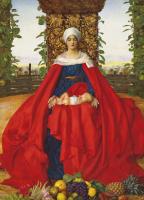
1919. Frank Cadogan Cowper (age 41). "Our Lady of The Fruits of The Earth."
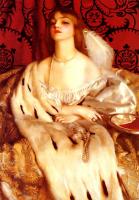
1919. Frank Cadogan Cowper (age 41). "Vanity II."

1920. Frank Cadogan Cowper (age 42). Portrait of Violet Miriam Nightingale Clay Baroness Vernon (age 25).
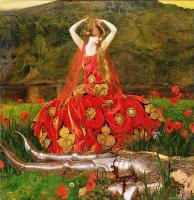
1926. Frank Cadogan Cowper (age 48). "La Belle Dame sans Merci."
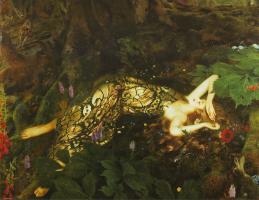
1928. Frank Cadogan Cowper (age 50). "Titania Sleeps."
On 28th May 1930 [his father] Frank Cowper (age 81) died.
On 18th November 1933 [his mother] Edith Elise Cadogan (age 74) died.
The History of William Marshal was commissioned by his son shortly after William’s death in 1219 to celebrate the Marshal’s remarkable life; it is an authentic, contemporary voice. The manuscript was discovered in 1861 by French historian Paul Meyer. Meyer published the manuscript in its original Anglo-French in 1891 in two books. This book is a line by line translation of the first of Meyer’s books; lines 1-10152. Book 1 of the History begins in 1139 and ends in 1194. It describes the events of the Anarchy, the role of William’s father John, John’s marriages, William’s childhood, his role as a hostage at the siege of Newbury, his injury and imprisonment in Poitou where he met Eleanor of Aquitaine and his life as a knight errant. It continues with the accusation against him of an improper relationship with Margaret, wife of Henry the Young King, his exile, and return, the death of Henry the Young King, the rebellion of Richard, the future King Richard I, war with France, the death of King Henry II, and the capture of King Richard, and the rebellion of John, the future King John. It ends with the release of King Richard and the death of John Marshal.
Available at Amazon in eBook and Paperback format.
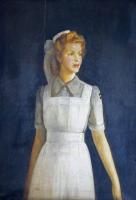
1946. Frank Cadogan Cowper (age 68). "Joan Saxton, a Student Nurse Who Trained at Cirencester Memorial Hospital".

Before 1958. Frank Cadogan Cowper (age 80). "The Ugly Duckling."
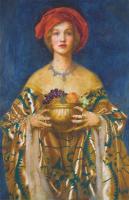
Before 1958. Frank Cadogan Cowper (age 80). "The Golden Bowl."
On 17th November 1958 Frank Cadogan Cowper (age 81) died.